Asian Palm Civet
Paradoxurus hermaphroditus
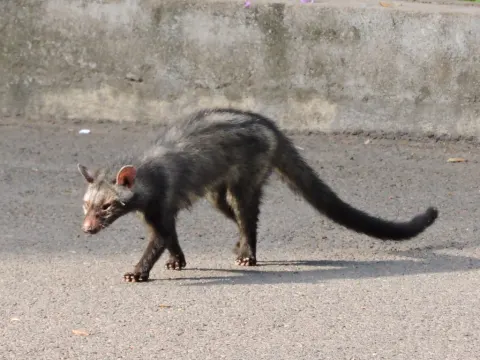
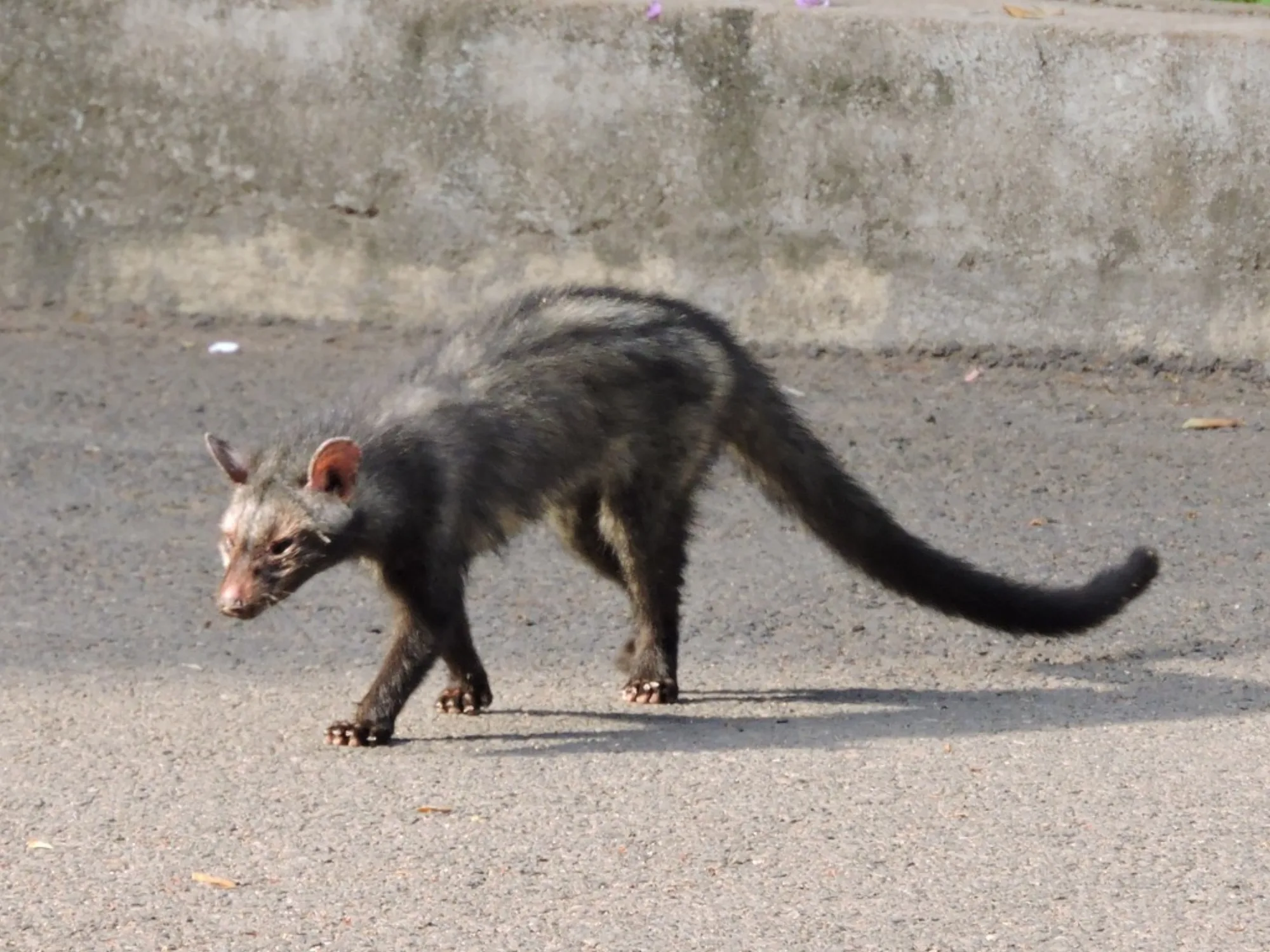
Shaggy greyish fur, a white facial mask and dark markings give the Asian Palm Civet a distinctive appearance. Its long, stocky body has three rows of black markings, while the muzzle, ears, lower legs and outer half of the tail are black. A small white patch sits beneath each eye, with a white spot beside each nostril and a slender dark stripe running between its eyes. The head and body measure about 53 cm, and the unringed tail is 48 cm long; the animal weighs 2 to 5 kg.
Native to South and Southeast Asia, it ranges from India and Sri Lanka through mainland Southeast Asia to China, the Philippines, Borneo and several Indonesian islands. It usually lives in primary forest, but is less common in secondary forest and areas that have been selectively logged. The civet is thought to live alone apart from brief periods around mating. It moves both on the ground and in trees, and is active at night, with activity peaking from late evening until after midnight. It is less active on the brightest moonlit nights. Fruit makes up much of its diet, including berries, chiku, mango and rambutan, but it also eats insects and small mammals. By dispersing seeds, it helps maintain tropical forest ecosystems. Its solitary, nocturnal habits mean that little is known about its breeding behaviour.
Hunting and trapping threaten the species, particularly in southern China, while in parts of its range it is hunted for meat and the pet trade. In Indonesia, poaching and illegal wildlife trade also supply the production of kopi luwak, made using coffee beans that civets have eaten and excreted. Many civets sold as pets in Indonesia come from the wild, and restrictions on taking and trading them are often ignored or left unenforced.
Written from the English Wikipedia article Asian palm civet (CC BY-SA 4.0).
- Records
- 125
- Countries
- 9
- Atlas places
- 4
These are open occurrence records, so they show where people looked for and recorded the Asian Palm Civet as much as where it lives. Cells are up to 25 km across, and every location is generalised to its cell.
Generalised encounter areas, not exact locations. Each shape is a grid cell coloured by how likely the species is there.
- Very likelyMalaysia25 km zone · medium confidence · 96 records · updated 80 days ago
- Very likelyIndia25 km zone · medium confidence · 14 records · updated 80 days ago
- Very likelyThailand25 km zone · medium confidence · 11 records · updated 80 days ago
- LikelySri Lanka25 km zone · medium confidence · 3 records · updated 80 days ago
- PossibleChina25 km zone · medium confidence · 1 record · updated 80 days ago
- PossibleBangladesh25 km zone · low confidence · 0 records · updated 80 days ago
- PossiblePakistan25 km zone · low confidence · 0 records · updated 80 days ago
- UncommonCambodia25 km zone · low confidence · 0 records · updated 80 days ago
- RarePhilippines25 km zone · low confidence · 0 records · updated 80 days ago
Conservation status not assessed here yet, so every location is generalised to its grid cell.