Neon Tetra
Paracheirodon innesi
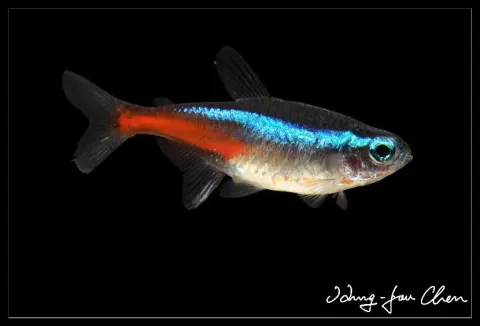
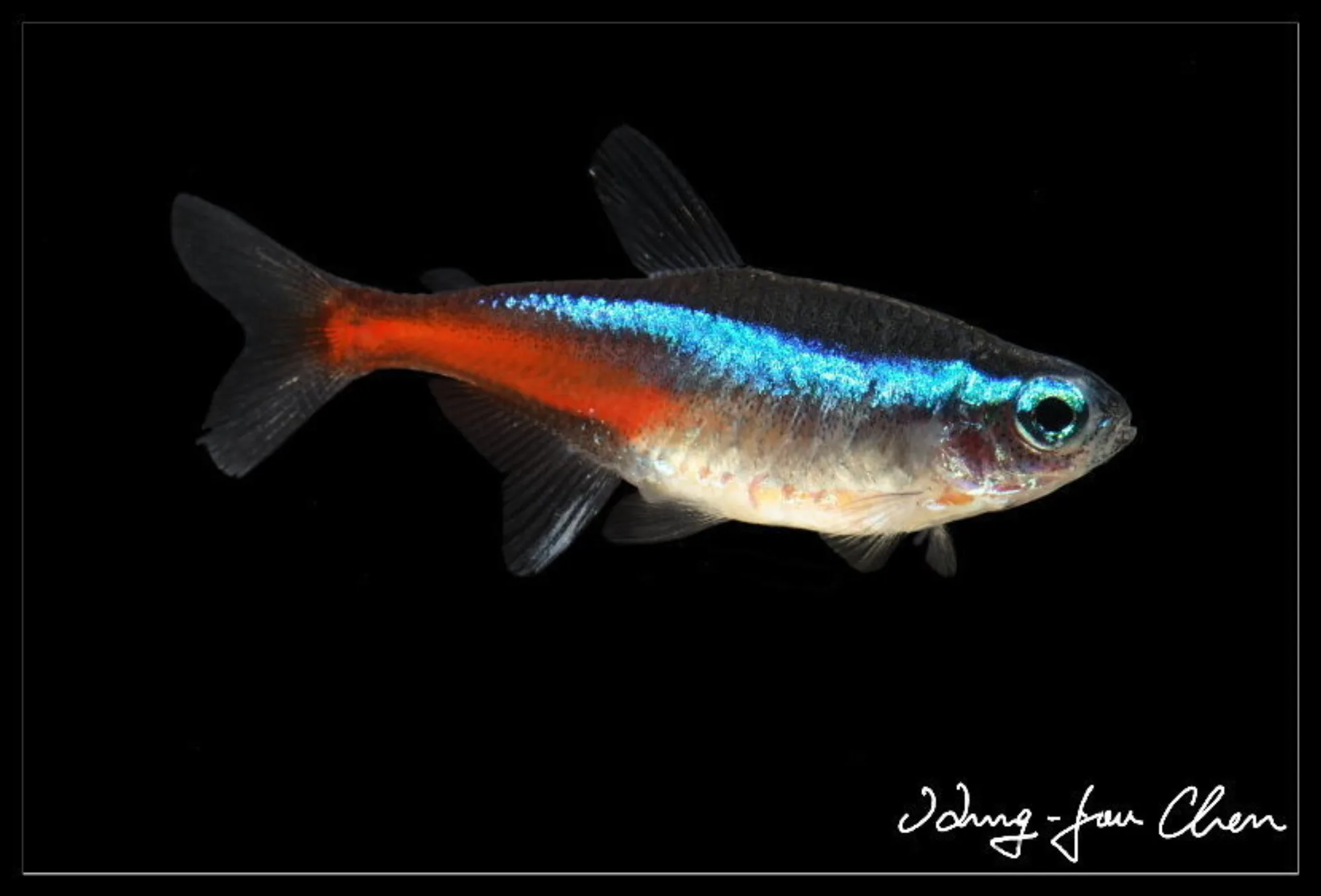
A flash of blue and red can reveal a Neon Tetra in the dark streams of the Amazon basin. This small freshwater fish grows to approximately 4 cm long, with a light-blue back and a silver-white belly. An iridescent blue stripe runs along each side from the nose towards the rear, while a red stripe extends from the middle of the body to the base of the tail. Apart from these markings, much of the fish, including its fins, is transparent. At night, as it rests, the blue and red turn grey or black, returning when it becomes active in the morning. Its colouring helps other neon tetras see it in dark water.
The species ranges through parts of the northern and western Amazon basin, from southeastern Colombia and eastern Peru to western Brazil. It favours acidic blackwater streams but also lives in clearwater streams, and is absent from whitewater rivers. Its native waters have temperatures between 20 and 28 °C, and the fish are associated with densely planted Amazon environments. Neon tetras live in shoals and eat both plant and animal food. In aquariums, they accept small foods including brine shrimp, daphnia and bloodworms. They can breed from 12 weeks old, although breeding them in home aquariums is considered difficult.
Neon tetra disease can affect these fish and is often fatal, although it is generally preventable. Signs include restlessness, fading colour and difficulty swimming, with secondary infections sometimes developing. Some neon tetras are collected from the wild for the aquarium trade, while many others are raised on farms.
Written from the English Wikipedia article Neon tetra (CC BY-SA 4.0).
- Records
- 4
- Countries
- 2
No atlas park has a record of the Neon Tetra in or around it yet.
These are open occurrence records, so they show where people looked for and recorded the Neon Tetra as much as where it lives. Cells are up to 25 km across, and every location is generalised to its cell.
Generalised encounter areas, not exact locations. Each shape is a grid cell coloured by how likely the species is there.
- Very likelyVenezuela25 km zone · medium confidence · 4 records · updated 80 days ago
- LikelyColombia25 km zone · low confidence · 0 records · updated 80 days ago
Conservation status not assessed here yet, so every location is generalised to its grid cell.