Palette Surgeonfish
Paracanthurus hepatus
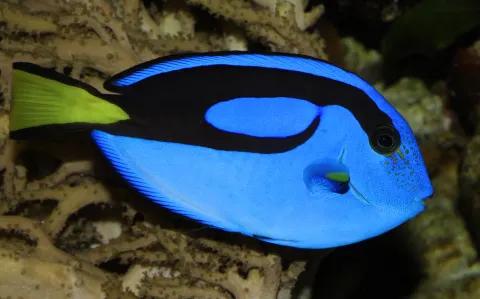
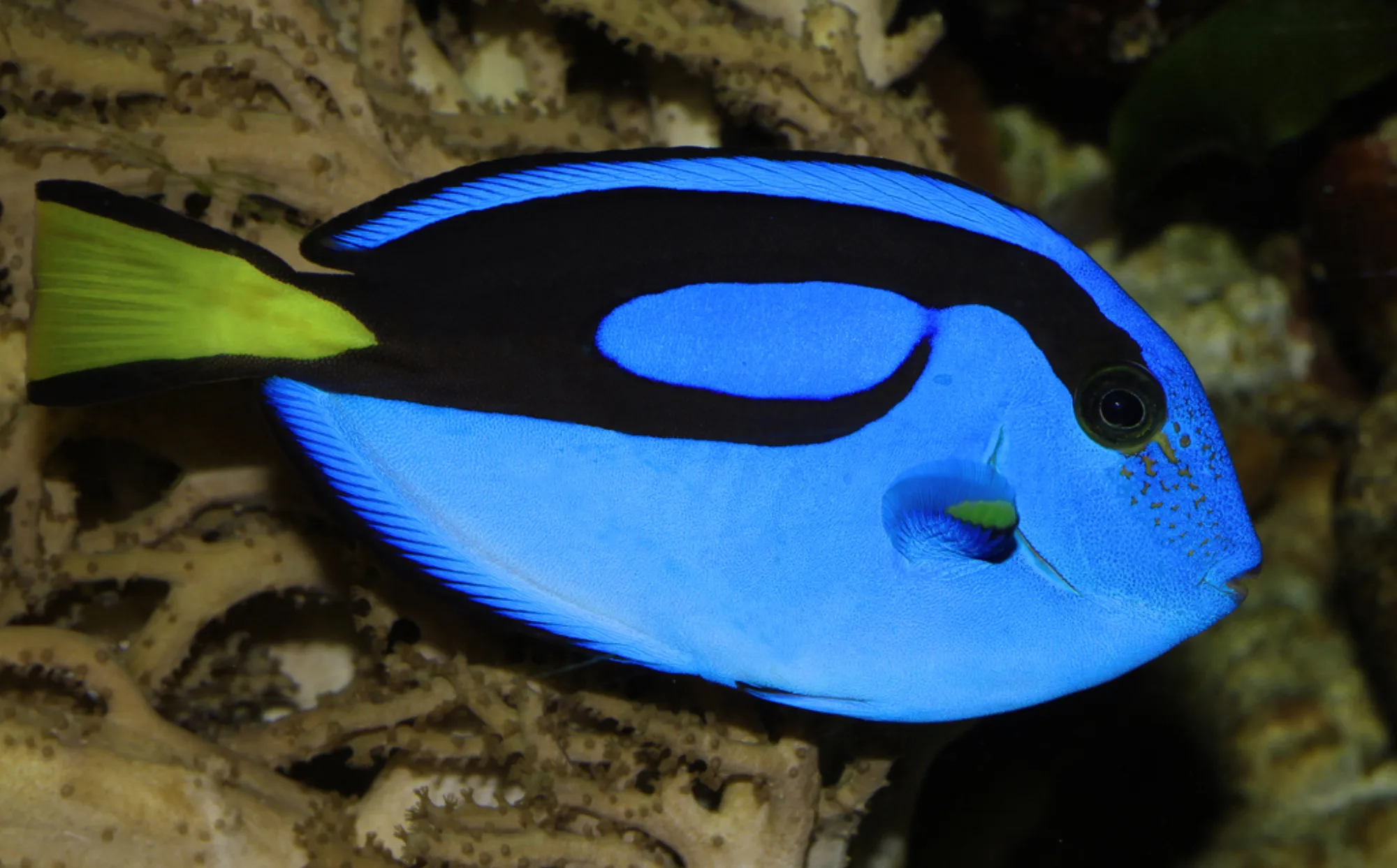
A flash of royal blue and yellow can reveal a Palette Surgeonfish on an Indo-Pacific reef. Its flattened, oval body carries a broad black marking that leaves a blue oval on each side, while a yellow triangle stands out on the tail. Fish in the west-central Indian Ocean have yellow lower bodies, whereas those in the Pacific are bluish below. The blue of the body becomes a little paler at night.
Look for this daytime fish in clear water on exposed outer reefs or in channels with moderate to strong currents, at depths of 2 to 40 metres. It occurs across the Indo-Pacific, including reefs around the Philippines, Indonesia, Japan, Australia's Great Barrier Reef, East Africa and Sri Lanka. Beyond coral reefs, it also uses rocky reefs and areas of seagrass, algae and mangroves. They occur in pairs and in groups of 8 to 14, while juveniles gather in schools and shelter among Acropora corals. Young fish mainly eat plankton; adults take zooplankton and graze on algae and other marine plants, helping coral by eating algae that might otherwise overgrow it.
Spawning takes place throughout the year, peaking between April and September, usually in the late afternoon or evening around outer reef slopes. At this time, the fish change from dark blue to pale blue, and their fertilised eggs hatch in twenty-four hours. Wild collection for the aquarium trade is a threat, with juveniles targeted because their schooling behaviour makes them easier to catch. Destructive fishing and the loss of fragile coral reef habitat also put pressure on the species in parts of its range.
Written from the English Wikipedia article Paracanthurus (CC BY-SA 4.0).
- Records
- 436
- Countries
- 27
- Atlas places
- 2
These are open occurrence records, so they show where people looked for and recorded the Palette Surgeonfish as much as where it lives. Cells are up to 25 km across, and every location is generalised to its cell.
Generalised encounter areas, not exact locations. Each shape is a grid cell coloured by how likely the species is there.
- Very likelyNorthern Mariana Islands25 km zone · medium confidence · 130 records · updated 80 days ago
- Very likelyAustralia25 km zone · medium confidence · 91 records · updated 80 days ago
- Very likelyMayotte25 km zone · medium confidence · 45 records · updated 80 days ago
- Very likelyU.S. Outlying Islands25 km zone · medium confidence · 31 records · updated 80 days ago
- Very likelyRéunion25 km zone · medium confidence · 23 records · updated 80 days ago
- Very likelyFiji25 km zone · medium confidence · 16 records · updated 80 days ago
- Very likelyPhilippines25 km zone · medium confidence · 13 records · updated 80 days ago
- Very likelyMozambique25 km zone · medium confidence · 11 records · updated 80 days ago
- Very likelySouth Africa25 km zone · medium confidence · 10 records · updated 80 days ago
- LikelyJapan25 km zone · medium confidence · 9 records · updated 80 days ago
Conservation status not assessed here yet, so every location is generalised to its grid cell.