Bearded Reedling
Panurus biarmicus
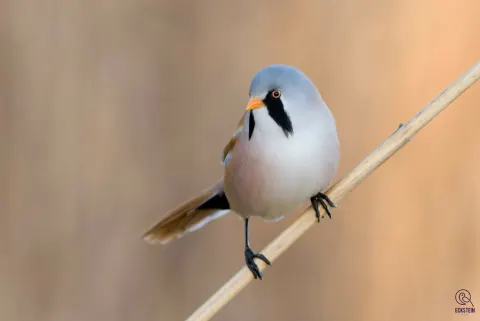
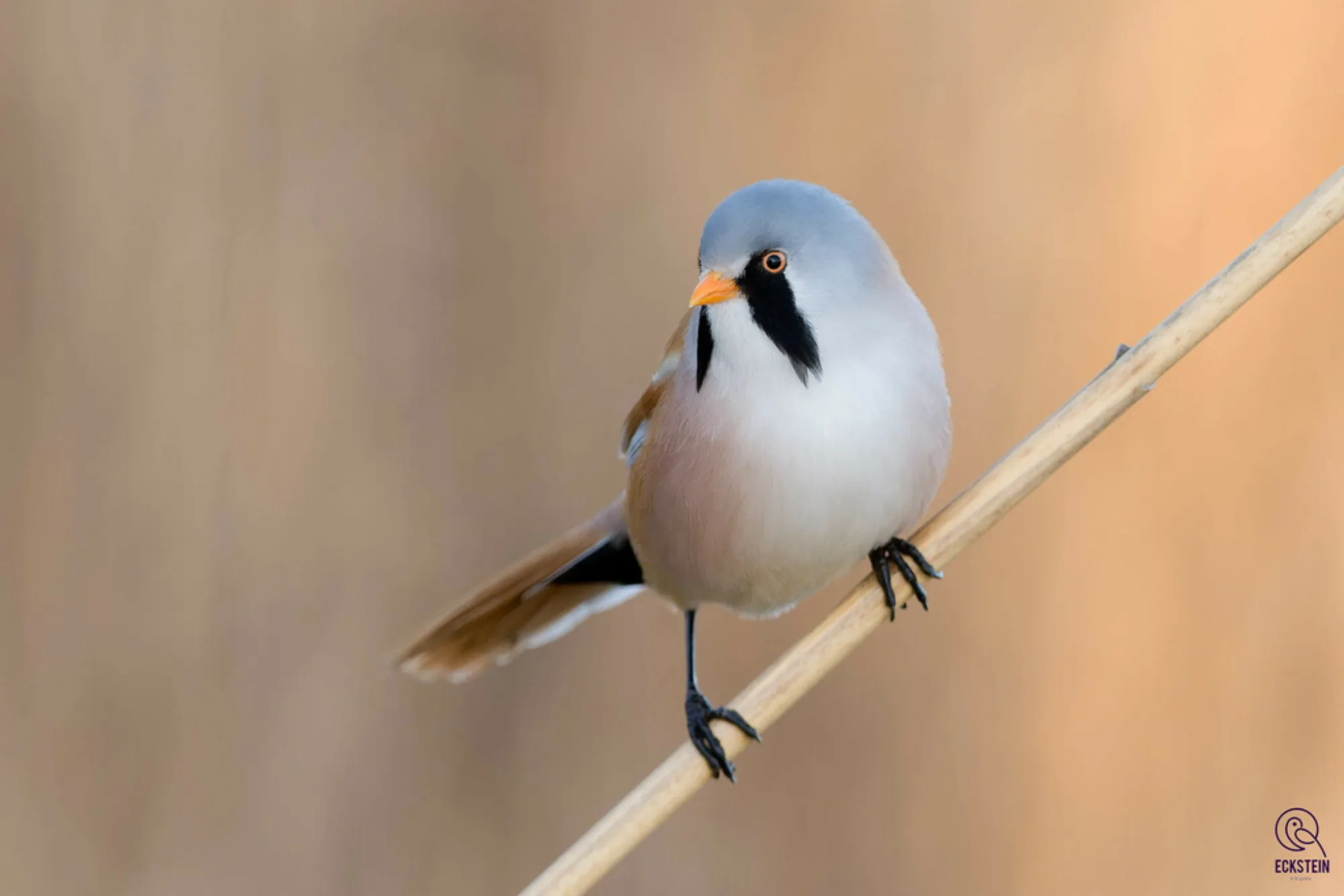
A metallic “ping” can give away a Bearded Reedling hidden among dense reeds, where its well-camouflaged plumage makes it easy to miss. This small, long-tailed bird measures 14.5 to 17 cm and flies with an undulating motion, its short wings making a whirring sound. Orange-brown covers most of its body, with a pale throat and chest, contrasting black and white wing markings, and white along the tail edges. Adult males have grey heads and black moustaches, while females are generally paler, with browner heads and no black moustaches.
The species has a patchy distribution across temperate Europe and Asia, reaching eastwards to the Manchurian region and westwards to the British Isles, France and Spain. Look for it in reed beds beside freshwater or brackish lakes, swamps and rivers, and in nearby bulrushes or sedges. It perches and climbs among reeds, but also hops on the ground, particularly at the water's edge or in swampy places. Outside the breeding season, it usually gathers in groups, while pairs and family parties are common during breeding. Pairs generally stay together for life, including when they sleep.
In summer, reedlings eat mostly insects and other small invertebrates, which they also feed to their young. In late autumn and winter, they turn mainly to seeds, taking them from plants or the ground. Breeding takes place in spring and summer, with pairs typically raising two or three broods in a season. Both parents build a cup-shaped nest attached to reeds or similar vegetation and share incubation. Hard winters can kill many birds when snow, ice or floods restrict access to seeds, while habitat loss has caused local populations to decline or disappear.
Written from the English Wikipedia article Bearded reedling (CC BY-SA 4.0).
- Records
- 135,019
- Countries
- 28
No atlas park has a record of the Bearded Reedling in or around it yet.
These are open occurrence records, so they show where people looked for and recorded the Bearded Reedling as much as where it lives. Cells are up to 25 km across, and every location is generalised to its cell.
Generalised encounter areas, not exact locations. Each shape is a grid cell coloured by how likely the species is there.
- Very likelySweden25 km zone · high confidence · 32611 records · updated 80 days ago
- Very likelyUnited Kingdom25 km zone · high confidence · 30732 records · updated 80 days ago
- Very likelyFrance25 km zone · high confidence · 18611 records · updated 80 days ago
- Very likelyBelgium25 km zone · high confidence · 9954 records · updated 80 days ago
- Very likelyFinland25 km zone · high confidence · 9499 records · updated 80 days ago
- Very likelyNorway25 km zone · high confidence · 8869 records · updated 80 days ago
- Very likelySpain25 km zone · high confidence · 5424 records · updated 80 days ago
- Very likelyNetherlands25 km zone · high confidence · 2788 records · updated 80 days ago
- Very likelyPoland25 km zone · high confidence · 2726 records · updated 80 days ago
- Very likelyGermany25 km zone · high confidence · 2582 records · updated 80 days ago
Conservation status not assessed here yet, so every location is generalised to its grid cell.