Chiru
Pantholops hodgsonii
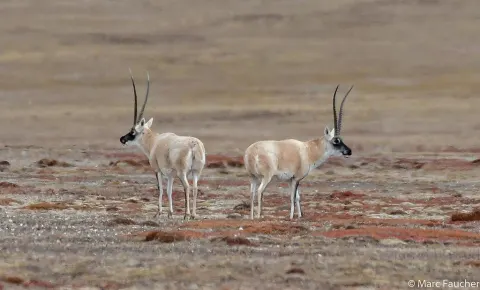
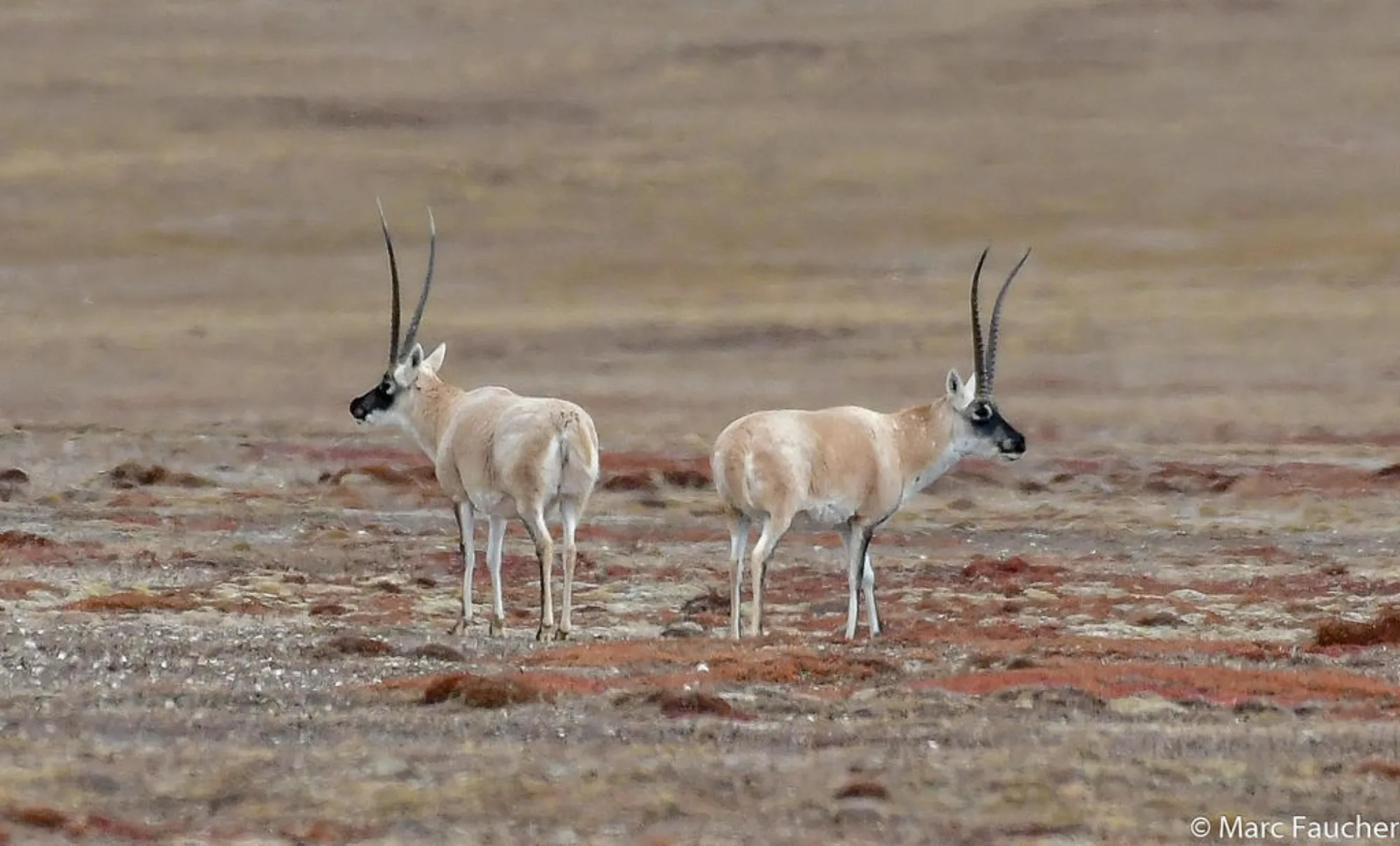
Across the high, open country of the Tibetan Plateau, the Chiru moves through a landscape of sparse vegetation and cold steppe. This medium-sized antelope has a thick, woolly coat ranging from pale fawn to reddish-brown, a whitish belly and an almost black face. Males are larger than females and have black leg stripes and long horns that curve backwards. Their horns typically measure 54 to 60 cm, while females have neither horns nor black leg stripes.
Chiru favour flat, open terrain in alpine and cold steppe habitats, at elevations between 3,250 and 5,500 m. They live almost entirely in China, including Tibet, southern Xinjiang and western Qinghai, with a few across the border in Ladakh, India. Most are found in northern Tibet's Chang Tang Nature Reserve, and Zhuonai Lake in Hoh Xil is a known calving ground. They eat grasses, sedges and other flowering plants, digging through snow for food in winter. Usually they gather in groups of no more than 20, though hundreds may travel together between seasonal pastures. Females travel up to 300 km each year to summer calving grounds, returning to join males on their winter range towards the end of autumn. A mother usually gives birth to one calf in June or July, and the calf can stand within 15 minutes.
Wolves, lynx and snow leopards prey on Chiru, while red foxes take young calves. Illegal hunting for their soft underfur caused a severe population decline, and demand continues for shawls made from it. Competition with domestic herds and gold mining on their rangeland have also affected them. A railway crosses their feeding grounds, with passages built beneath it for migrating animals, but it could also bring potential poachers closer to their habitat and breeding grounds.
Written from the English Wikipedia article Tibetan antelope (CC BY-SA 4.0).
- Records
- 0
- Countries
- 1
No atlas park has a record of the Chiru in or around it yet.
These are open occurrence records, so they show where people looked for and recorded the Chiru as much as where it lives. Cells are up to 25 km across, and every location is generalised to its cell.
Generalised encounter areas, not exact locations. Each shape is a grid cell coloured by how likely the species is there.
- Very likelyChina25 km zone · low confidence · 0 records · updated 80 days ago
Conservation status not assessed here yet, so every location is generalised to its grid cell.