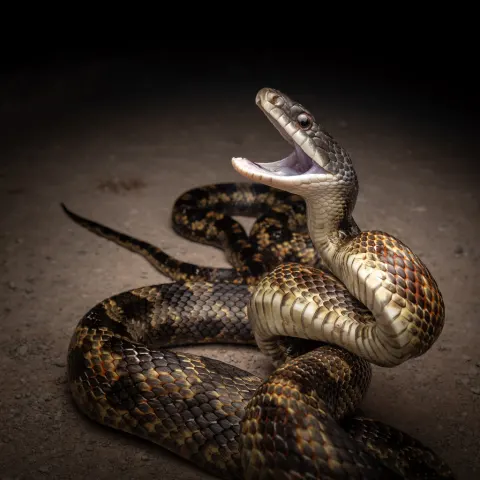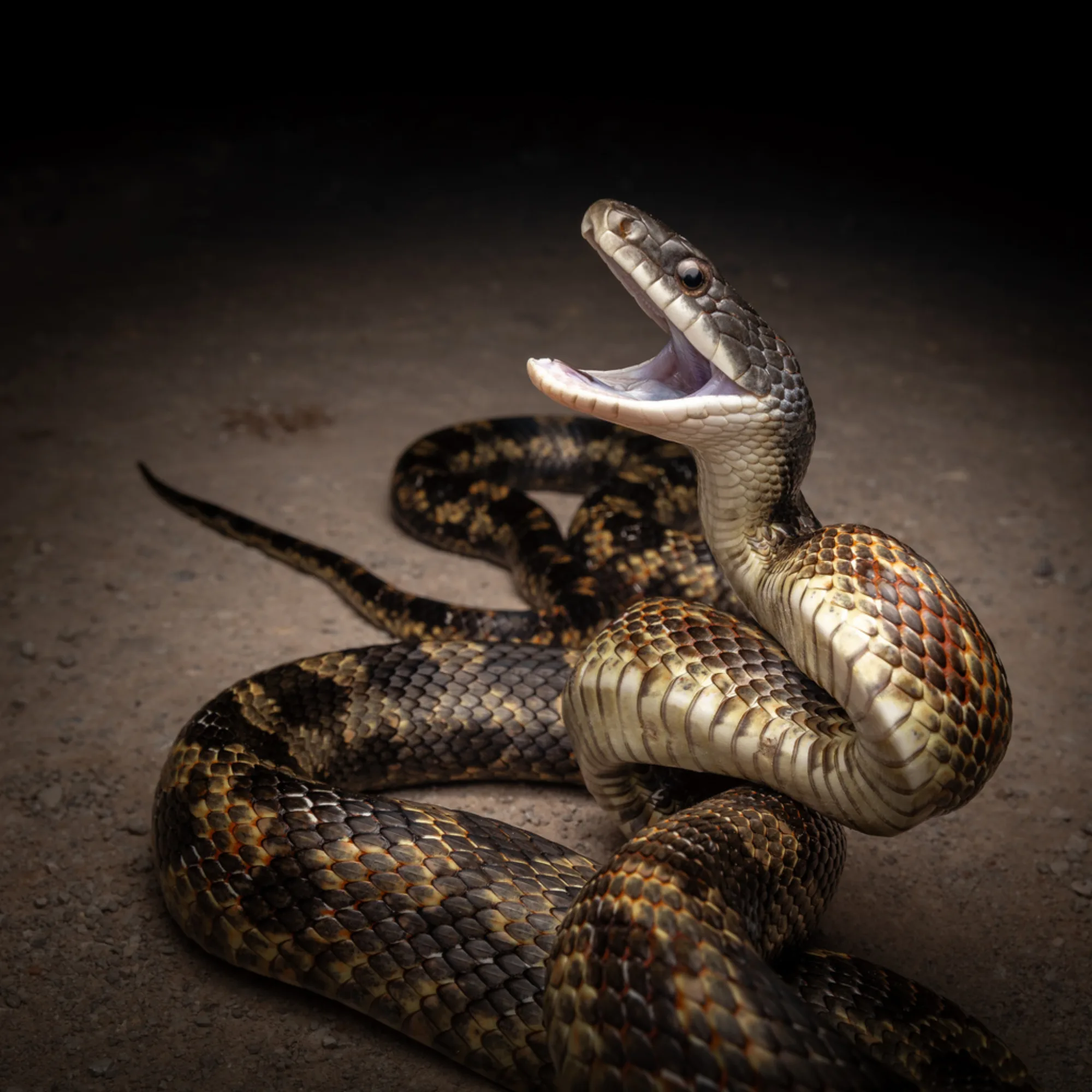
Black Rat Snake
Pantherophis obsoletus
The adult Black Rat Snake has a glossy black back and a white throat, chin and lips. It is a nonvenomous snake native to central North America. Young snakes look quite different, with brown blotches on a grey background, and darken quickly as they grow. Adults typically measure 106.7 to 183 cm in total length, although a record individual reached 218.4 cm. Colour varies across its range: the Texas rat snake can be brown to black, often with hints of orange or red.
West of the Mississippi River, this snake ranges from Iowa south through Missouri and Arkansas to western Louisiana, and west to eastern Texas, Oklahoma, Kansas and southeastern Nebraska. It uses habitats from bayous and prairies to rocky outcrops, with a particular preference for woodland, especially oak trees. An excellent climber, it spends much of its time in trees and can also swim. Rat snakes in its genus are mainly active during the day, but can adjust their schedules and be active at night. In winter, they hibernate in shared dens, sometimes alongside copperheads and timber rattlesnakes.
The snake constricts its prey and eats mice, voles and rats, as well as other small vertebrates and bird eggs. Snakes mate from late May into early June, and females later lay about 12 to 20 eggs. Hatching follows roughly 65 to 70 days later. Young rat snakes face predators including other snakes, while adults are preyed on by mammalian carnivores and large birds of prey. When startled, a rat snake may freeze and kink its body; if further threatened, it may flee or vibrate its tail. It can also release a foul-smelling musk when picked up by a predator.
Written from the English Wikipedia article Pantherophis obsoletus (CC BY-SA 4.0).
- Records
- 2,350
- Countries
- 2
- Atlas places
- 1
These are open occurrence records, so they show where people looked for and recorded the Black Rat Snake as much as where it lives. Cells are up to 25 km across, and every location is generalised to its cell.
Generalised encounter areas, not exact locations. Each shape is a grid cell coloured by how likely the species is there.
- Very likelyUnited States25 km zone · medium confidence · 2324 records · updated 80 days ago
- Very likelyCanada25 km zone · medium confidence · 26 records · updated 80 days ago
Conservation status not assessed here yet, so every location is generalised to its grid cell.