Red Cornsnake
Pantherophis guttatus
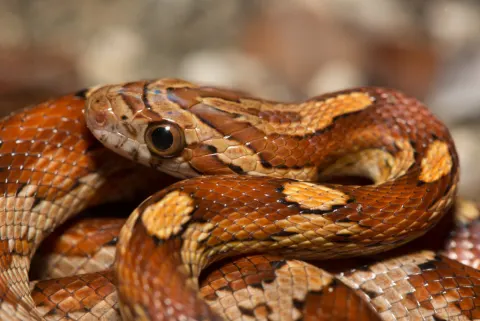
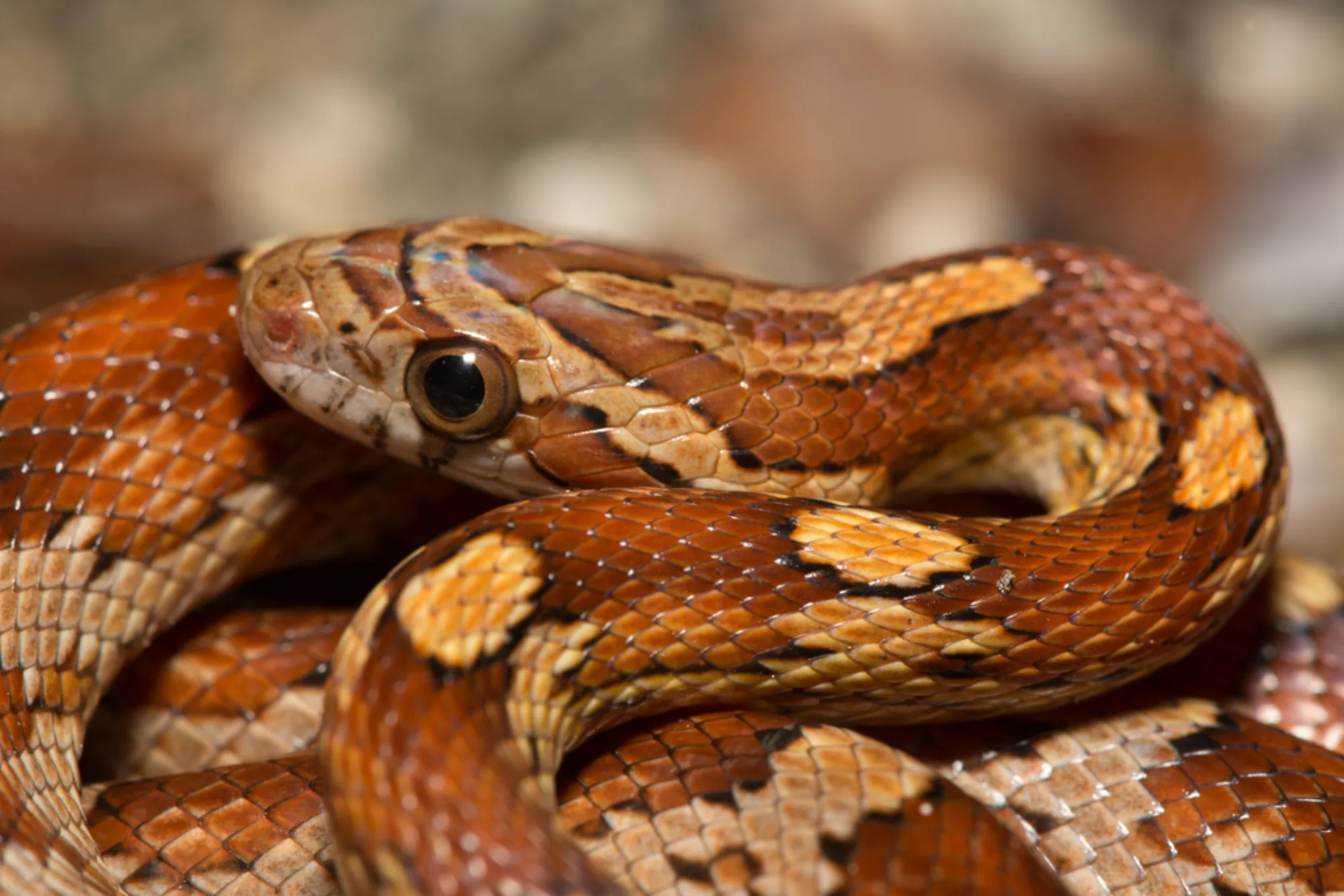
Look for large red blotches edged in black along the back of a Red Cornsnake (Pantherophis guttatus), a North American rat snake. Its body is usually orange or brown, while its belly carries alternating black and white marks. Adults can reach 61 to 182 cm in total length, including the tail. Although it can resemble a venomous copperhead, it has a slender build and is harmless to humans. Mistaken identity can be fatal for the snake, which is often killed by people who confuse the two.
Its range covers the southeastern and central United States, including an area from New Jersey to the Florida Keys. It uses overgrown fields, forest openings, trees and palmetto flatwoods, as well as abandoned or little-used farms and buildings. Corn snakes can climb trees and cliffs, though they typically stay on the ground until four months old. In colder regions they spend winter in brumation; along the more temperate coast they shelter in logs and rock crevices during cold weather. They may emerge from shelter on warm days to bask, and hunt less when it is cold.
Corn snakes show nocturnal patterns and use the warmth of the ground at night. They subdue small prey by constriction, eating rodents and other small mammals, as well as bird eggs taken from unguarded nests. In Florida, reptiles and amphibians make up most of their diet. After breeding, a female lays 12 to 24 eggs in a warm, moist hiding place and leaves them there. Birds of prey, larger snakes and carnivorous mammals eat corn snakes, and they can also suffer from snake fungal disease.
Written from the English Wikipedia article Corn snake (CC BY-SA 4.0).
- Records
- 446
- Countries
- 3
- Atlas places
- 4
These are open occurrence records, so they show where people looked for and recorded the Red Cornsnake as much as where it lives. Cells are up to 25 km across, and every location is generalised to its cell.
Generalised encounter areas, not exact locations. Each shape is a grid cell coloured by how likely the species is there.
- Very likelyUnited States25 km zone · medium confidence · 401 records · updated 82 days ago
- Very likelyAustralia25 km zone · medium confidence · 44 records · updated 82 days ago
- PossibleBelgium25 km zone · medium confidence · 1 record · updated 82 days ago
Conservation status not assessed here yet, so every location is generalised to its grid cell.