Snow Leopard
Panthera uncia
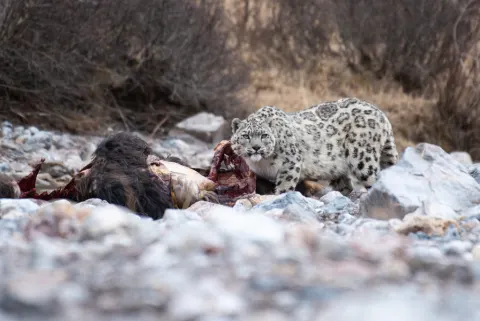
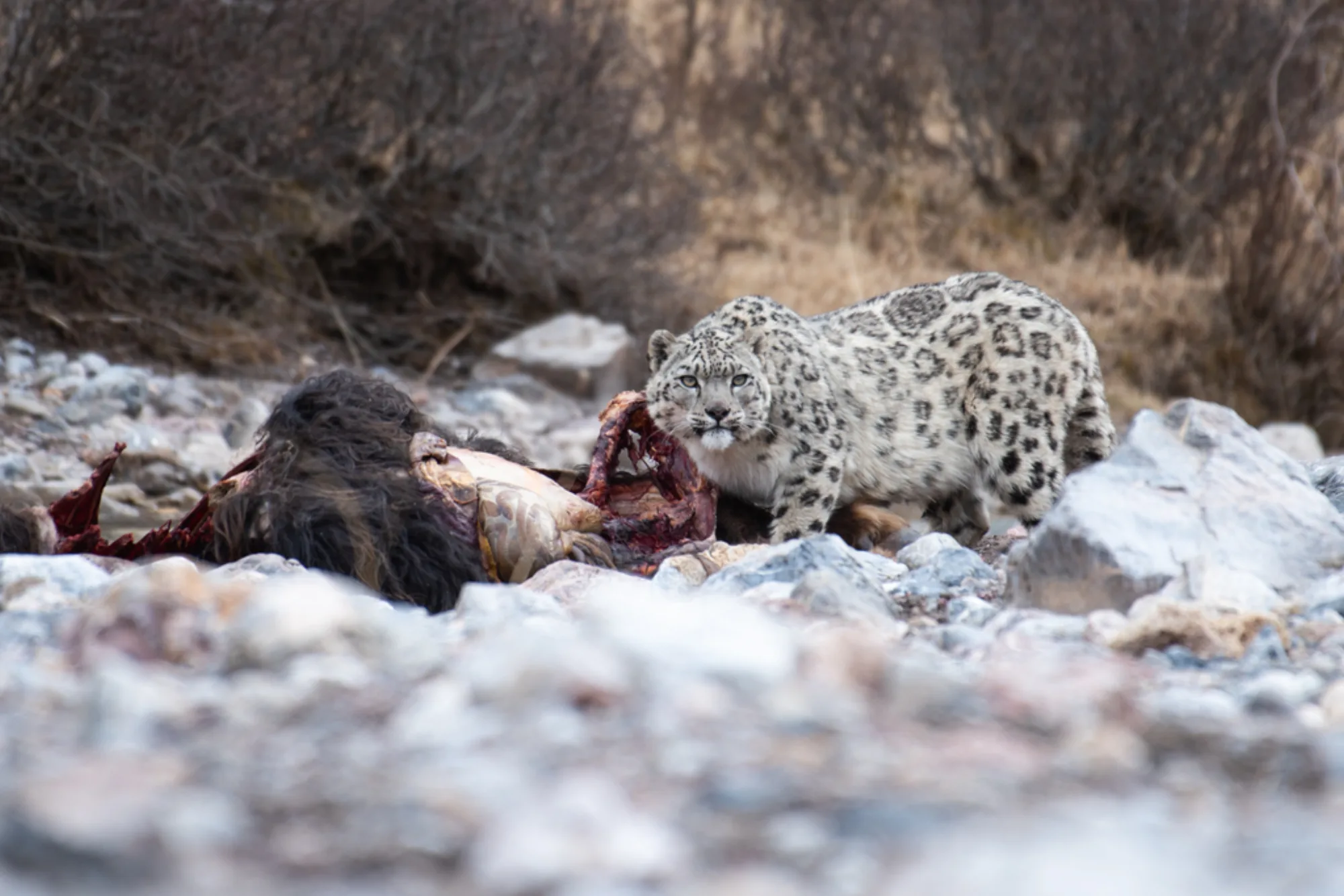
Across the mountains of Asia, the Snow Leopard moves through a landscape of cliffs, ridges and broken rock. This stocky cat has a dense, pale coat, with small black spots on the head and neck and larger rosettes over its back, sides and bushy tail. Small rounded ears help limit heat loss, while broad, furred paws help it walk on snow and grip steep ground. Its long, flexible tail helps it balance on rocky terrain and can cover its face while it sleeps.
Its range extends from the eastern Hindu Kush and the Himalayas across the Tibetan Plateau, reaching Mongolia, western China and southern Siberia. It inhabits alpine and subalpine zones, often at 3,000 to 4,500 m, although it also occurs lower down in the north. In summer it usually stays above the tree line, among alpine meadows and rocky ground; in winter it descends to lower elevations. Solitary for much of its life, it is most active around dawn and again from afternoon into early evening, resting near cliffs and ridges that offer shade and lookout points. It hunts wild prey including Himalayan blue sheep, ibex and argali, as well as smaller mammals and domestic livestock. Females usually give birth to two or three cubs between April and June, sheltering them in a fur-lined rocky den or crevice.
Poaching and illegal trade in skins and body parts threaten the species, as does habitat destruction. Loss of wild prey, livestock grazing and conflict with people defending livestock also put pressure on snow leopards. In the Himalayas, a rising tree line and shrinking alpine zone could further reduce their habitat.
Written from the English Wikipedia article Snow leopard (CC BY-SA 4.0).
- Records
- 28
- Countries
- 7
- Atlas places
- 1
These are open occurrence records, so they show where people looked for and recorded the Snow Leopard as much as where it lives. Cells are up to 25 km across, and every location is generalised to its cell.
Generalised encounter areas, not exact locations. Each shape is a grid cell coloured by how likely the species is there.
- Very likelyUnited States25 km zone · medium confidence · 14 records · updated 80 days ago
- Very likelyKyrgyzstan25 km zone · medium confidence · 3 records · updated 80 days ago
- LikelyIndia25 km zone · medium confidence · 3 records · updated 80 days ago
- LikelyPakistan25 km zone · medium confidence · 3 records · updated 80 days ago
- LikelyUzbekistan25 km zone · medium confidence · 3 records · updated 80 days ago
- LikelyMongolia25 km zone · medium confidence · 1 record · updated 80 days ago
- PossibleChina25 km zone · medium confidence · 1 record · updated 80 days ago
Conservation status not assessed here yet, so every location is generalised to its grid cell.