Striped Catfish
Pangasianodon hypophthalmus
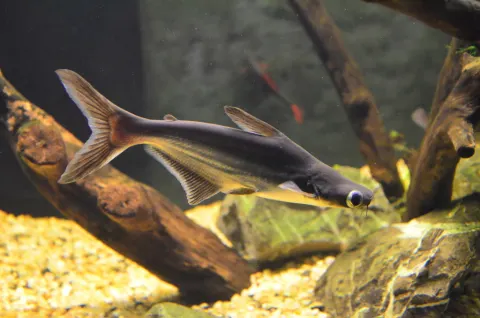
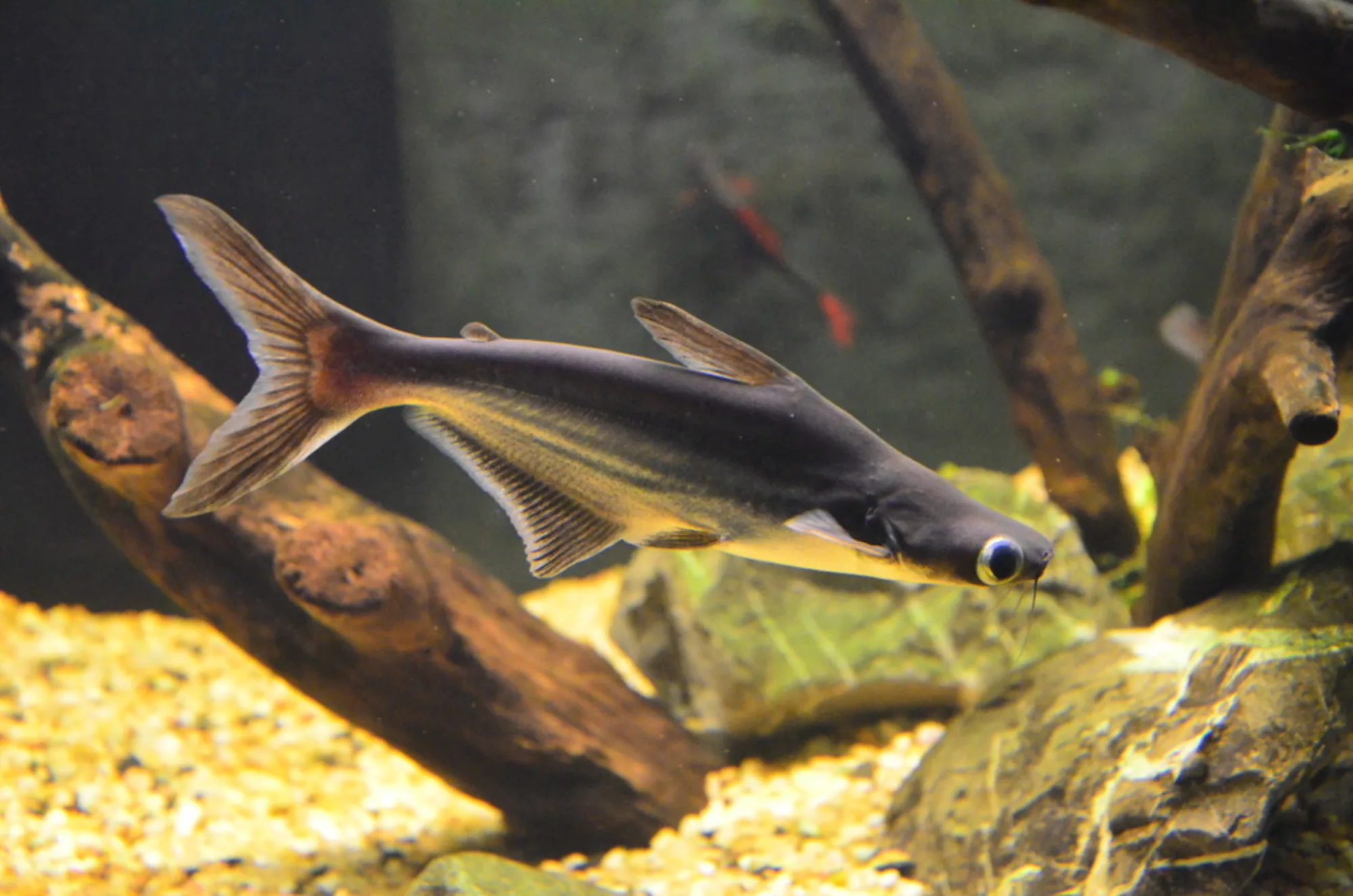
Shimmering when young and shark-like in outline, the Striped Catfish is a freshwater catfish native to Southeast Asia, despite the name iridescent shark. Juveniles have two black stripes along their sides, while large adults are uniformly grey, with dark grey or black fins. Adults can reach 130 cm in length and weigh up to 44 kg. The species comes from the great Mekong and Chao Phraya rivers, where it favours large bodies of water like the deep stretches of the Mekong basin. It has also been introduced to other rivers for aquaculture and as a source of food, including rivers in several other Southeast Asian countries.
Striped Catfish live in large schools, sometimes sharing them with other fish, including spot pangasius and tinfoil barb. In Thailand, they can be found in rivers and canals passing Buddhist temples or waterside places, where people often feed fish and do not catch them. Their varied diet includes crustaceans, other fish and plant matter. These fish migrate to spawn, generally moving upstream when flood-season waters are high, then returning downstream as levels fall to find places where their young can grow. Migration timing changes between river systems: in the Mekong basin, fish travel upstream from May to July and return downstream between September and December. Below the Khone Falls, upstream migration lasts from October to February and seems to begin as floodwaters fall. Hydropower developments can expose the fish to forces, rapid decompression, blade strikes and turbulence, which can cause injury and death.
Written from the English Wikipedia article Iridescent shark (CC BY-SA 4.0).
- Records
- 54
- Countries
- 7
No atlas park has a record of the Striped Catfish in or around it yet.
These are open occurrence records, so they show where people looked for and recorded the Striped Catfish as much as where it lives. Cells are up to 25 km across, and every location is generalised to its cell.
Generalised encounter areas, not exact locations. Each shape is a grid cell coloured by how likely the species is there.
- Very likelyPhilippines25 km zone · medium confidence · 15 records · updated 80 days ago
- Very likelyBangladesh25 km zone · medium confidence · 11 records · updated 80 days ago
- Very likelyEgypt25 km zone · medium confidence · 6 records · updated 80 days ago
- LikelyThailand25 km zone · medium confidence · 13 records · updated 80 days ago
- LikelyCambodia25 km zone · medium confidence · 3 records · updated 80 days ago
- LikelyIndonesia25 km zone · medium confidence · 3 records · updated 80 days ago
- LikelyMexico25 km zone · medium confidence · 3 records · updated 80 days ago
Conservation status not assessed here yet, so every location is generalised to its grid cell.