Osprey
Pandion haliaetus
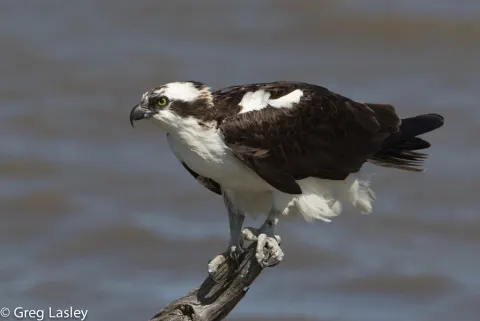
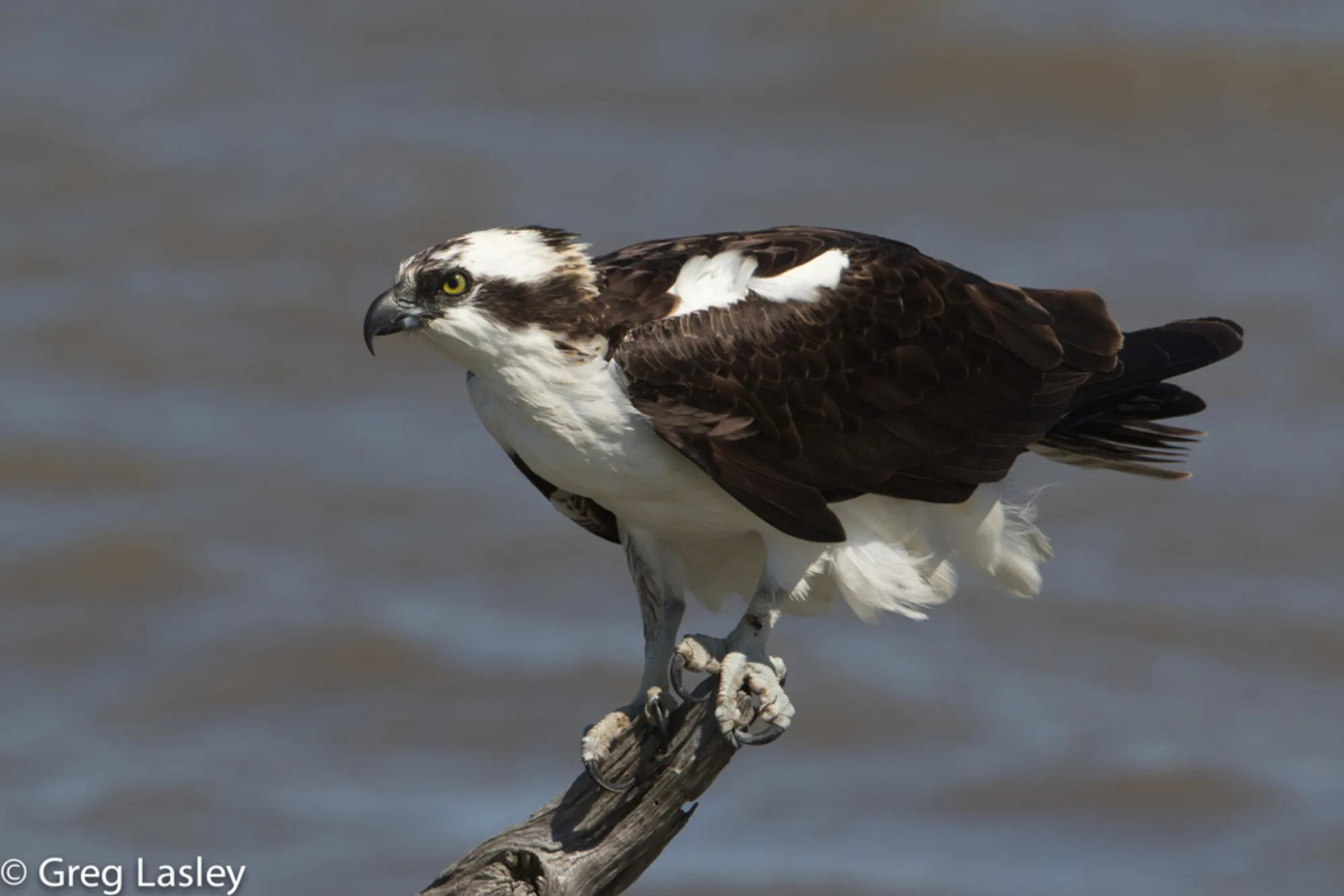
Watch for the Osprey above water: this large bird of prey has a glossy brown back, a white head crossed by a dark eye mask, and mostly white underparts. Its long, narrow wings have dark patches underneath at the wrists, while its arched wings and drooping wing tips give it a gull-like shape in flight. Adults can measure 50 to 66 cm long, with a wingspan of 127 to 180 cm.
Ospreys occur in tropical and temperate regions on every continent except Antarctica, though they visit South America only outside the breeding season. They use a wide range of habitats, nesting near water with enough food, including freshwater lakes and rivers and sometimes coastal brackish waters. Many migrate: European breeders spend the winter in Africa, while Australasian birds tend to stay in their region. Fish make up almost all of the Osprey's diet, and it searches from the air before hovering briefly and plunging feet first into the water. It may disappear beneath the surface during a dive, then eat its catch on a nearby perch. Pairs usually remain together for life and build large nests from materials such as sticks, driftwood and seaweed, placing them in trees, on rocky outcrops or on artificial structures. The female lays two to four eggs, and the chicks leave the nest in 8 to 10 weeks.
Migration can be dangerous, and birds can also die in collisions with aircraft or in accidents involving overhead electric cables. In South Australia, unmanaged coastal recreation and urban development threaten nesting sites, while habitat loss has reduced nesting opportunities. In the past, hunting, egg collecting and insecticides contributed to declines, although populations have since recovered significantly in many areas.
Written from the English Wikipedia article Osprey (CC BY-SA 4.0).
- Records
- 2,669,275
- Countries
- 8
- Atlas places
- 2
These are open occurrence records, so they show where people looked for and recorded the Osprey as much as where it lives. Cells are up to 25 km across, and every location is generalised to its cell.
Generalised encounter areas, not exact locations. Each shape is a grid cell coloured by how likely the species is there.
- Very likelyUnited States25 km zone · high confidence · 2532537 records · updated 80 days ago
- Very likelyCanada25 km zone · high confidence · 70642 records · updated 80 days ago
- Very likelyMexico25 km zone · high confidence · 23679 records · updated 80 days ago
- Very likelyChina25 km zone · high confidence · 11747 records · updated 80 days ago
- Very likelyTaiwan25 km zone · high confidence · 8984 records · updated 80 days ago
- Very likelyCosta Rica25 km zone · high confidence · 7974 records · updated 80 days ago
- Very likelyBelize25 km zone · high confidence · 7331 records · updated 80 days ago
- Very likelyNorway25 km zone · high confidence · 6381 records · updated 80 days ago
Conservation status not assessed here yet, so every location is generalised to its grid cell.