Cuvier's Smooth-fronted Caiman
Paleosuchus palpebrosus
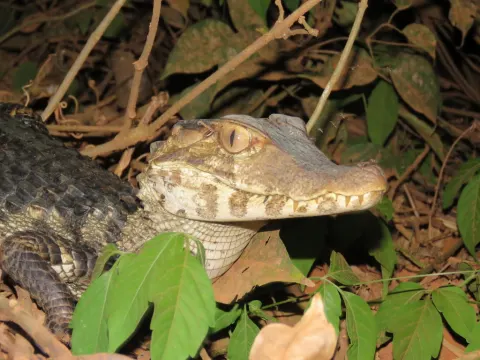
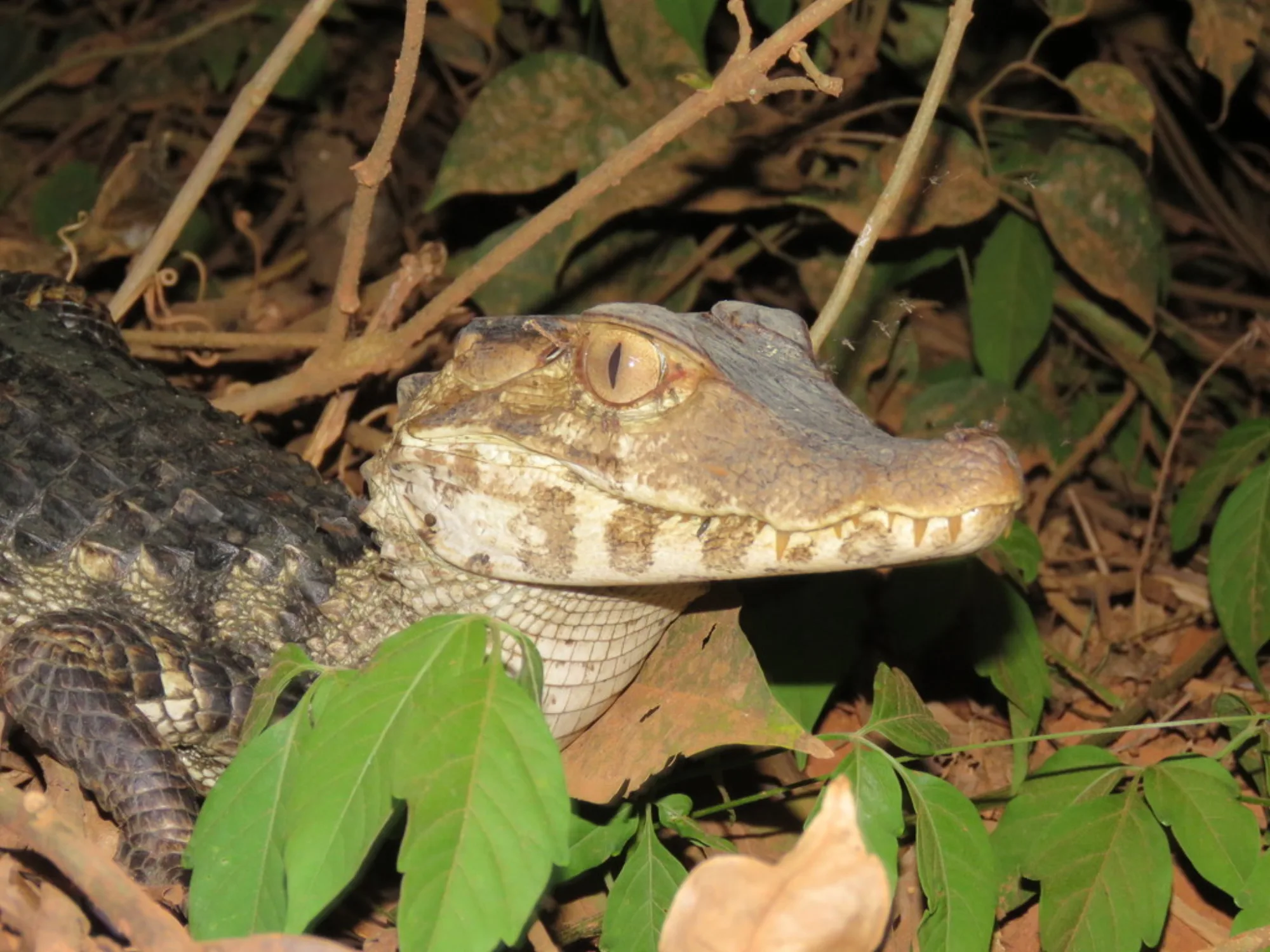
Small and heavily armoured, the Cuvier's Smooth-fronted Caiman (Paleosuchus palpebrosus) belongs to the alligator family. Males average 1.4 m in total length, while females reach up to 1.2 m. Its short, smooth snout curves upwards at the tip, and its head has a domed shape. Adults are dark brownish-black, with dark brown heads, while young caimans are brown with black bands.
This freshwater caiman ranges across tropical northern and central South America, including Brazil, Peru, Colombia, Guyana and Paraguay. It lives in forests along rivers and in flooded woodland around lakes, and seems to favour fast-flowing rivers and streams. It also occurs in quiet waters in Venezuela and southeastern Brazil. Mainly active at night, it can travel considerable distances overland, and younger animals have been found in isolated temporary pools. By day, it may shelter in a burrow, rest on rocks or sun itself in shallow water. In the Pantanal, it spends the dry season in burrows to stay cool.
Adults are usually seen alone or in pairs. They hunt on land and in water, taking fish, amphibians, small mammals, birds, reptiles and a variety of invertebrates. Young caimans eat insects, crustaceans, tadpoles, frogs and snails, among other prey. A female builds a concealed mound of mud and vegetation, lays 10 to 25 eggs and covers them with more vegetation. She opens the nest when the young call as they hatch and stays with them for around a year. Eggs and newly hatched young face predators including snakes, birds and other caimans; adults are preyed on by jaguars, green anacondas and large boa constrictors. Habitat destruction, including gold mining, poses a threat, and some caimans are collected for the pet trade, particularly in Guyana.
Written from the English Wikipedia article Cuvier's dwarf caiman (CC BY-SA 4.0).
- Records
- 683
- Countries
- 4
- Atlas places
- 1
These are open occurrence records, so they show where people looked for and recorded the Cuvier's Smooth-fronted Caiman as much as where it lives. Cells are up to 25 km across, and every location is generalised to its cell.
Generalised encounter areas, not exact locations. Each shape is a grid cell coloured by how likely the species is there.
- Very likelyFrench Guiana25 km zone · high confidence · 632 records · updated 80 days ago
- LikelyBrazil25 km zone · medium confidence · 37 records · updated 80 days ago
- LikelyColombia25 km zone · medium confidence · 10 records · updated 80 days ago
- PossibleBolivia25 km zone · medium confidence · 4 records · updated 80 days ago
Conservation status not assessed here yet, so every location is generalised to its grid cell.