Masked Palm Civet
Paguma larvata
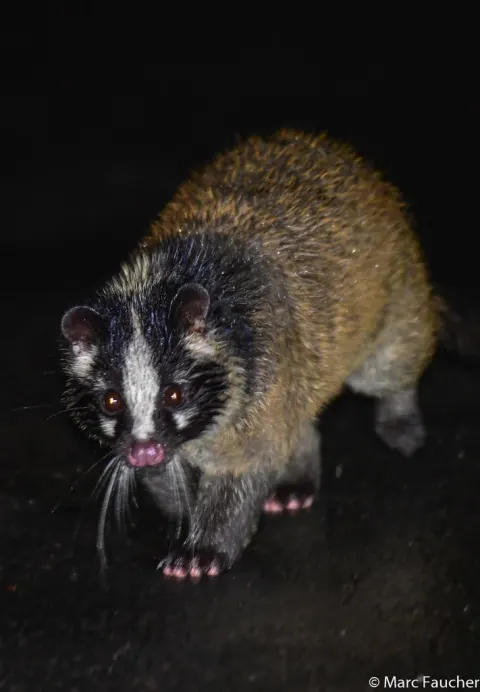
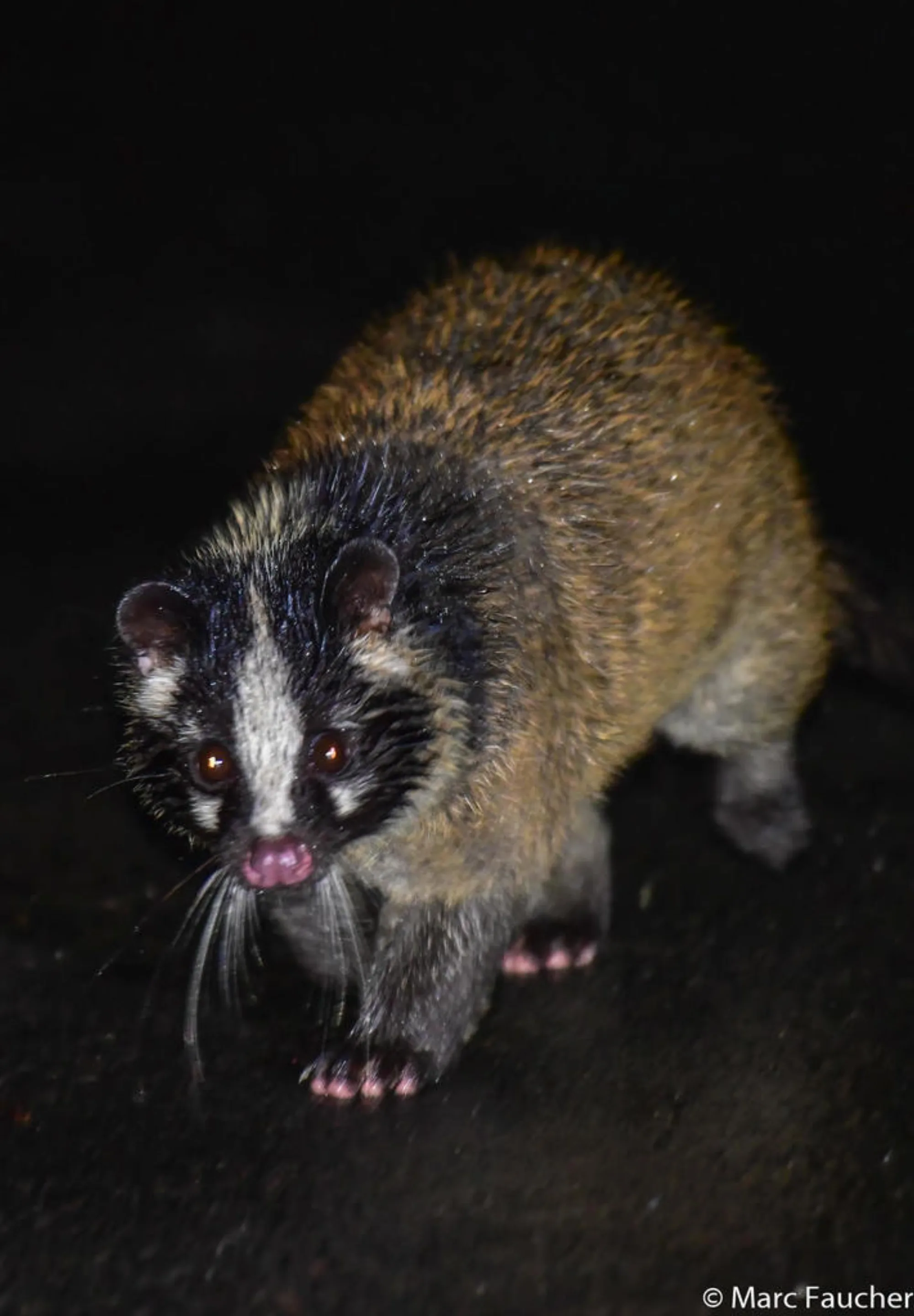
A pale facial mask gives the Masked Palm Civet much of its distinctive appearance. Its fur ranges from greyish to ochre, with black on the head, shoulders and neck, darker brown on the feet and tail, and no spots or stripes. White markings run from around the eyes towards the ears, while the lips, chin and throat are also white. Adults usually measure 50 to 60 cm in body length, with a 40 to 50 cm tail, and weigh 3 to 5 kg.
Its range stretches from the northern Indian subcontinent, especially the Himalayas, east through Southeast Asia to China, and includes Taiwan, Borneo, Sumatra and the Andaman and Nicobar islands. It lives in evergreen and deciduous forests, as well as disturbed habitat, and can persist at lower densities in fragmented forest. Mainly nocturnal and solitary, it sometimes ventures out during the day and spends part of its time in trees. An alarmed civet can spray a secretion to deter predators.
Its varied diet includes rats, birds, leaves and fruit such as figs, mangoes and bananas. Evidence from droppings also shows that it eats molluscs, arthropods and bark, with snakes and frogs making up a smaller part of the diet. What it eats changes with the season and location. There are two breeding seasons each year, and a female can have up to four young, which reach adult size in about three months. Habitat destruction and hunting for bushmeat are major threats, while illegal animal trafficking also takes a toll.
Written from the English Wikipedia article Masked palm civet (CC BY-SA 4.0).
- Records
- 4,701
- Countries
- 8
No atlas park has a record of the Masked Palm Civet in or around it yet.
These are open occurrence records, so they show where people looked for and recorded the Masked Palm Civet as much as where it lives. Cells are up to 25 km across, and every location is generalised to its cell.
Generalised encounter areas, not exact locations. Each shape is a grid cell coloured by how likely the species is there.
- Very likelyJapan25 km zone · high confidence · 4029 records · updated 80 days ago
- Very likelyChina25 km zone · high confidence · 527 records · updated 80 days ago
- LikelyTaiwan25 km zone · medium confidence · 137 records · updated 80 days ago
- PossibleIndia25 km zone · medium confidence · 3 records · updated 80 days ago
- UncommonMalaysia25 km zone · medium confidence · 3 records · updated 80 days ago
- UncommonHong Kong SAR China25 km zone · medium confidence · 2 records · updated 80 days ago
- UncommonPakistan25 km zone · low confidence · 0 records · updated 80 days ago
- RareVietnam25 km zone · low confidence · 0 records · updated 80 days ago
Conservation status not assessed here yet, so every location is generalised to its grid cell.