Red Sea Bream
Pagrus major
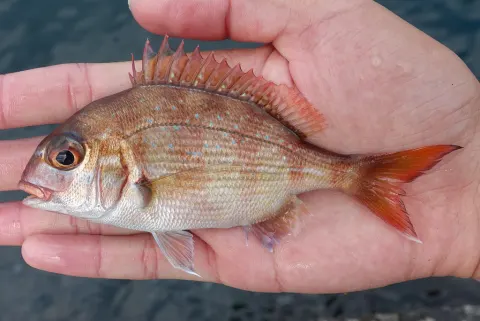
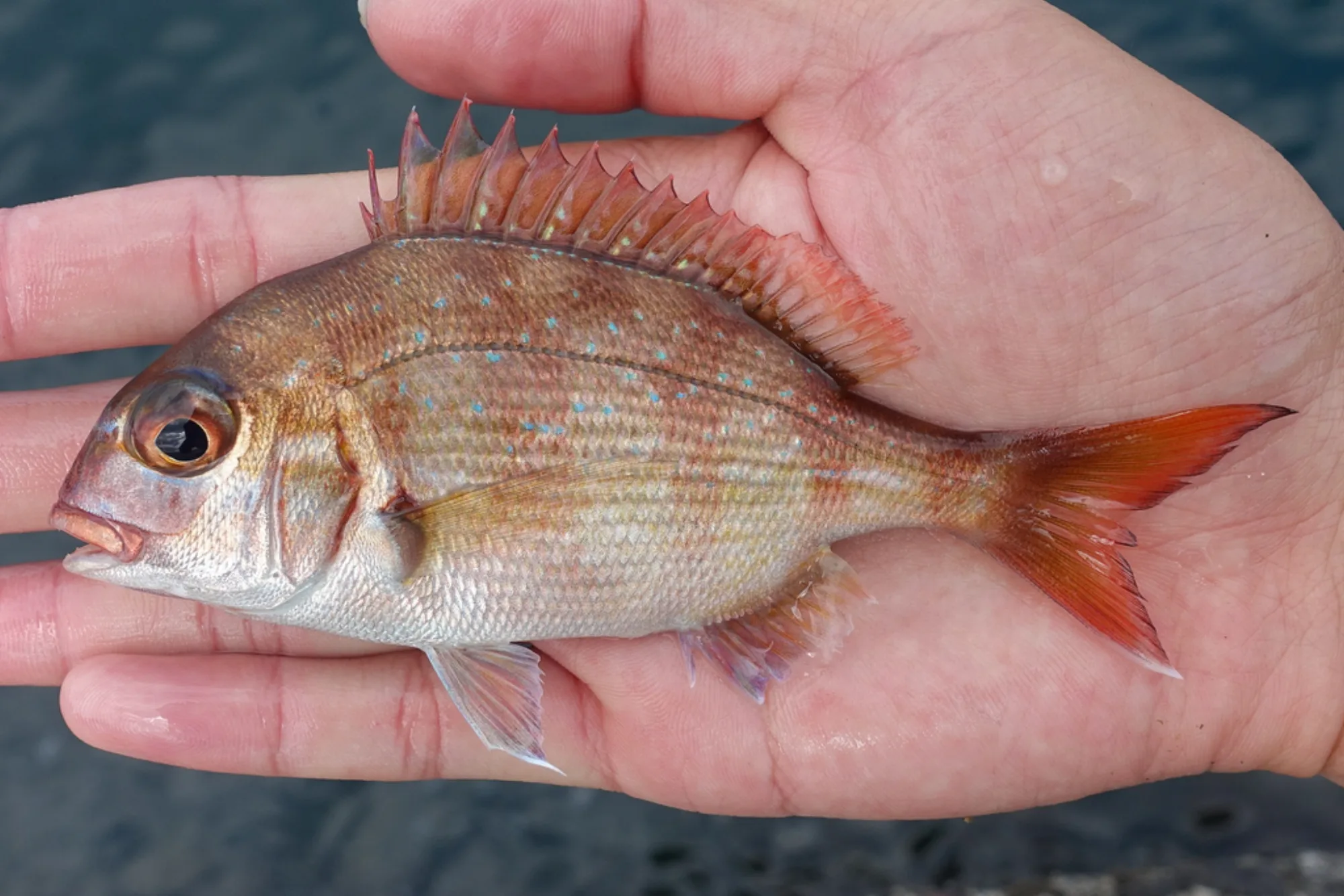
Look for a pinkish red to purplish brown fish marked with blue spots across its body. The Red Sea Bream has an oblong, flattened shape, long, slender fins along its sides and a large, forked tail. It can reach 120 cm in length, though most are smaller, and young fish have five stripes that fade as they mature. It lives in subtropical waters of the Northwest Pacific, from the northeastern South China Sea, excluding the Philippines, north to Japan. Adults are often alone near the bottom of reefs, at depths of 30 to 200 meters, while juveniles occupy shallower water.
Its diet changes with age and season. Young fish begin with small prey such as brittle stars, then eat more crabs, mantis shrimps and cephalopods as they grow. Fully grown fish may also prey on other fish. Cephalopods dominate the diet throughout the year, while crabs are eaten mostly in summer and autumn. Both adults and juveniles also eat small crustaceans, smaller fish and sea urchins. The fish can live for an average of 20 to 40 years.
Between February and August, Red Sea Bream move from deeper water into shallower areas to spawn. Their eggs and young float freely in the ocean without parental protection, leaving them exposed to larger fish. Fishing is another pressure: larger specimens are favoured for the catch in countries where the fish is eaten. The fish is prized as food in Japan, and people in Korea and Taiwan eat it frequently too.
Written from the English Wikipedia article Pagrus major (CC BY-SA 4.0).
- Records
- 275
- Countries
- 5
No atlas park has a record of the Red Sea Bream in or around it yet.
These are open occurrence records, so they show where people looked for and recorded the Red Sea Bream as much as where it lives. Cells are up to 25 km across, and every location is generalised to its cell.
Generalised encounter areas, not exact locations. Each shape is a grid cell coloured by how likely the species is there.
- Very likelyJapan25 km zone · medium confidence · 204 records · updated 80 days ago
- Very likelySouth Korea25 km zone · medium confidence · 58 records · updated 80 days ago
- LikelyChina25 km zone · medium confidence · 7 records · updated 80 days ago
- UncommonTaiwan25 km zone · medium confidence · 6 records · updated 80 days ago
- RareHong Kong SAR China25 km zone · low confidence · 0 records · updated 80 days ago
Conservation status not assessed here yet, so every location is generalised to its grid cell.