Harp Seal
Pagophilus groenlandicus
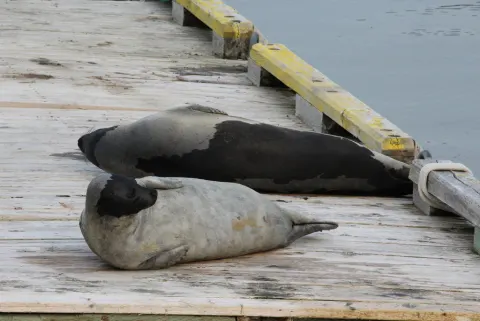
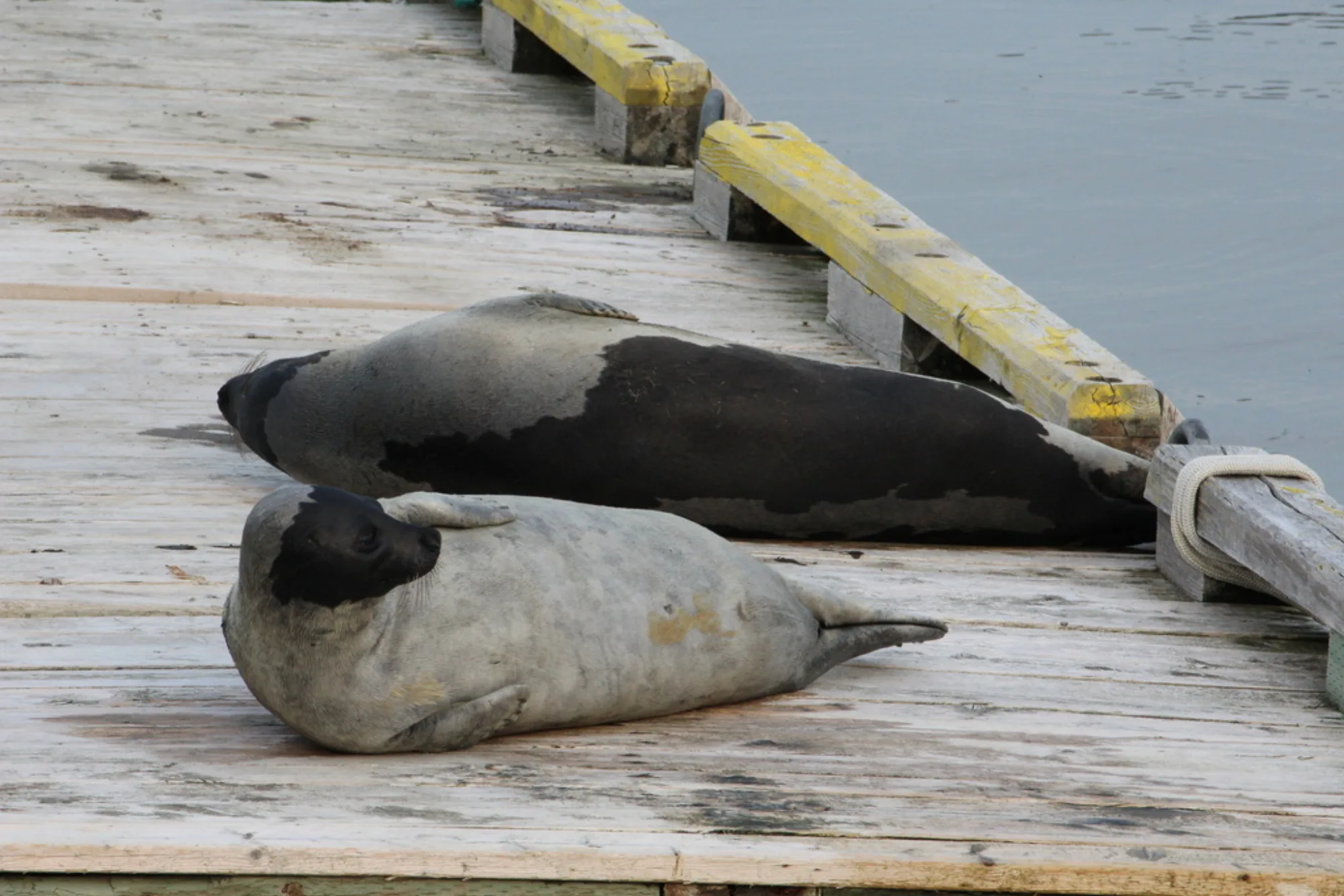
A silver-grey coat and dark, wishbone-shaped markings across the back help distinguish an adult Harp Seal. This earless seal has black eyes and can reach 1.7 to 2.0 m in length. Newborn pups wear white coats for their first 2 to 3 weeks, before a silver to grey coat with black dots replaces them. The familiar adult pattern appears as seals approach maturity, although some females never develop it fully.
Harp seals live in the northernmost Atlantic and Arctic oceans, in areas where seasonal pack ice provides breeding habitat. They gather on ice each year to moult, give birth and breed, then migrate to summer feeding grounds. Breeding areas include waters off eastern Canada and eastern Greenland, as well as the White Sea off northern Russia. These social seals spend far more time at sea than on land and can be vocal when gathered in groups. Their varied diet includes krill, capelin, herring, flatfish and cod, with the balance depending largely on what prey is available. In the Greenland Sea, seals forage along pack ice in spring and summer, when most dives are shallower than 50 m.
Breeding takes place between mid-February and April, and females usually give birth to one pup in late February. A mother feeds her own pup for approximately 12 days, then leaves it on the ice. Young pups face polar bears and marine predators, including killer whales and Greenland sharks, as the ice begins to melt. All three populations are commercially hunted, and hunting has greatly affected their numbers. Fishing nets can also kill seals: during a movement into Norwegian waters in 1987, thousands were reported drowned.
Written from the English Wikipedia article Harp seal (CC BY-SA 4.0).
- Records
- 990
- Countries
- 9
- Atlas places
- 1
These are open occurrence records, so they show where people looked for and recorded the Harp Seal as much as where it lives. Cells are up to 25 km across, and every location is generalised to its cell.
Generalised encounter areas, not exact locations. Each shape is a grid cell coloured by how likely the species is there.
- Very likelyGreenland25 km zone · medium confidence · 680 records · updated 80 days ago
- Very likelySvalbard & Jan Mayen25 km zone · high confidence · 226 records · updated 80 days ago
- LikelyNorway25 km zone · medium confidence · 42 records · updated 80 days ago
- LikelyCanada25 km zone · medium confidence · 14 records · updated 80 days ago
- LikelyUnited States25 km zone · medium confidence · 11 records · updated 80 days ago
- LikelyRussia25 km zone · medium confidence · 7 records · updated 80 days ago
- PossibleFrance25 km zone · medium confidence · 4 records · updated 80 days ago
- PossibleNetherlands25 km zone · medium confidence · 3 records · updated 80 days ago
- PossibleSt. Pierre & Miquelon25 km zone · medium confidence · 3 records · updated 80 days ago
Conservation status not assessed here yet, so every location is generalised to its grid cell.