Coastal Taipan
Oxyuranus scutellatus
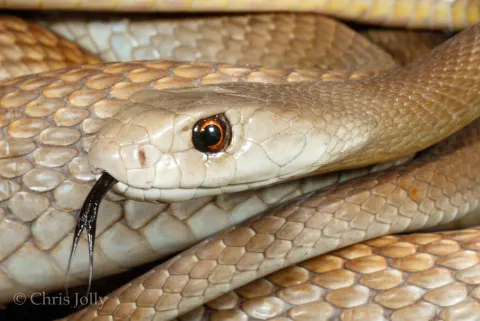
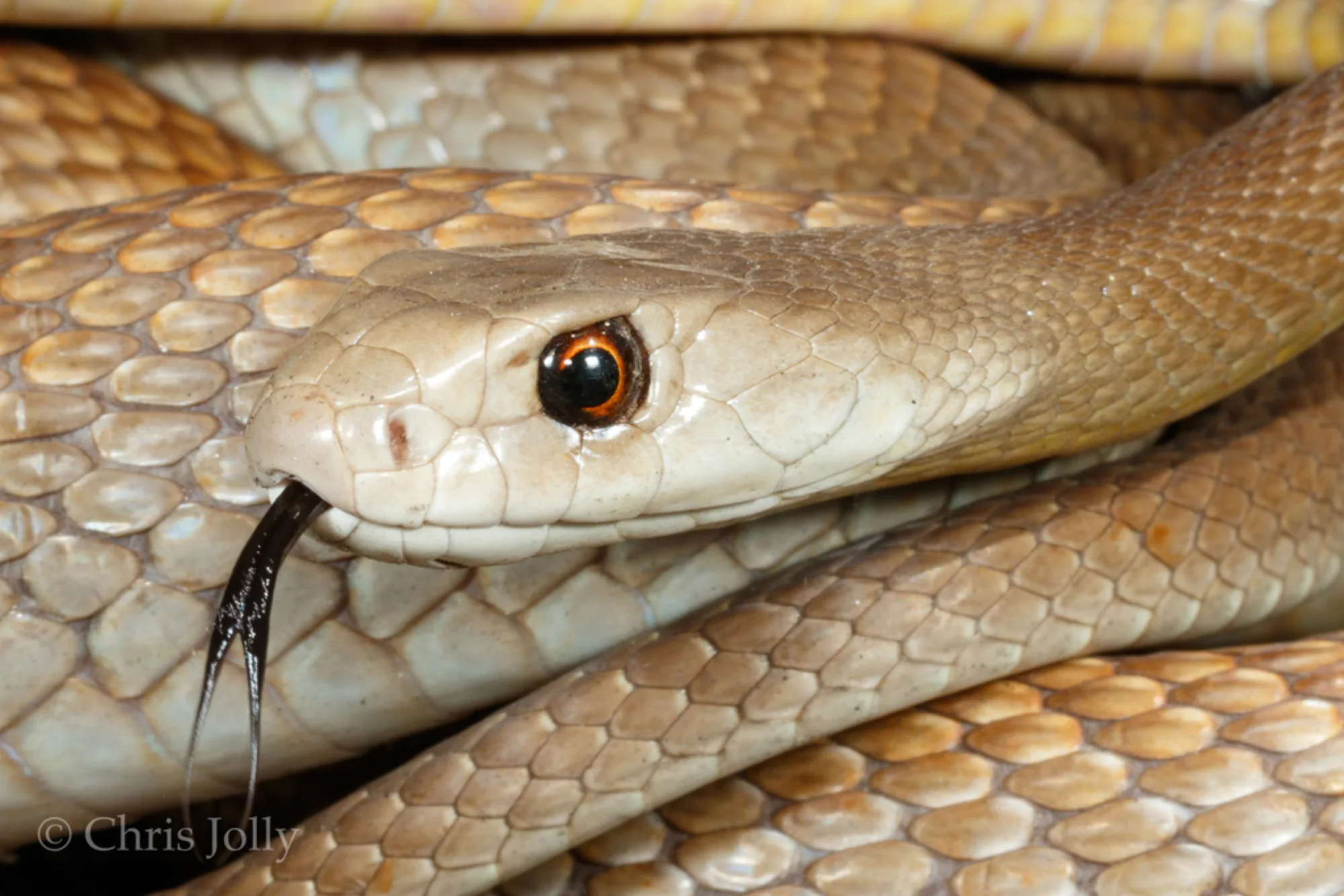
Long and slender, the Coastal Taipan is an extremely venomous snake with a narrow head, a light face and a neck slimmer than its head. It averages around 2.0 m in length, though the longest recorded specimen reached 2.9 m. Its upper body is often light olive or reddish-brown, while the belly is usually creamy white to pale yellow, sometimes flecked with orange or pink. Some individuals are dark grey to black, and their colour darkens in winter and fades in summer.
The snake lives in northern and eastern Australia and New Guinea, with its Australian range reaching northern New South Wales through Queensland. It occupies habitats from monsoon forest and open woodland to grazing paddocks and sugarcane fields, where rodents provide food. On Cape York Peninsula, open woodland and thickets of introduced Lantana are favoured. It takes cover beneath vegetation and litter, inside hollow logs and in burrows left by other animals. Usually active in the early to midmorning, it may switch to night activity in hot weather. Snake handlers generally describe it as inclined to avoid confrontation, though it becomes highly defensive if provoked.
Rats, mice and bandicoots make up much of its diet, with birds taken when the opportunity arises. It scans for prey with its head raised slightly, then freezes, lunges and delivers several quick bites before releasing its catch. Breeding takes place between August and December, and females lay clutches of 7 to 20 eggs that hatch after 60 to 80 days. Rats can inflict lethal injuries on a hunting taipan, and the release after biting reduces the risk of retaliation. One dead snake was found on a road after swallowing a cane toad, but whether poison or a vehicle killed it was unknown.
Written from the English Wikipedia article Coastal taipan (CC BY-SA 4.0).
- Records
- 46
- Countries
- 2
- Atlas places
- 2
These are open occurrence records, so they show where people looked for and recorded the Coastal Taipan as much as where it lives. Cells are up to 25 km across, and every location is generalised to its cell.
Generalised encounter areas, not exact locations. Each shape is a grid cell coloured by how likely the species is there.
- Very likelyAustralia25 km zone · medium confidence · 37 records · updated 80 days ago
- Very likelyPapua New Guinea25 km zone · medium confidence · 9 records · updated 80 days ago
Conservation status not assessed here yet, so every location is generalised to its grid cell.