Dall's Sheep
Ovis dalli
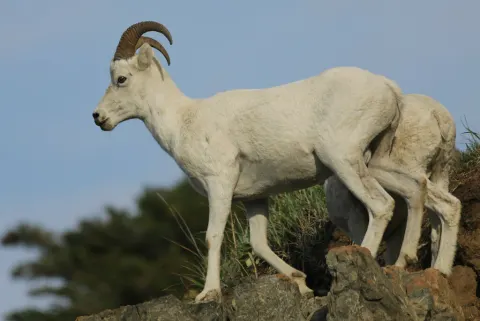
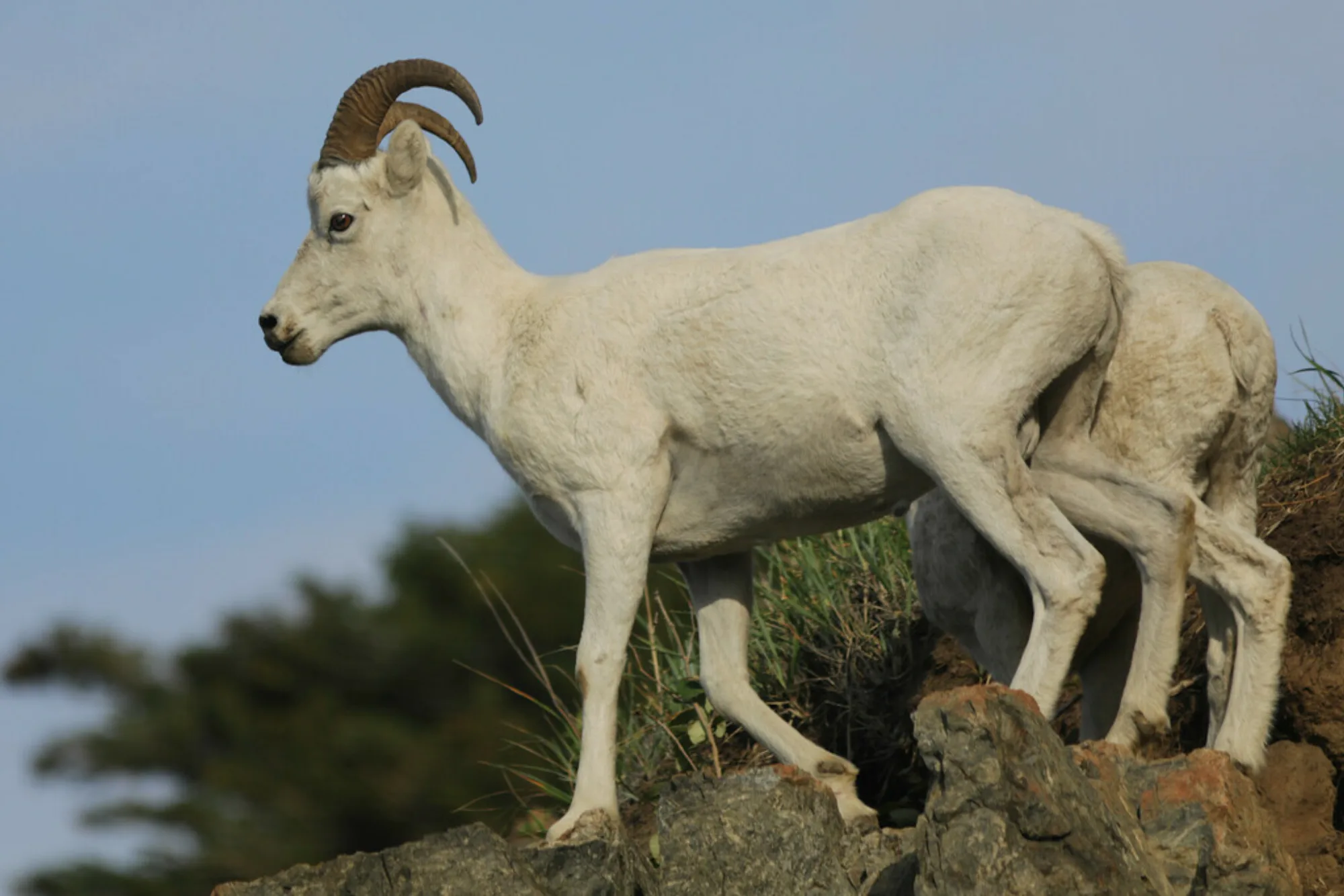
High in the mountains of northwestern North America, the Dall's Sheep is a wild sheep with an off-white coat and a thick layer of wool beneath its longer outer hairs. Rams are larger than ewes and have massive curling horns, while the horns of ewes are small and slender. The sheep stand about 0.9 m at the shoulder, and their winter coats can be more than 5 cm thick. Their range includes Alaska, the Yukon, the western Northwest Territories and parts of British Columbia. Look for them in dry alpine tundra and meadows where steep, rugged ground offers an escape from predators. Places where they can often be observed include Denali National Park and Preserve in Alaska, the Kluane park's Sheep Mountain, and the area near Faro in the Yukon.
Rams and ewes usually form separate groups outside the mating season, which runs from mid-November to mid-December. Within ram groups, head-on horn clashes help establish social order, and encounters between males with similarly sized horns become more intense as the mating season approaches. Ewes favour steep, rocky slopes in spring and summer, where the risk to their young is lower. Lambs are born in May, after which their mothers seek places with both food and nearby escape terrain. The sheep eat grasses, sedges and shrubs such as willow, and travel long distances to mineral licks in spring. Winter food is restricted to plants available in snow-free areas. Wolves, coyotes and bears prey on the sheep, while golden eagles take young animals. Hunting continues, and climate change may alter their food supply and bring more heavy winter snow or icing, potentially affecting where the sheep live and how their populations fare.
Written from the English Wikipedia article Dall sheep (CC BY-SA 4.0).
- Records
- 323
- Countries
- 2
- Atlas places
- 3
These are open occurrence records, so they show where people looked for and recorded the Dall's Sheep as much as where it lives. Cells are up to 25 km across, and every location is generalised to its cell.
Generalised encounter areas, not exact locations. Each shape is a grid cell coloured by how likely the species is there.
- Very likelyUnited States25 km zone · medium confidence · 307 records · updated 80 days ago
- LikelyCanada25 km zone · medium confidence · 16 records · updated 80 days ago
Conservation status not assessed here yet, so every location is generalised to its grid cell.