Argali
Ovis ammon
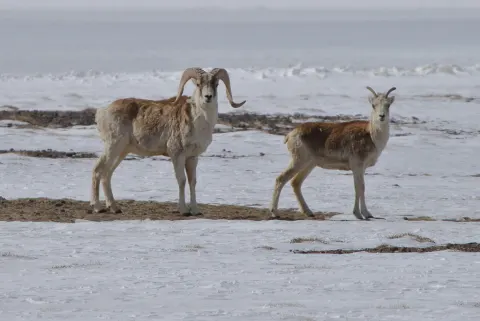
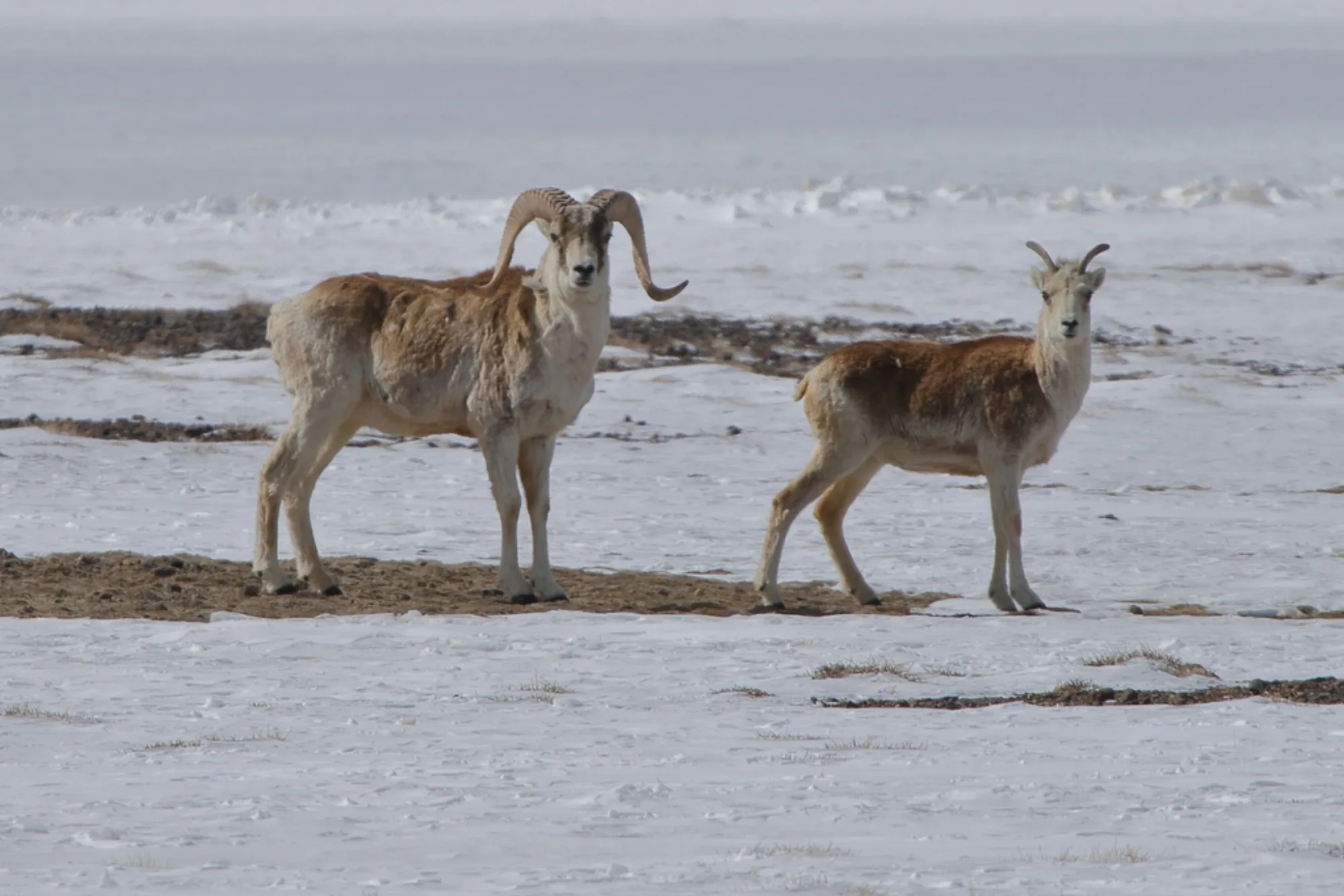
Across the highlands of central Asia, the Argali stands out as the largest wild sheep. It reaches 85 to 135 cm at the shoulder, with females considerably smaller than males. Coat colours range from pale yellow through reddish-brown to dark grey-brown, while the face and rump are yellowish-white. Rams carry enormous corkscrew horns, sometimes reaching 190 cm in total length, and a whitish ruff around the neck. Ewes have horns too, though these are usually shorter than 60 cm.
The species ranges from central Kazakhstan east to China's Shanxi Province, and from the Altai Mountains south to the Himalayas. It occupies mountain country at elevations of 300 to 5,800 m, often favouring gentle slopes and broken ground in protected areas. Ewes with lambs may use steeper country with canyons and jagged rocks. In winter, argali may seek mountain areas where wind has cleared some of the snow. Herds usually contain two to 150 animals, with males and females apart outside the breeding season. Some rams live alone, while females and young gather in larger groups. Seasonal food shortages can prompt herds to move, and they tend to spend summer at higher elevations.
At high elevations, grasses, sedges and other herbaceous plants dominate the diet; bushes feature more often at middle elevations. The breeding season can run from October to mid-January, when mature rams clash with enough force to be heard from 800 m away. Most subspecies have a single lamb, born in late March or April. Poaching for meat and horns remains a major threat, while competition with domestic livestock also exposes argali to diseases and parasites.
Written from the English Wikipedia article Argali (CC BY-SA 4.0).
- Records
- 423
- Countries
- 5
No atlas park has a record of the Argali in or around it yet.
These are open occurrence records, so they show where people looked for and recorded the Argali as much as where it lives. Cells are up to 25 km across, and every location is generalised to its cell.
Generalised encounter areas, not exact locations. Each shape is a grid cell coloured by how likely the species is there.
- Very likelyFrance25 km zone · high confidence · 355 records · updated 80 days ago
- Very likelyLuxembourg25 km zone · medium confidence · 31 records · updated 80 days ago
- LikelyRussia25 km zone · medium confidence · 31 records · updated 80 days ago
- PossibleMongolia25 km zone · medium confidence · 6 records · updated 80 days ago
- UncommonDenmark25 km zone · low confidence · 0 records · updated 80 days ago
Conservation status not assessed here yet, so every location is generalised to its grid cell.