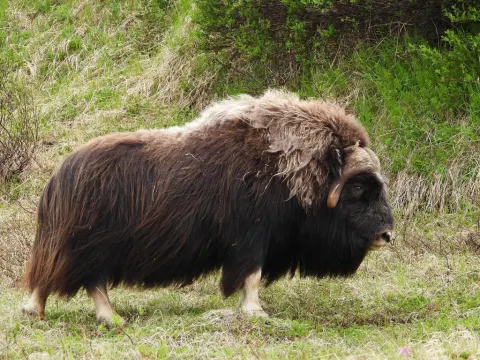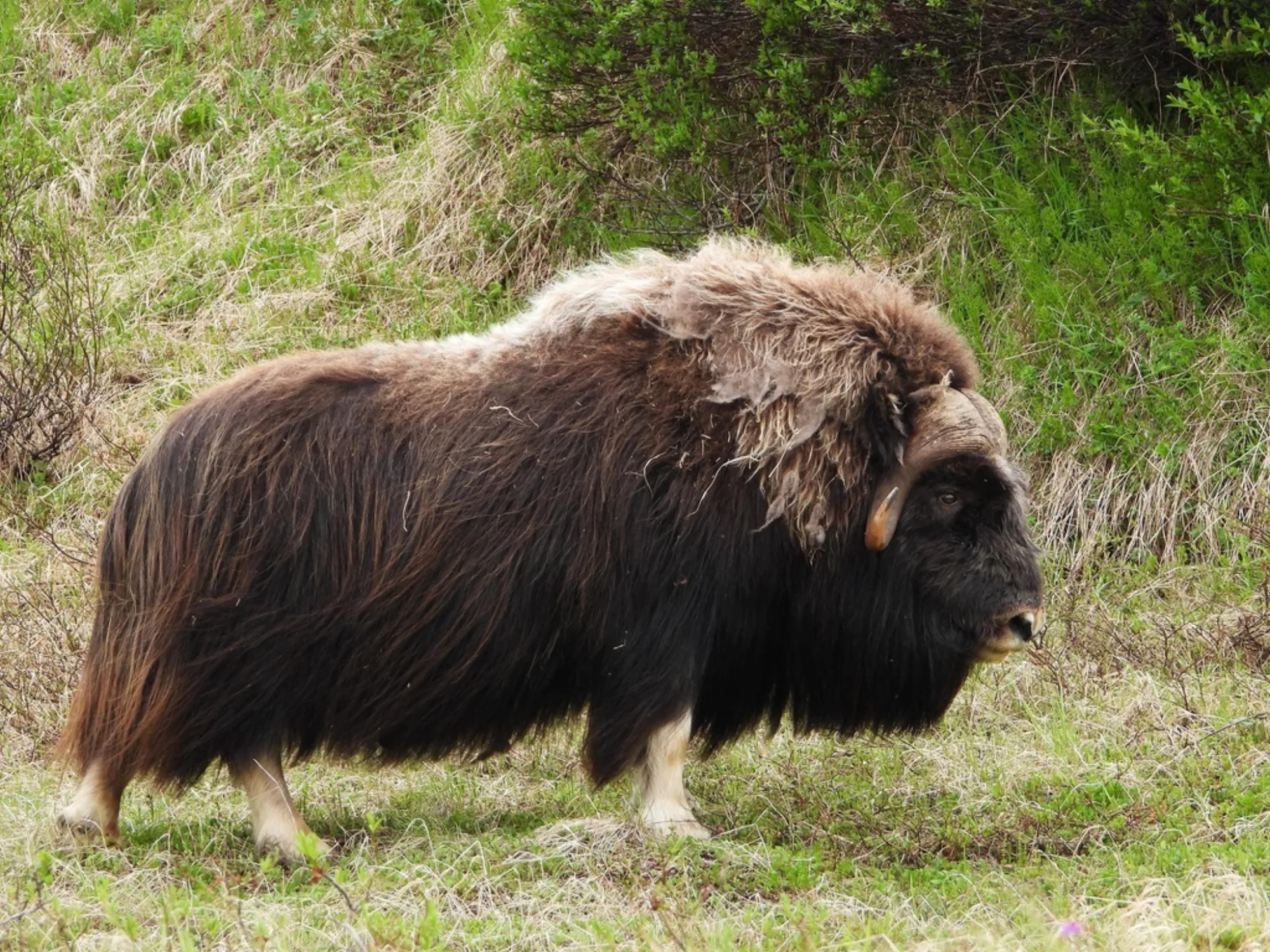
Muskox
Ovibos moschatus
A heavy coat and a pair of long, curved horns make the Muskox distinctive on the Arctic tundra. Both males and females have horns, while their coats combine black, grey and brown, with long hairs hanging almost to the ground. Beneath that bulk is a hoofed mammal whose thick fur and large head make it look bigger than it is. Muskoxen live mainly in Greenland, the Canadian Arctic and Alaska. They have also been reintroduced to Yukon and Siberia, while animals introduced to Norway have spread into Sweden. Their typical habitat is dry Arctic grassland, although in summer they also use wetter places such as river valleys.
As winter approaches, muskoxen move higher to avoid deep snow, favouring areas where they can dig through a shallow covering to find food. Their diet includes grasses and woody plants, as well as Arctic willows, mosses and lichens; in winter, willows are their most common food. Herds are larger in winter than in summer, when dominant bulls drive other males away. During the breeding season, bulls compete for groups of females; after summer, the herds come together again. Calves arrive from April to June and can follow the herd within hours of birth. When danger threatens, adults turn outwards and form a ring or semicircle around the calves.
Arctic wolves are their main predators, while bears and wolverines sometimes take calves or weakened adults. Excessive hunting caused historical declines, and small, scattered populations remain exposed to local changes in climate. In Norway, train collisions occasionally kill animals, and an outbreak of measles has also killed members of the Dovrefjell population.
Written from the English Wikipedia article Muskox (CC BY-SA 4.0).
- Records
- 7,147
- Countries
- 6
No atlas park has a record of the Muskox in or around it yet.
These are open occurrence records, so they show where people looked for and recorded the Muskox as much as where it lives. Cells are up to 25 km across, and every location is generalised to its cell.
Generalised encounter areas, not exact locations. Each shape is a grid cell coloured by how likely the species is there.
- Very likelyNorway25 km zone · medium confidence · 6975 records · updated 80 days ago
- Very likelyGreenland25 km zone · medium confidence · 70 records · updated 80 days ago
- Very likelyUnited States25 km zone · medium confidence · 68 records · updated 80 days ago
- Very likelyCanada25 km zone · medium confidence · 30 records · updated 80 days ago
- LikelySweden25 km zone · medium confidence · 4 records · updated 80 days ago
- PossibleRussia25 km zone · low confidence · 0 records · updated 80 days ago
Conservation status not assessed here yet, so every location is generalised to its grid cell.