California Ground Squirrel
Otospermophilus beecheyi
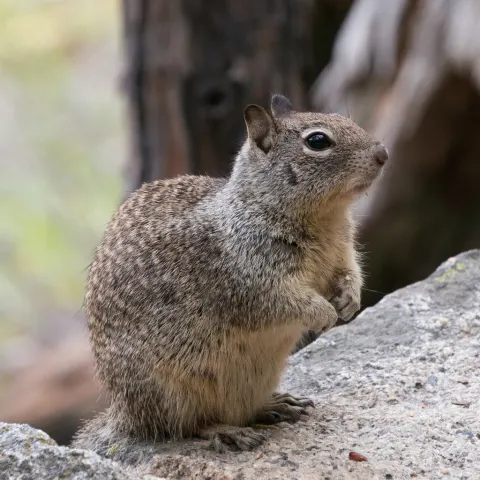
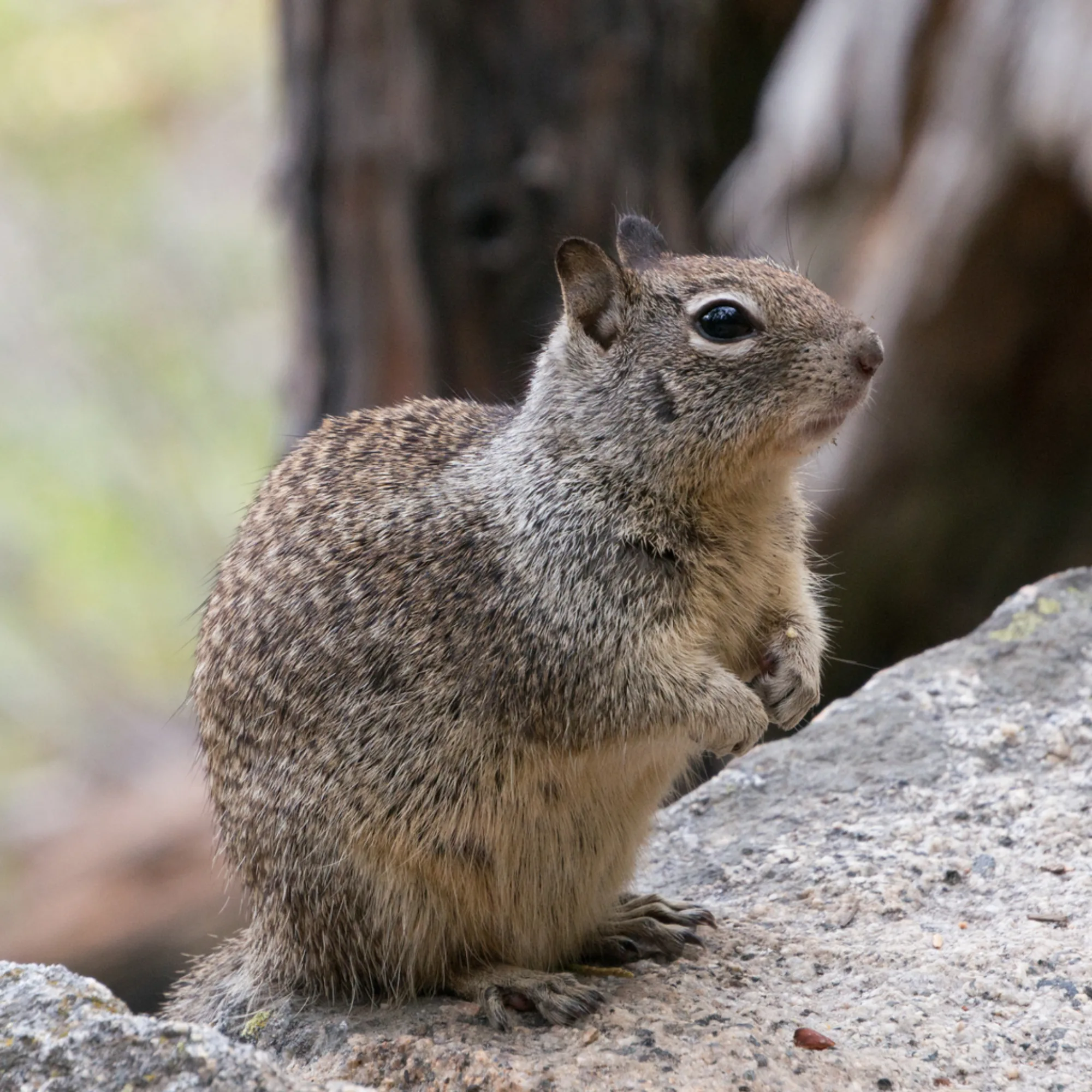
Across much of California, the California Ground Squirrel is a common sight, with a range that also includes the Baja California Peninsula and parts of northeastern Nevada around Reno and Lake Tahoe. Its upper coat mixes grey, light brown and dusky hairs, with paler shoulders and neck, whitish fur around the eyes and a light underside. The head and body measure about 30 cm, with a relatively bushy tail adding another 15 centimetres. It tends to avoid desert regions, where food and cover are scarce. Look for it close to a burrow: it spends most of its time within 25 m of one and rarely travels farther than 50 m away.
These squirrels dig their own burrows, sometimes sharing a system while maintaining separate entrances. The burrows serve as places to sleep, store food, rear young and retreat, and colonies can hold 2 to 20 squirrels. They may appear at any time of day, though they favour foraging in the early morning or late afternoon and early evening. Seeds, grains, nuts and fruit make up much of their diet, along with occasional roots, while insects and even voles are also eaten. They carry food back to their burrows in cheek pouches. In colder areas they hibernate for several months, while in hot summers they may spend a few days estivating. Breeding takes place in early spring, and each female has one litter of five to eleven young a year. Rattlesnakes frequently prey on the squirrels, which also face eagles, foxes, badgers, raccoons and weasels. A squirrel may wave its tail to deter a snake or alert others to a predator nearby.
Written from the English Wikipedia article California ground squirrel (CC BY-SA 4.0).
- Records
- 6,900
- Countries
- 2
- Atlas places
- 4
These are open occurrence records, so they show where people looked for and recorded the California Ground Squirrel as much as where it lives. Cells are up to 25 km across, and every location is generalised to its cell.
Generalised encounter areas, not exact locations. Each shape is a grid cell coloured by how likely the species is there.
- Very likelyUnited States25 km zone · high confidence · 6617 records · updated 80 days ago
- Very likelyMexico25 km zone · medium confidence · 283 records · updated 80 days ago
Conservation status not assessed here yet, so every location is generalised to its grid cell.