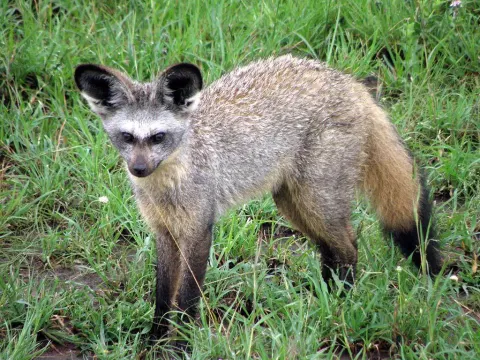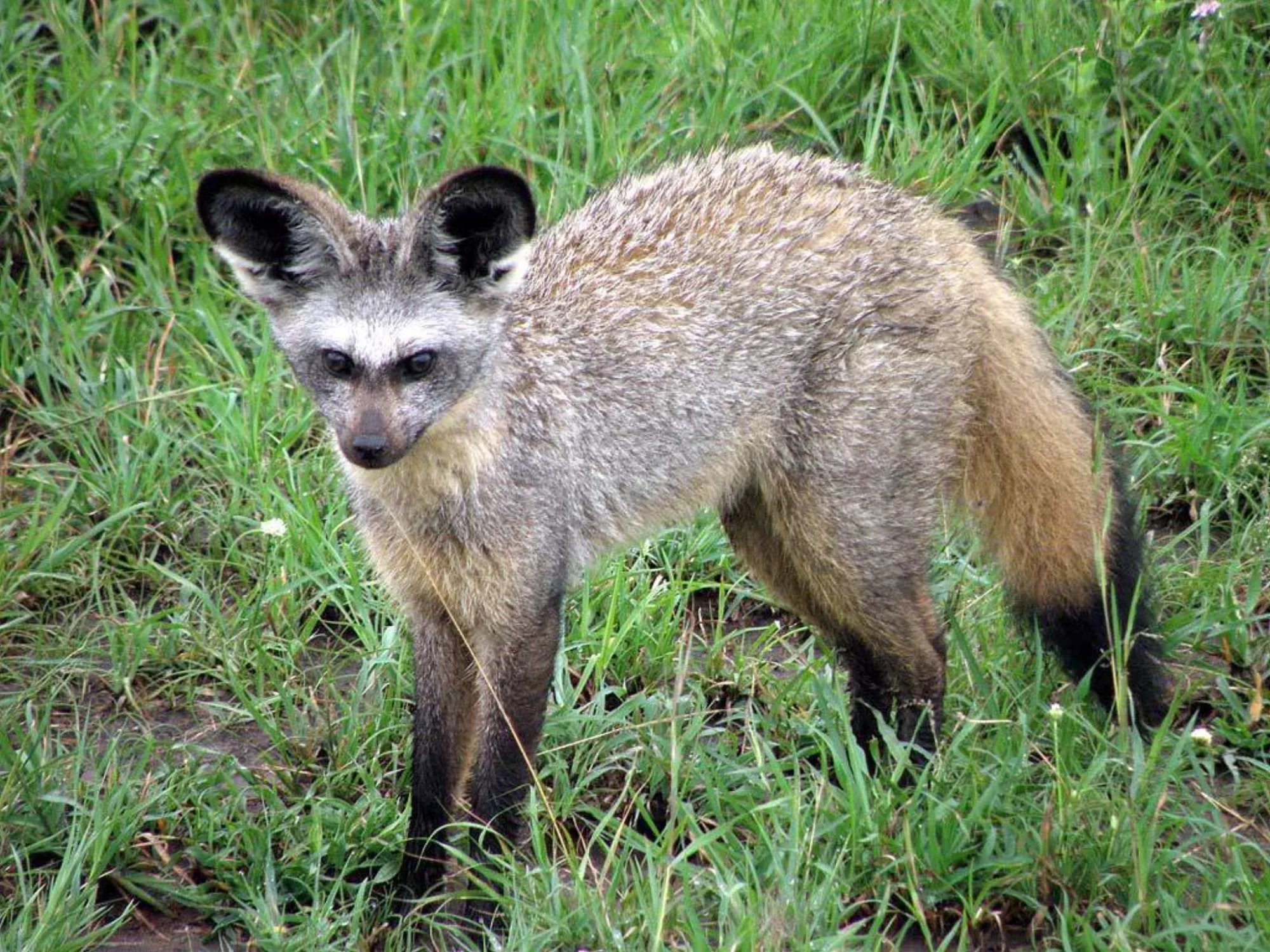
Bat-eared Fox
Otocyon megalotis
Enormous ears give the Bat-eared Fox its name and help it both find prey and release heat. This small African canid usually has a tan coat, a pale throat and underside, dark legs and a black facial mask. Its ears are white inside, while the tip and upper side of its tail are black.
Two separate populations live in eastern and southern Africa, with about 1,000 km between them. Look for them in dry and semi-dry country, including short grasslands, open acacia woodland and the edges of woodland. They favour bare ground and places where grazing animals keep the grass short, but may retreat into taller grass and thick shrubs when threatened. They dig dens for shelter from harsh weather and for raising young, and sometimes rest in the shade of acacia trees.
Bat-eared foxes live in pairs or family groups, foraging, playing and resting together. Around South Africa, they are active at night in summer and during the day in winter. Insects dominate their diet, especially harvester termites, though they also eat other small creatures, berries, seeds and wild fruit. While searching for food, they walk slowly with their noses near the ground and ears angled forwards, listening for prey. Females give birth to one to six pups, and males take on much of their care, including grooming, guarding and carrying them between dens. Hunting, disease and drought can reduce numbers temporarily, and the foxes have been hunted for their fur. Large carnivores, raptors and the Central African rock python also prey on them, while black-backed jackals are a particular danger to pups.
Written from the English Wikipedia article Bat-eared fox (CC BY-SA 4.0).
- Records
- 7
- Countries
- 5
- Atlas places
- 7
These are open occurrence records, so they show where people looked for and recorded the Bat-eared Fox as much as where it lives. Cells are up to 25 km across, and every location is generalised to its cell.
Generalised encounter areas, not exact locations. Each shape is a grid cell coloured by how likely the species is there.
- Very likelyKenya25 km zone · medium confidence · 6 records · updated 80 days ago
- LikelyNamibia25 km zone · medium confidence · 1 record · updated 80 days ago
- LikelySouth Africa25 km zone · low confidence · 0 records · updated 80 days ago
- UncommonTanzania25 km zone · low confidence · 0 records · updated 80 days ago
Conservation status not assessed here yet, so every location is generalised to its grid cell.