Manul
Otocolobus manul
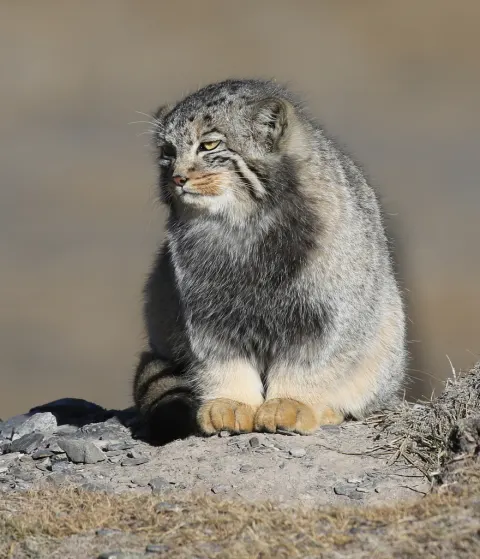
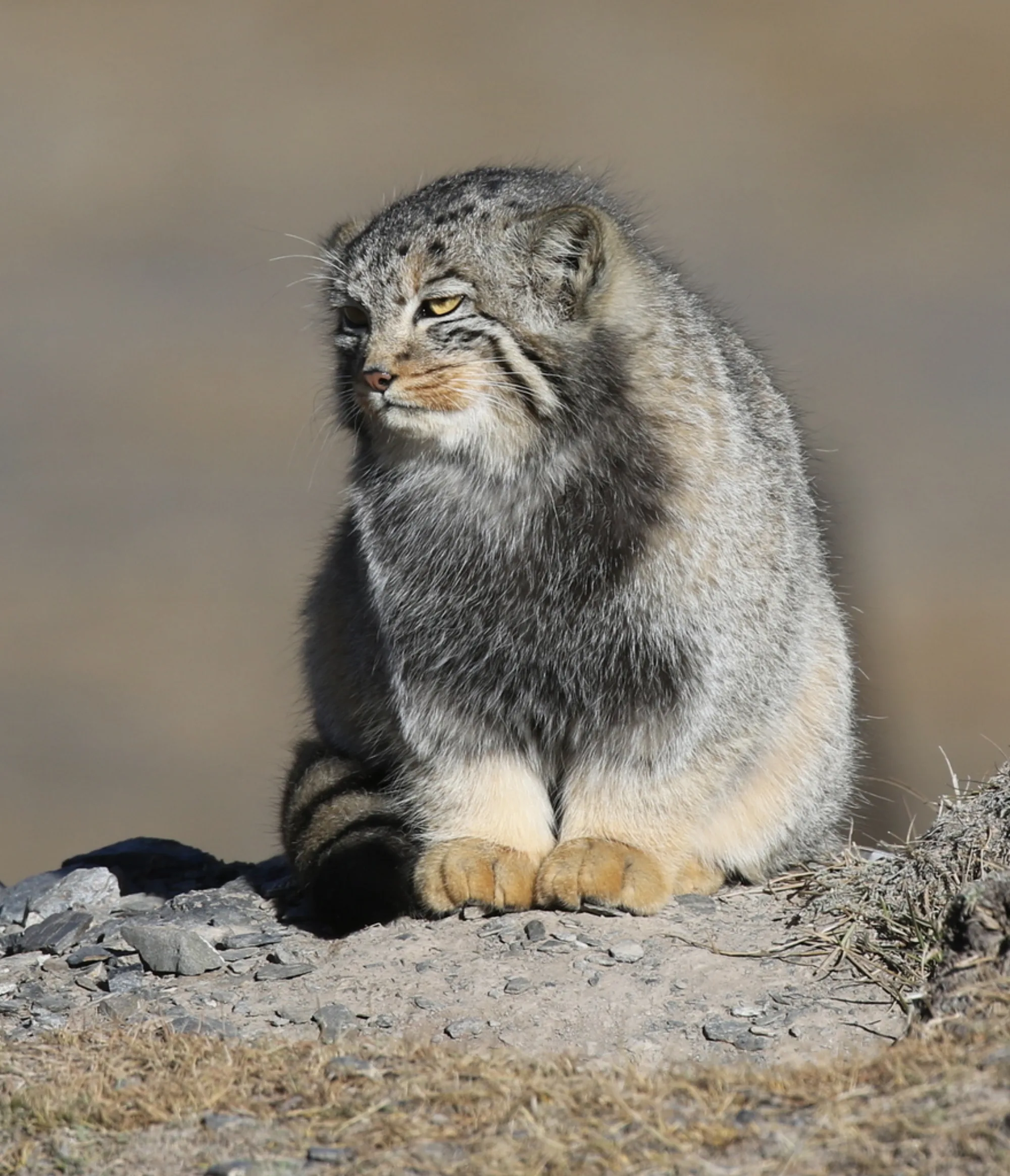
With its dense grey coat, low-set rounded ears and stocky build, the Manul looks plush but is a wild cat about the size of a domestic one. Its fur becomes greyer and denser in winter, while the bushy grey tail has narrow black rings and a black tip. Small dark spots mark the forehead, and two black zigzag lines run across each cheek.
Records span a wide area from the Caucasus through Central Asia to Mongolia, the Tibetan Plateau and parts of the Himalayas, though sites are widely spaced. The cat lives among rocky mountain grasslands and shrublands, as well as on scree slopes and in ravines. In central parts of its range, it occupies hills, high plateaus and valleys with dry steppe or semi-desert vegetation. Rocky, rugged steppe provides cover and camouflage in Mongolian parks where it has been recorded.
Solitary by nature, the Manul shelters in caves, rock crevices and marmot burrows. In central Mongolia, it was mainly active around dawn and dusk from May to August, but active during the day from September to November. It stalks small mammals or waits to ambush them near burrow exits, and can pull rodents from shallow burrows with its paws. Its prey includes pikas and rodents, while remains of birds and insects have also appeared in its droppings. Wild females have litters of two to six kittens, born from late April through late May. Threats include poaching, dogs, traps set for small mammals, and the loss of prey associated with rodent control. Mining and infrastructure projects may also fragment its habitat.
Written from the English Wikipedia article Pallas's cat (CC BY-SA 4.0).
- Records
- 0
- Countries
- 1
No atlas park has a record of the Manul in or around it yet.
These are open occurrence records, so they show where people looked for and recorded the Manul as much as where it lives. Cells are up to 25 km across, and every location is generalised to its cell.
Generalised encounter areas, not exact locations. Each shape is a grid cell coloured by how likely the species is there.
- Very likelyChina25 km zone · low confidence · 0 records · updated 80 days ago
Conservation status not assessed here yet, so every location is generalised to its grid cell.