Great Bustard
Otis tarda
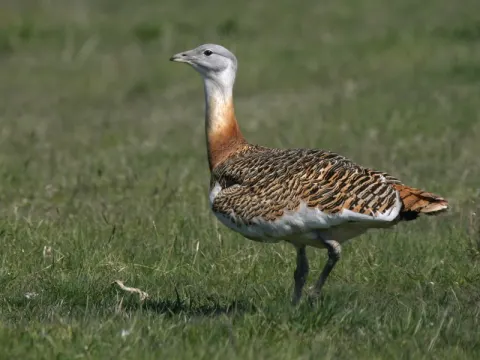
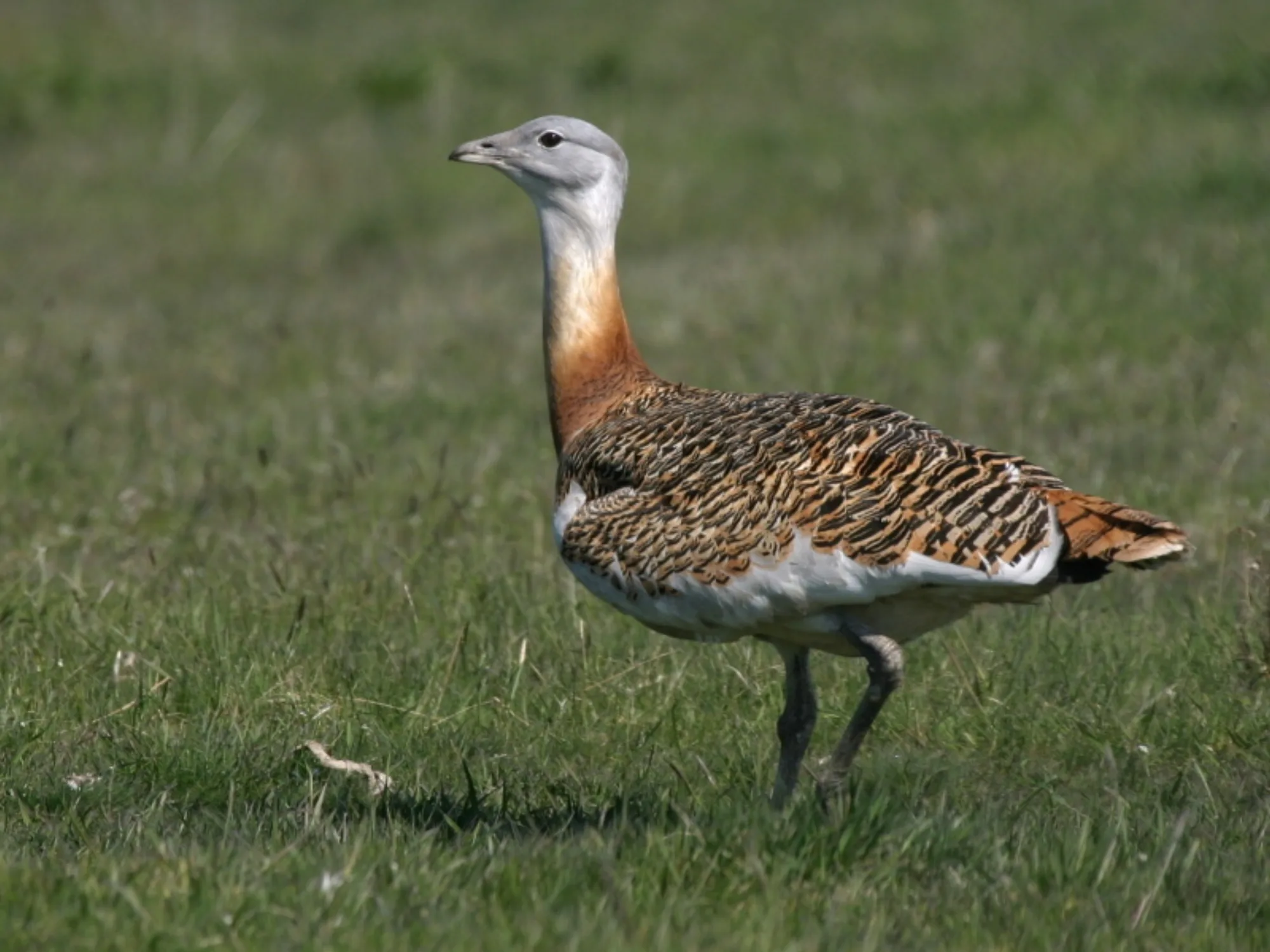
With its long legs, long neck and heavy body, the Great Bustard cuts a distinctive figure in open country. The adult male has a grey head and neck, a brown back marked with black, and white underparts; his breast is chestnut. During the breeding season he develops long white neck bristles, while his wings show mostly white in flight. The smaller female has a buff breast and neck, with brown and pale plumage that helps conceal her in open habitat.
Great Bustards breed across a broad range from northern Morocco and southern and central Europe to temperate central and eastern Asia. Look for them in open grassland, steppe and farmland, including fields with cereals, vineyards or fodder crops. European birds are mainly resident, while Asian populations travel farther south for winter. Usually quiet, they walk slowly and tend to run when disturbed, although they are strong fliers. They gather in groups, particularly in winter, when several dozen may be together. Their varied diet includes green plants, seeds and insects, with insects especially important to chicks in their first summer.
In spring, males display to attract females, spreading their white feathers into a conspicuous show. Females lay one to three eggs in shallow ground nests, usually on dry slopes or plains. Chicks leave the nest soon after hatching and stay close to their mother. Grassland ploughing, intensive farming and infrastructure can deprive bustards of habitat, while agricultural work can disturb nests. Pesticides and machinery threaten young birds, and collisions with overhead electricity cables can kill adults.
Written from the English Wikipedia article Great bustard (CC BY-SA 4.0).
- Records
- 41,849
- Countries
- 16
No atlas park has a record of the Great Bustard in or around it yet.
These are open occurrence records, so they show where people looked for and recorded the Great Bustard as much as where it lives. Cells are up to 25 km across, and every location is generalised to its cell.
Generalised encounter areas, not exact locations. Each shape is a grid cell coloured by how likely the species is there.
- Very likelySpain25 km zone · high confidence · 32225 records · updated 80 days ago
- Very likelyPortugal25 km zone · high confidence · 5223 records · updated 80 days ago
- Very likelyHungary25 km zone · high confidence · 1768 records · updated 80 days ago
- Very likelyAustria25 km zone · high confidence · 762 records · updated 80 days ago
- Very likelyGermany25 km zone · high confidence · 717 records · updated 80 days ago
- Very likelyBelgium25 km zone · high confidence · 324 records · updated 80 days ago
- LikelyChina25 km zone · high confidence · 294 records · updated 80 days ago
- LikelyUnited Kingdom25 km zone · medium confidence · 185 records · updated 80 days ago
- LikelyUkraine25 km zone · medium confidence · 69 records · updated 80 days ago
- LikelyIran25 km zone · medium confidence · 55 records · updated 80 days ago
Conservation status not assessed here yet, so every location is generalised to its grid cell.