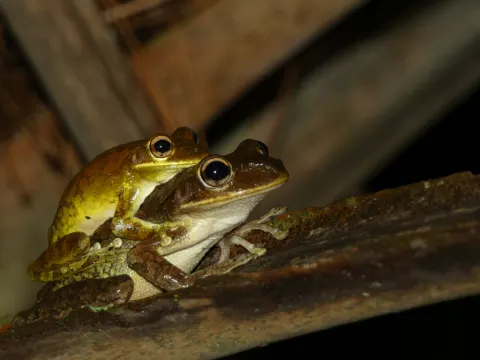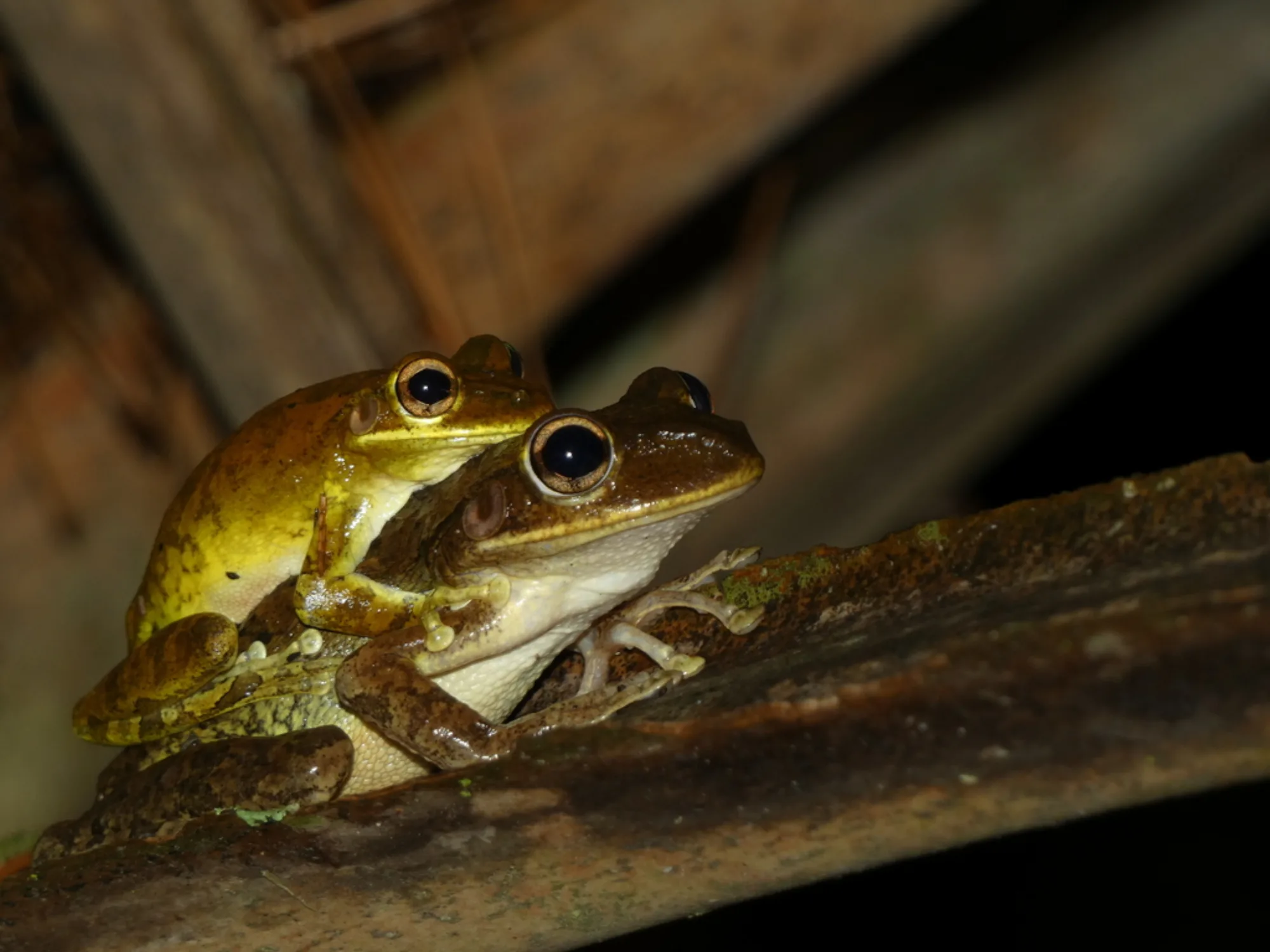
Cuban Treefrog
Osteopilus septentrionalis
Broad sticky toe pads help the Cuban Treefrog move among trees, while its rough, warty skin carries a blotched or mottled pattern. This large frog measures 5 to 12.7 cm long and is usually grey, brown or green, with younger frogs showing more green than adults. It can change its colour and pattern for camouflage, but a leap reveals bright yellow on its inner thighs, which can confuse a predator.
Its original range includes Cuba, the Cayman Islands and the Bahamas; established populations now also live in places including Florida and Oahu. Its habitats range from lowland forests and swamps to estuaries, farmland, small towns and suburban areas. Look for it in damp shade around shrubs and trees, or near buildings, cisterns and rain barrels. It sometimes sleeps on palm trees or in potted plants, and is mainly active at night, when it favours hunting and breeding.
The frog eats a wide variety of animals that fit in its mouth, including smaller frogs, while its tadpoles feed on algae and sometimes other tadpoles. Breeding can take place throughout the year when conditions allow, though wetter months are favoured. A female may lay several hundred to over a thousand eggs in one clutch; hatching can take less than 30 hours, and the young can develop fully within one month. Snakes, American crows, Cuban knight anoles and humans prey on these frogs, although toxic skin mucus helps limit their natural predators. In places where it has spread, its appetite threatens native frogs, lizards and snakes, and some experts have recommended killing it when found in a new habitat.
Written from the English Wikipedia article Cuban tree frog (CC BY-SA 4.0).
- Records
- 6,008
- Countries
- 13
- Atlas places
- 1
These are open occurrence records, so they show where people looked for and recorded the Cuban Treefrog as much as where it lives. Cells are up to 25 km across, and every location is generalised to its cell.
Generalised encounter areas, not exact locations. Each shape is a grid cell coloured by how likely the species is there.
- Very likelyUnited States25 km zone · high confidence · 5436 records · updated 80 days ago
- Very likelyCayman Islands25 km zone · high confidence · 224 records · updated 80 days ago
- Very likelyCuba25 km zone · high confidence · 192 records · updated 80 days ago
- Very likelyBritish Virgin Islands25 km zone · high confidence · 77 records · updated 80 days ago
- LikelyPuerto Rico25 km zone · medium confidence · 35 records · updated 80 days ago
- LikelyU.S. Virgin Islands25 km zone · medium confidence · 19 records · updated 80 days ago
- PossibleBahamas25 km zone · medium confidence · 12 records · updated 80 days ago
- PossibleSint Maarten25 km zone · medium confidence · 4 records · updated 80 days ago
- PossibleSt. Martin25 km zone · medium confidence · 3 records · updated 80 days ago
- PossibleAntigua & Barbuda25 km zone · medium confidence · 2 records · updated 80 days ago
Conservation status not assessed here yet, so every location is generalised to its grid cell.