Giant Gourami
Osphronemus goramy
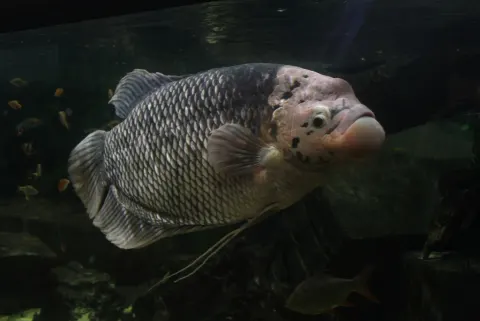
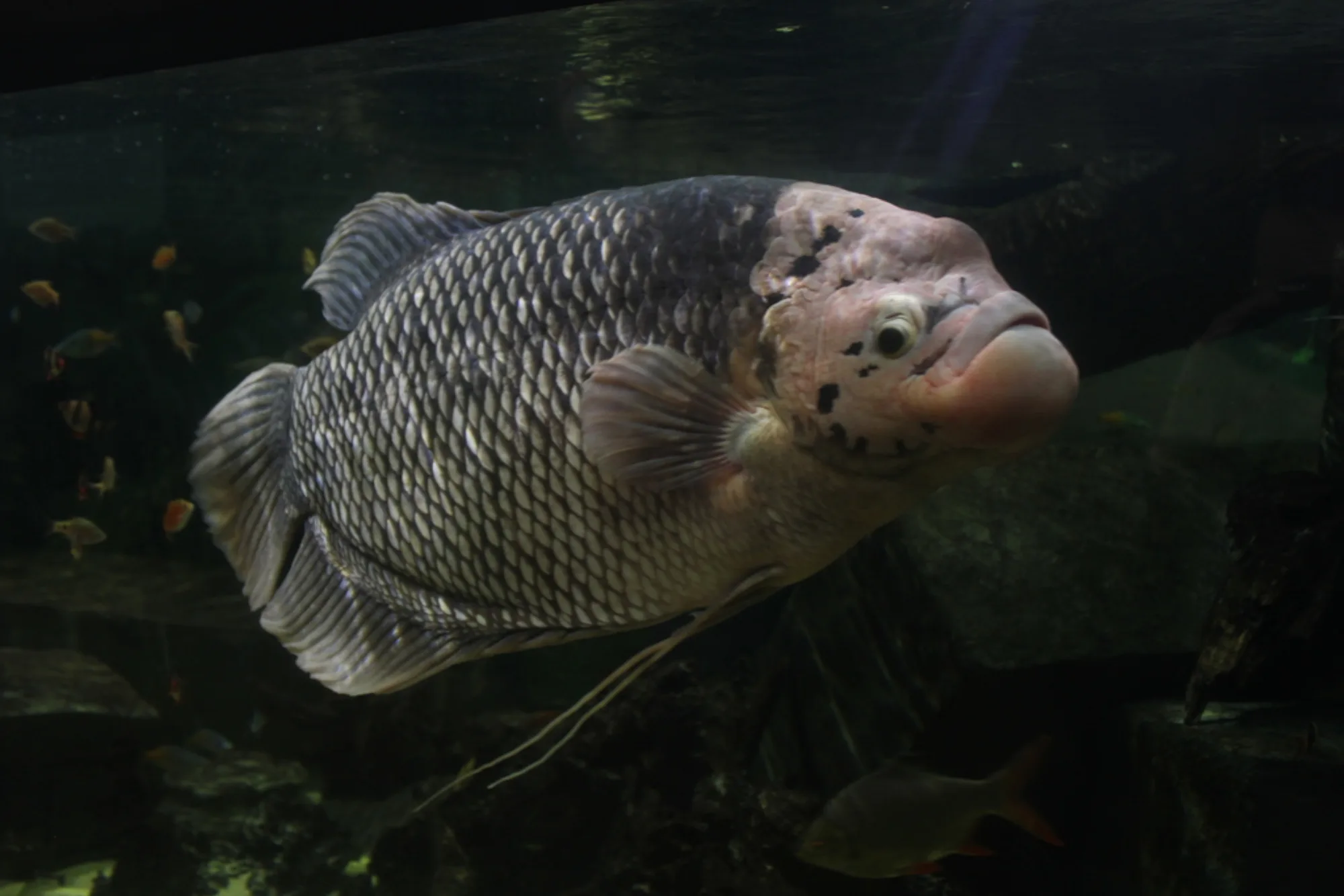
Much larger than most of its relatives, the Giant Gourami is a freshwater fish native to Southeast Asia. It can reach 80 cm in standard length, although most are around 45 cm. Young fish have a pronounced beak, while mature adults develop a rounded face and a hump above the eyes. During spawning, the male's body darkens, becoming nearly black.
Its native waters include rivers, streams, marshes, swamps and lakes, from the lower Mekong in Cambodia and Vietnam to river basins of the Malay Peninsula, Java and Sumatra. The boundaries of its natural range are uncertain, partly because it has been confused with related fish and widely released beyond that range. Introduced populations occur in southern China, India and Sri Lanka, as well as in Australia, Mauritius, Réunion and Madagascar. Able to breathe moist air, the fish can survive for long periods out of water.
In the wild, it eats fish, frogs, earthworms and sometimes dead animals, along with aquatic weeds. It tends towards plant food and favours algae-based foods, although it also eats meat. Giant gouramis lay eggs in a nest built from plant fibres, with both parents taking part in construction and the male apparently doing more. In captivity, the male guards the eggs after spawning and can become aggressive towards the female. The fish is harvested as a customary food source in its native regions and is highly valued in Southeast Asian markets. It is also farmed and kept in aquariums. The information provided does not say whether harvesting or other pressures threaten wild populations.
Written from the English Wikipedia article Giant gourami (CC BY-SA 4.0).
- Records
- 17
- Countries
- 5
- Atlas places
- 1
These are open occurrence records, so they show where people looked for and recorded the Giant Gourami as much as where it lives. Cells are up to 25 km across, and every location is generalised to its cell.
Generalised encounter areas, not exact locations. Each shape is a grid cell coloured by how likely the species is there.
- Very likelyMalaysia25 km zone · medium confidence · 9 records · updated 80 days ago
- Very likelyIndonesia25 km zone · medium confidence · 4 records · updated 80 days ago
- LikelyThailand25 km zone · medium confidence · 3 records · updated 80 days ago
- PossibleSingapore25 km zone · medium confidence · 1 record · updated 80 days ago
- PossibleSri Lanka25 km zone · low confidence · 0 records · updated 80 days ago
Conservation status not assessed here yet, so every location is generalised to its grid cell.