Blue Flier
Osphranter rufus
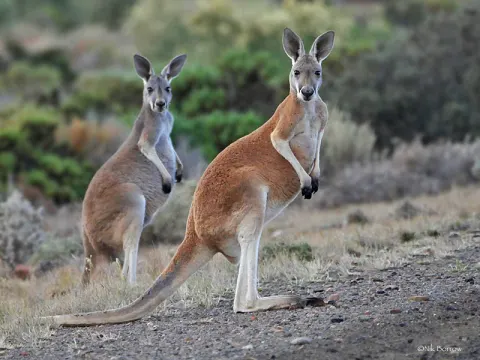
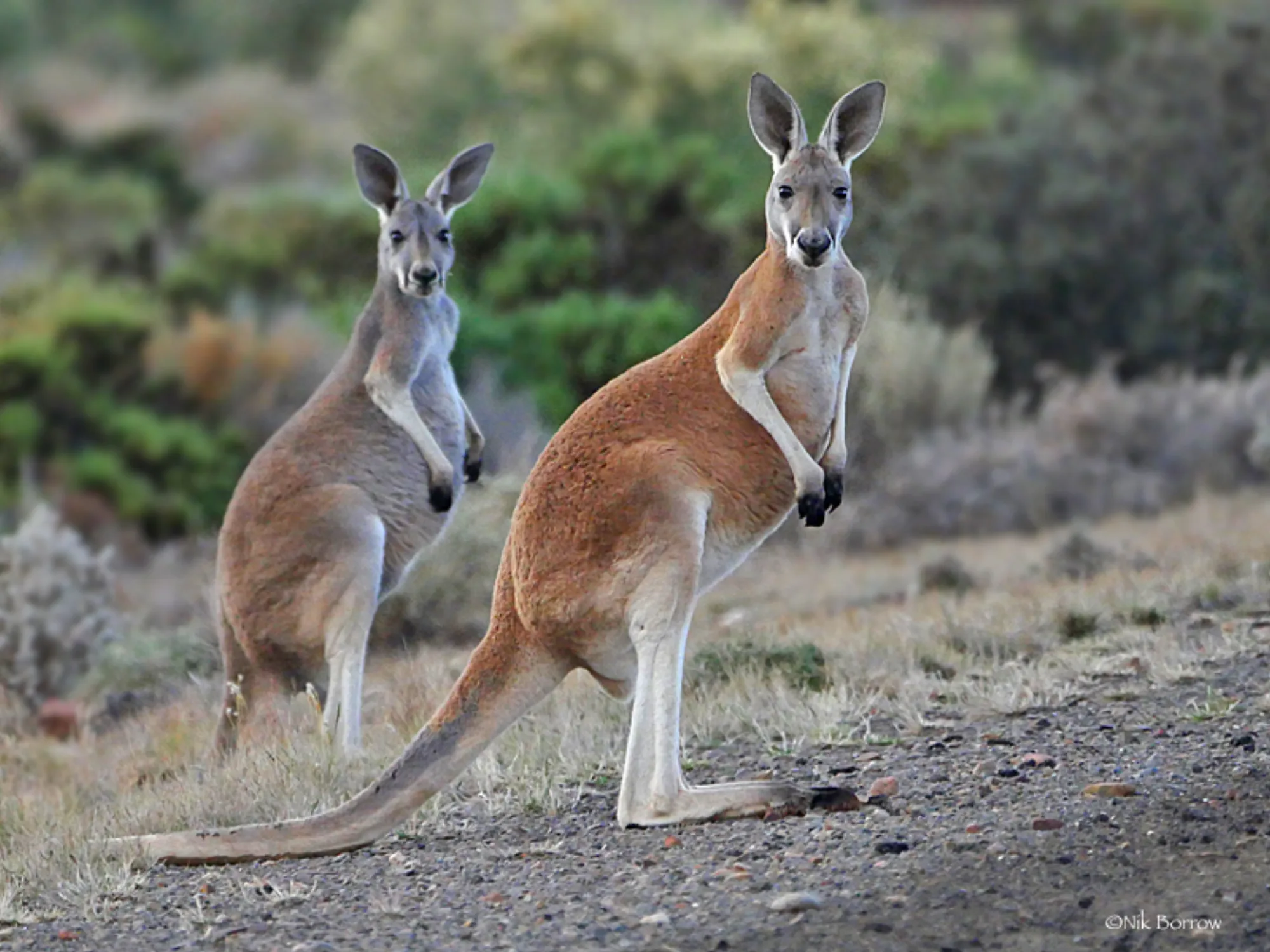
Across the open country of western and central Australia, the Blue Flier moves through scrubland, grassland and desert. It is the largest kangaroo, with long, pointed ears, a square muzzle, powerful hind legs and a strong tail. Males have short red-brown fur, paler underneath and on the limbs. Females are smaller and generally blue-grey with a brown tinge, though those in arid areas are coloured more like males. When standing upright, a kangaroo often uses its tail for support.
Open habitats with some trees provide shade, and small saltbushes or mulga bushes offer shelter in extreme heat. Red kangaroos are most active around twilight and at night, usually resting in shade during the day, although they sometimes move about then too. Grazing occupies much of their time: they favour fresh green grasses and other flowering plants, and browse shrubs when preferred food is scarce. They can go for long periods without drinking, obtaining moisture from vegetation. Usually they remain within a defined home range, but when forage is poor and rain patchy, they may travel 25 to 30 km to better feeding grounds. Groups commonly consist of females and their young, with membership changing freely.
Breeding takes place throughout the year, usually producing one young at a time. A joey first emerges fully from the pouch at about 190 days and leaves it for the last time at around 235 days. Dingoes and birds of prey can take joeys, while dingoes and wedge-tailed eagles occasionally kill adults. Red kangaroos also face competition from livestock and rabbits, shooting by farmers, vehicle collisions and regulated harvesting for meat and hides.
Written from the English Wikipedia article Red kangaroo (CC BY-SA 4.0).
- Records
- 54,732
- Countries
- 1
No atlas park has a record of the Blue Flier in or around it yet.
These are open occurrence records, so they show where people looked for and recorded the Blue Flier as much as where it lives. Cells are up to 25 km across, and every location is generalised to its cell.
Generalised encounter areas, not exact locations. Each shape is a grid cell coloured by how likely the species is there.
- Very likelyAustralia25 km zone · high confidence · 54732 records · updated 81 days ago
Conservation status not assessed here yet, so every location is generalised to its grid cell.