Antilopine Kangaroo
Osphranter antilopinus
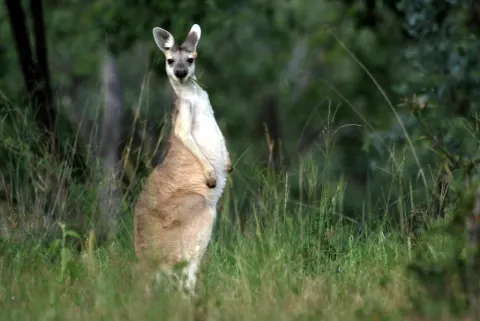
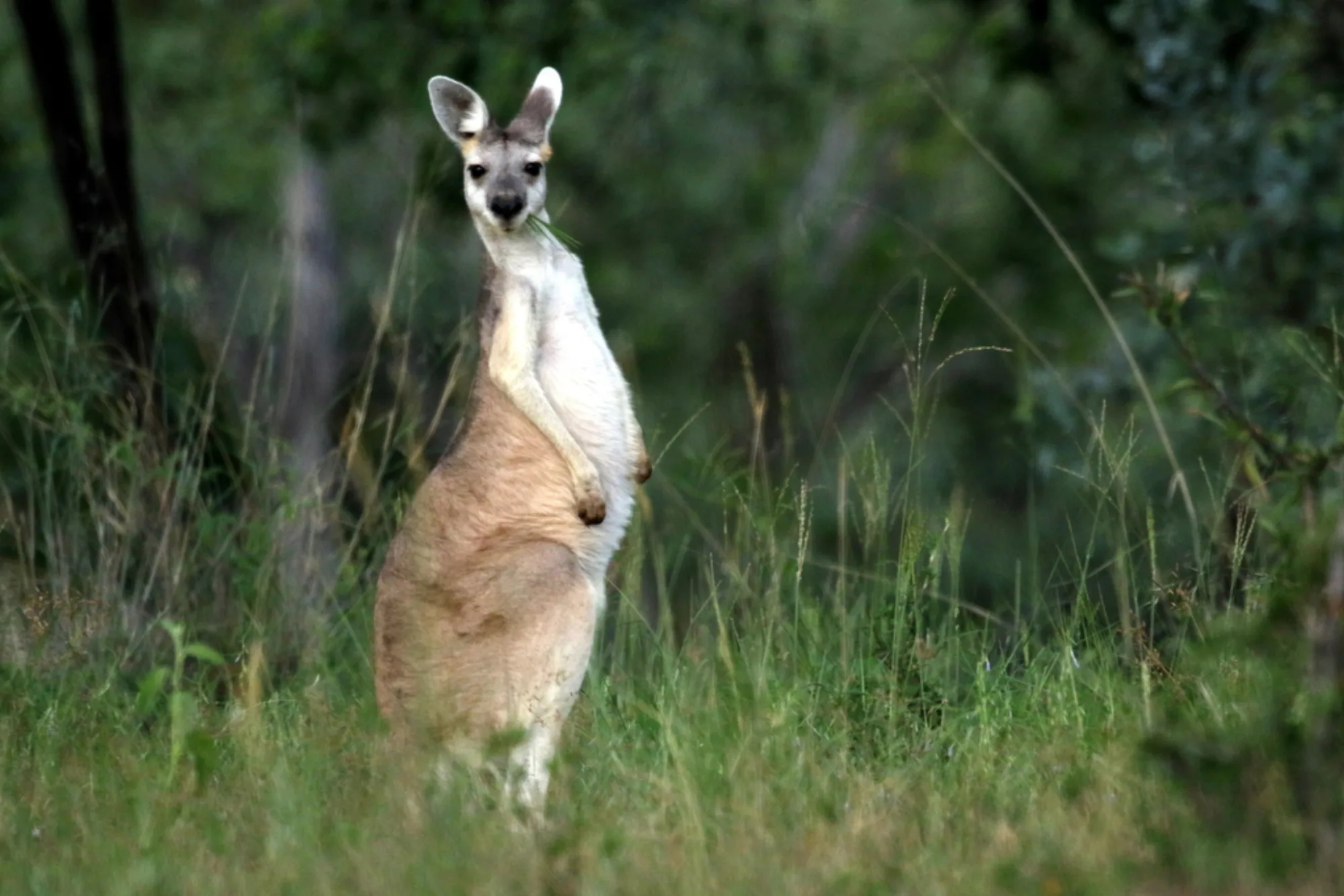
Across the tropical north of Australia, the Antilopine Kangaroo is a large, sociable grazer with long, slender limbs and short fur. Males are mostly reddish above, while females are lighter and greyer, especially around the head and shoulders. Look for the pale stripe or patch low on the head, dark paws and a thickly furred tail that is paler than the upper body. Males can reach 1.2 metres in head and body length, while females can reach 840 mm; standing height is approximately 1.1 metres.
Its range reaches inland from the northern coast, spanning the Kimberley, the Top End and parts of Cape York. It favours tropical country below 500 metres, where perennial grasses grow on plains and lower hills. These grasslands occur among open or regenerating eucalypt woodlands and on plains without trees, though the kangaroo's distribution within its broad range is patchy. A traveller might see one alone or with one or two others; groups can reach 30, though these gatherings may form in response to people or dingoes.
During rainy periods, the kangaroos may feed by day or night, but in the dry season they forage later in the day. They sometimes gather at waterholes alongside other macropods, and warn one another of danger with a hiss or a thump of the foot. Breeding can take place throughout the year, with births tending to come before the northern wet season begins. Some local populations have declined, and possible pressures include expanding pastoral land use, changes to fire patterns and hunting.
Written from the English Wikipedia article Antilopine kangaroo (CC BY-SA 4.0).
- Records
- 3,697
- Countries
- 1
- Atlas places
- 1
These are open occurrence records, so they show where people looked for and recorded the Antilopine Kangaroo as much as where it lives. Cells are up to 25 km across, and every location is generalised to its cell.
Generalised encounter areas, not exact locations. Each shape is a grid cell coloured by how likely the species is there.
- Very likelyAustralia25 km zone · medium confidence · 3697 records · updated 80 days ago
Conservation status not assessed here yet, so every location is generalised to its grid cell.