Japanese Medaka
Oryzias latipes
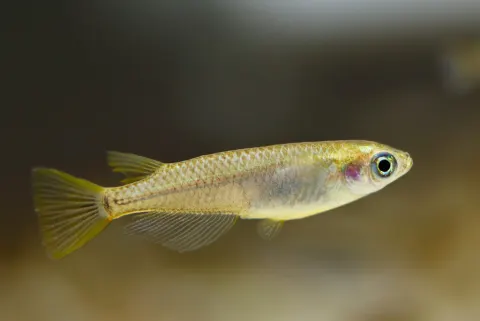
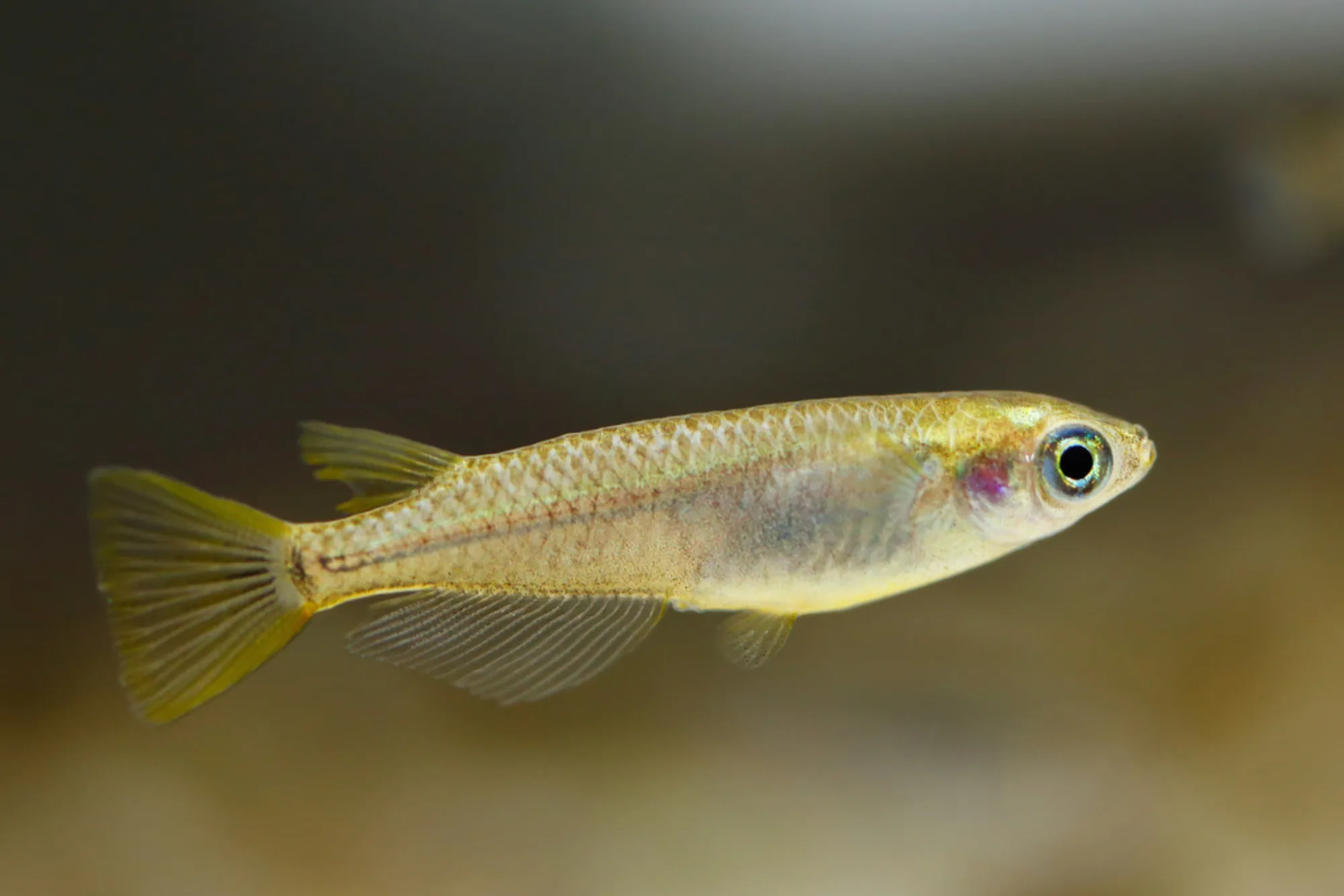
Small enough to overlook, the Japanese Medaka is a rice fish native to Japan that grows to about 3.6 cm. Wild fish range in colour from creamy white to yellowish, while aquarium-bred fish can also be orange. It lives in schools, and individuals can recognise the faces of other medaka.
Its native range covers Shikoku, Kyushu and smaller islands in southern Japan, as well as the east and south of Honshu. It has also been introduced to Hokkaido, where ricefish are not native. Look for it in marshes and rice paddies, as well as ponds, tide pools and slow-moving streams. The fish can live in fresh, brackish and salt water, and can survive temperatures from 0 to 42 °C, although it favours 15 to 28 °C. It eats juvenile mosquitoes and small plankton. Breeding is seasonal, with eggs usually laid between spring and summer, often around water grass. Females carry their eggs for a time, then leave them on plants or similar surfaces. The eggs usually hatch in 4 to 10 days, and the estimated average lifespan in the wild is 2 years.
Modernisation of rice fields and irrigation canals is reducing places suitable for reproduction. Released domestic medaka can breed with wild fish, threatening local genetic adaptations; their orange hybrids may also draw more predators. Artificial releases have mixed wild sub-populations as well, reducing local genetic diversity. Invasive mosquitofish share medaka habitat and compete with them, and attacks by mosquitofish have injured medaka fins. A fluorescent transgenic line has also been released into the wild, causing genetic pollution. Local communities in Japan are working to preserve wild medaka.
Written from the English Wikipedia article Japanese rice fish (CC BY-SA 4.0).
- Records
- 294
- Countries
- 2
No atlas park has a record of the Japanese Medaka in or around it yet.
These are open occurrence records, so they show where people looked for and recorded the Japanese Medaka as much as where it lives. Cells are up to 25 km across, and every location is generalised to its cell.
Generalised encounter areas, not exact locations. Each shape is a grid cell coloured by how likely the species is there.
- Very likelySouth Korea25 km zone · medium confidence · 179 records · updated 80 days ago
- Very likelyJapan25 km zone · medium confidence · 115 records · updated 80 days ago
Conservation status not assessed here yet, so every location is generalised to its grid cell.