Arabian Oryx
Oryx leucoryx
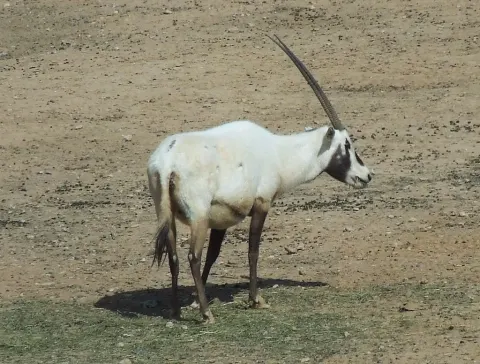
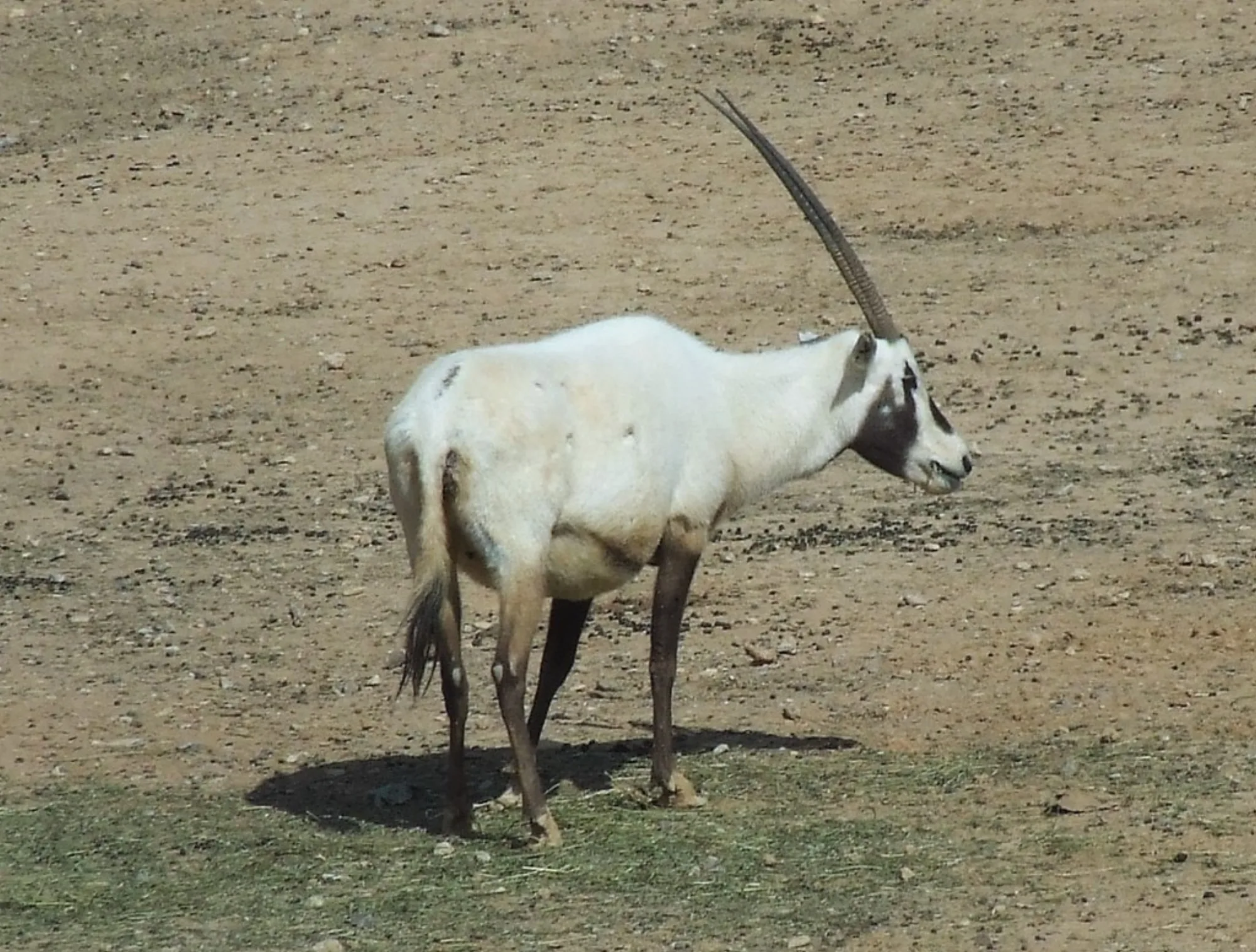
With a pale coat and long, near-straight horns, the Arabian Oryx is a distinctive antelope of the Arabian Peninsula. Its coat is almost luminous white, with brown legs and underparts and black markings across the face. Both sexes carry ringed horns, and a shoulder bump and tufted tail add to its outline. It favours gravel desert and hard sand, including the firm flats between softer dunes and ridges. Once found across much of the Middle East, it has returned to parts of its range through reintroductions in Jordan, Syria, Oman, Saudi Arabia and the United Arab Emirates; Bahrain's Hawar Island also has a small introduced population.
Herds usually contain 2 to 15 animals of both sexes, although groups of up to 100 have been reported. They keep in visual contact, and displays help establish a hierarchy without risking serious injury from their horns. During the heat of the day, oryxes rest in shallow hollows they dig beneath shrubs or trees. In summer droughts, they may lie inactive under shade trees by day and cover smaller areas at night in search of food. Grasses make up much of their diet, supplemented by buds, herbs, fruit, tubers and roots. They follow infrequent rain towards fresh growth and can spend several weeks without water.
Hunting with vehicles and rifles contributed to the oryx's disappearance from the wild by 1972, before reintroductions began in 1980. Drought can shorten its life through malnutrition and dehydration, while disease, snakebites and floods are other causes of death. In Oman, oil prospecting affected a sanctuary where the population fell sharply, leaving fewer than four breeding pairs in 2007.
Written from the English Wikipedia article Arabian oryx (CC BY-SA 4.0).
- Records
- 11
- Countries
- 2
No atlas park has a record of the Arabian Oryx in or around it yet.
These are open occurrence records, so they show where people looked for and recorded the Arabian Oryx as much as where it lives. Cells are up to 25 km across, and every location is generalised to its cell.
Generalised encounter areas, not exact locations. Each shape is a grid cell coloured by how likely the species is there.
- Very likelyUnited Arab Emirates25 km zone · medium confidence · 11 records · updated 80 days ago
- UncommonIsrael25 km zone · low confidence · 0 records · updated 80 days ago
Conservation status not assessed here yet, so every location is generalised to its grid cell.