Scimitar-horned Oryx
Oryx dammah
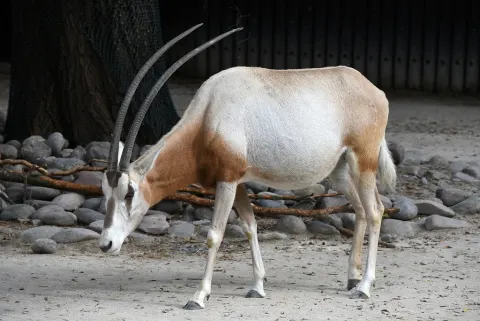
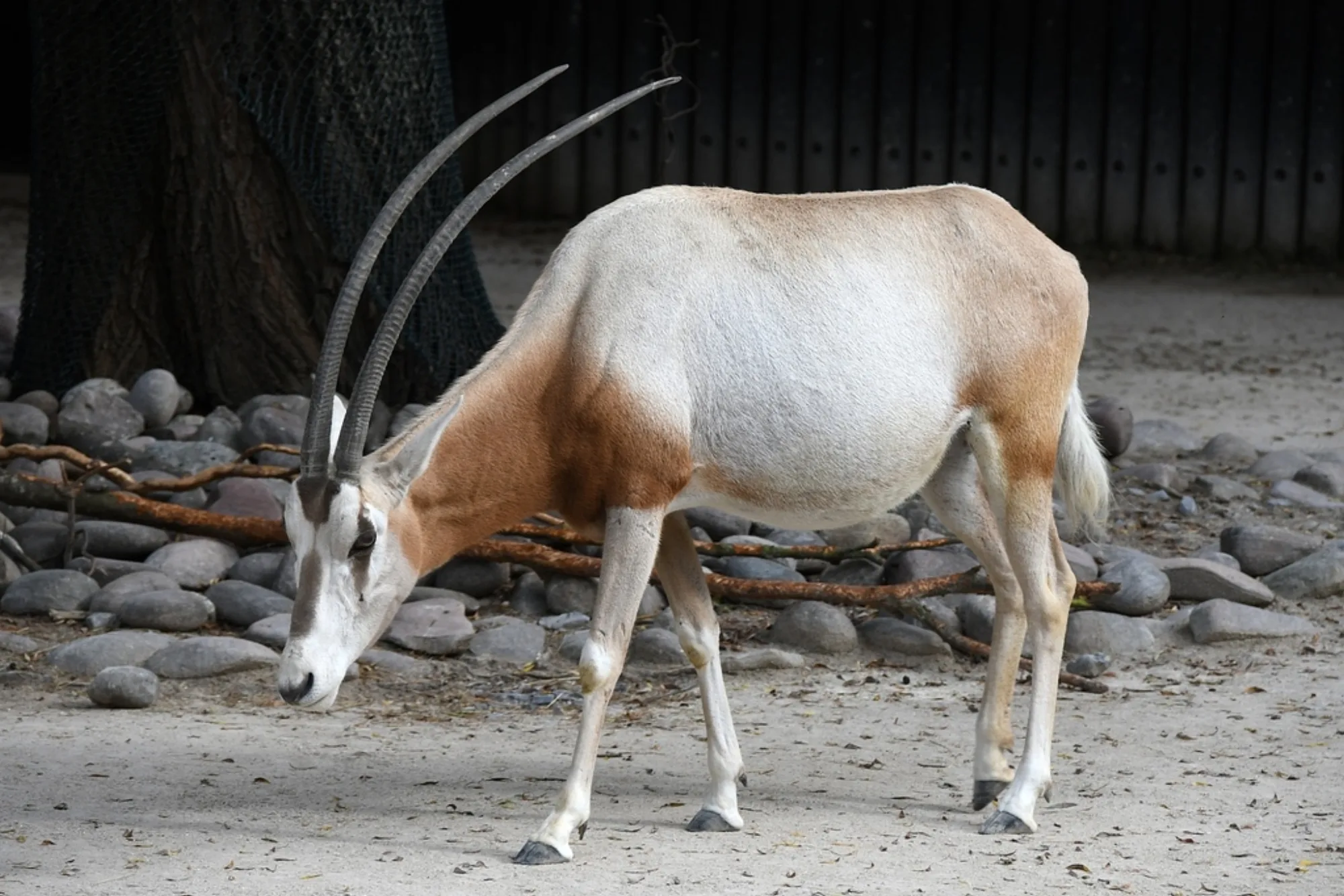
Long, slender horns sweep backwards from the head of the Scimitar-horned Oryx, an antelope named for their resemblance to curved swords. Both sexes carry horns, measuring up to 1.0 to 1.2 m, though those of females are more slender. Against its white coat, the chest is red-brown and the forehead and nose are marked in black; its tail ends in a tuft. Standing just over 1 m at the shoulder, it has broad, spreading hooves suited to walking on sand.
The oryx formerly ranged widely through North Africa and into areas of West and Central Africa, living in grassy steppes, semideserts and deserts along the Sahara's fringes. A small herd has been reintroduced in Chad, including animals released in the Ouadi Rimé-Ouadi Achim reserve. Oryxes are active by day and rest beneath trees or shrubs in the cool of early morning and evening, sometimes digging hollows when shade is unavailable. They travelled in herds generally led by a dominant male, and once assembled in groups of several thousand to migrate north during the wet season. Grazing and browsing provide a varied diet of grasses, leaves, herbs, shrubs, roots, buds and fruit. Plants also supply most of their daily moisture, allowing them to spend months without drinking.
After a pregnancy of about nine months, a female gives birth to a single calf, which hides away from the herd while its mother returns to the group. As the Sahara dried, suitable habitat was lost, and hunting for meat, hides and horns further reduced populations. Roadkill, settlements near watering holes, cattle and firearms have also contributed to the decline.
Written from the English Wikipedia article Scimitar oryx (CC BY-SA 4.0).
- Records
- 7
- Countries
- 3
No atlas park has a record of the Scimitar-horned Oryx in or around it yet.
These are open occurrence records, so they show where people looked for and recorded the Scimitar-horned Oryx as much as where it lives. Cells are up to 25 km across, and every location is generalised to its cell.
Generalised encounter areas, not exact locations. Each shape is a grid cell coloured by how likely the species is there.
- Very likelyUnited States25 km zone · medium confidence · 6 records · updated 80 days ago
- LikelyMorocco25 km zone · medium confidence · 1 record · updated 80 days ago
- UncommonTunisia25 km zone · low confidence · 0 records · updated 80 days ago
Conservation status not assessed here yet, so every location is generalised to its grid cell.