Aardvark
Orycteropus afer
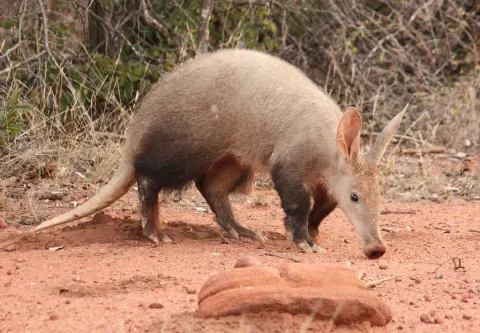
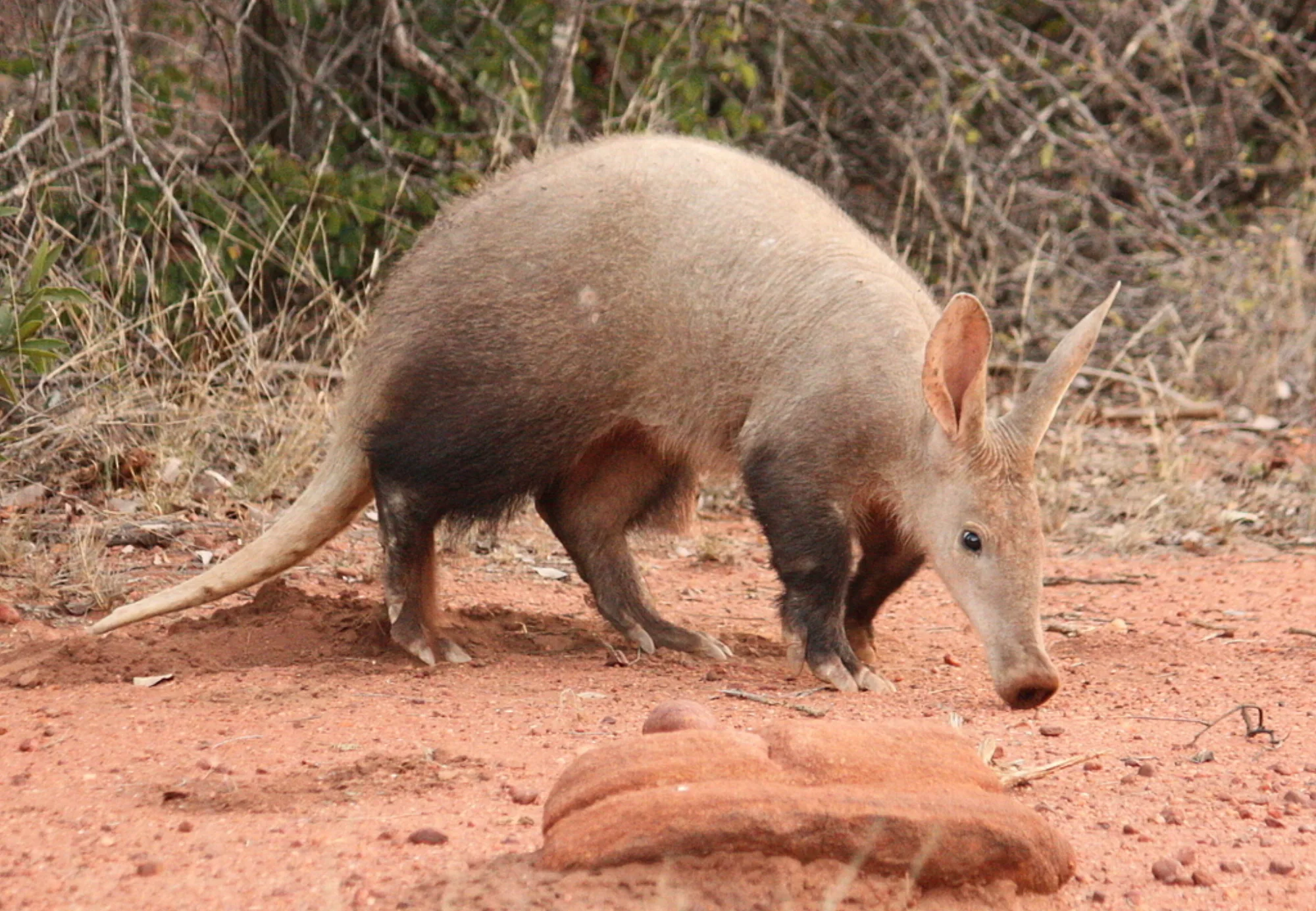
With its arched back, long snout and oversized ears, the Aardvark (Orycteropus afer) has a distinctive outline. This medium-sized burrowing mammal has a stout body, sparse coarse hair and pale yellowish-grey skin that is often stained reddish-brown by soil. Its powerful legs and large, flattened claws help it dig. Aardvarks occur across much of sub-Saharan Africa, wherever ants, termites and suitable habitat are available. They inhabit savannas, grasslands, woodlands and bushland, but avoid rocky ground that makes digging difficult and swamp forest where the water table is too high.
By day, an aardvark shelters from the heat in a dark burrow. It usually emerges towards evening or soon after the sun has set to forage alone, moving with its nose close to the ground and its ears pointing forward. Ants and termites make up almost all its diet: it digs into their concentrations and gathers insects with a long, sticky tongue. Its main burrow can have several entrances and is also used for breeding, while temporary burrows provide refuges across its range. After a pregnancy of seven months, a female gives birth to one cub, which can accompany her outside the burrow after two weeks. The youngster begins eating termites at nine weeks and often stays with its mother until the next mating season.
Lions, leopards, hyenas and pythons prey on aardvarks, and people also hunt them for meat. Their dependence on ants and termites leaves them exposed when drought reduces the supply of these insects; changes in temperature associated with climate change may also threaten them.
Written from the English Wikipedia article Aardvark (CC BY-SA 4.0).
- Records
- 36
- Countries
- 11
- Atlas places
- 6
These are open occurrence records, so they show where people looked for and recorded the Aardvark as much as where it lives. Cells are up to 25 km across, and every location is generalised to its cell.
Generalised encounter areas, not exact locations. Each shape is a grid cell coloured by how likely the species is there.
- Very likelyKenya25 km zone · medium confidence · 10 records · updated 80 days ago
- Very likelyBenin25 km zone · medium confidence · 8 records · updated 80 days ago
- Very likelySouth Africa25 km zone · medium confidence · 8 records · updated 80 days ago
- Very likelyUganda25 km zone · medium confidence · 8 records · updated 80 days ago
- Very likelyNamibia25 km zone · medium confidence · 2 records · updated 80 days ago
- PossibleBurkina Faso25 km zone · low confidence · 0 records · updated 80 days ago
- PossibleNiger25 km zone · low confidence · 0 records · updated 80 days ago
- UncommonAngola25 km zone · low confidence · 0 records · updated 80 days ago
- UncommonCentral African Republic25 km zone · low confidence · 0 records · updated 80 days ago
- UncommonNigeria25 km zone · low confidence · 0 records · updated 80 days ago
Conservation status not assessed here yet, so every location is generalised to its grid cell.