Common Tailorbird
Orthotomus sutorius
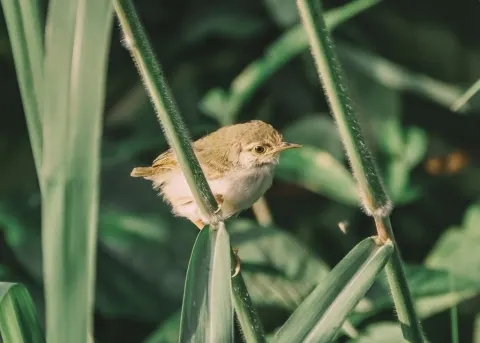
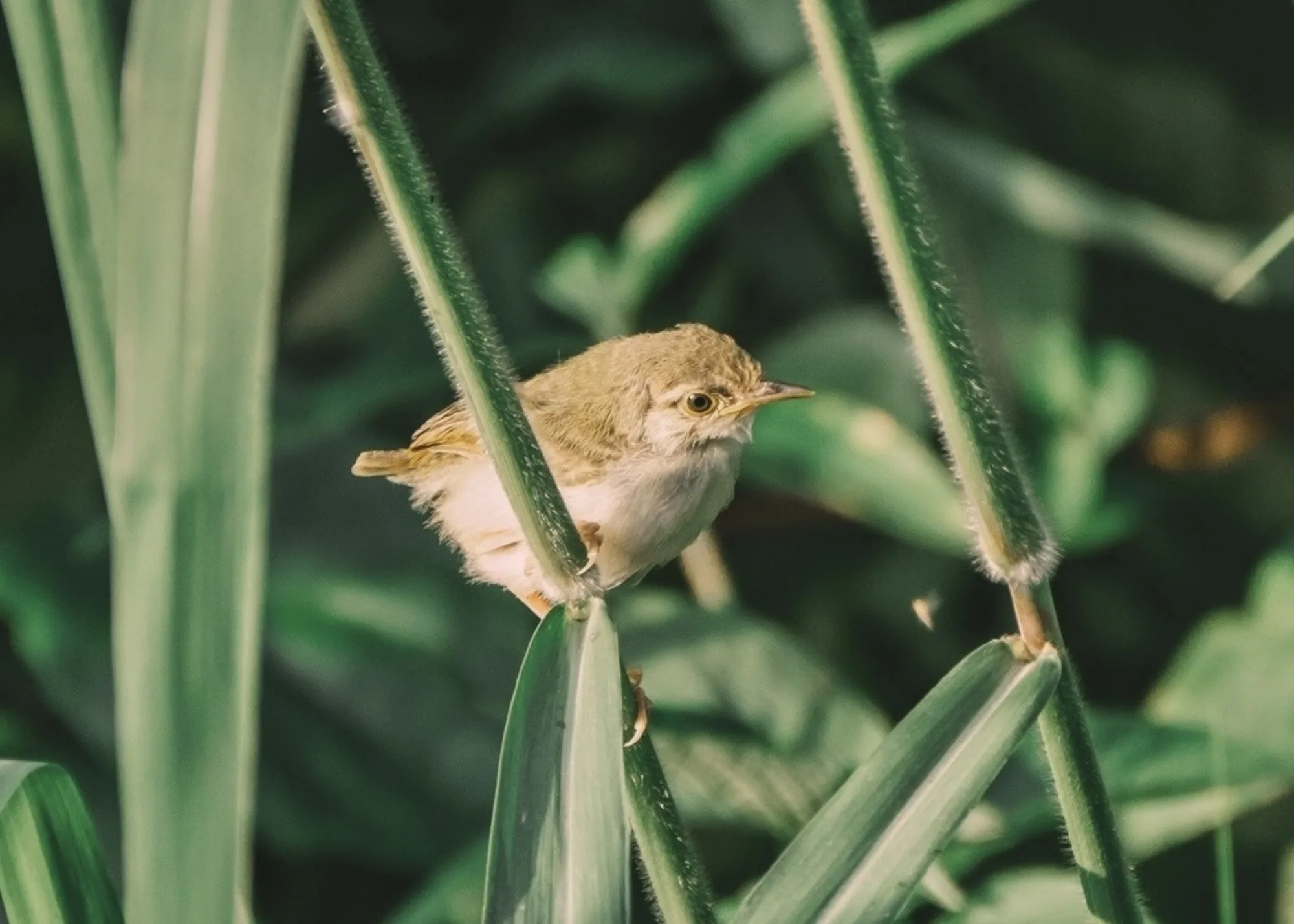
A loud, repeated cheeup-cheeup-cheeup can reveal a Common Tailorbird before the bird itself appears. Shy and often concealed among plants, this small songbird has green upperparts, a creamy white underside and a rust-coloured crown. Its long tail usually points upwards and often moves around. It measures 10 to 14 centimetres and weighs 6 to 10 grams, while young birds are duller than adults. Common Tailorbirds live across tropical and subtropical Asia, with populations in South and Southeast Asia. Look for them around gardens and forest margins, as well as in scrub and open farmland; they are common residents of urban gardens.
These birds occur alone or in pairs, usually low in trees or undergrowth, and sometimes hop on the ground. They search for insects, including beetles and bugs, and are drawn to insects at flowers, particularly mango flower clusters. They also visit flowers for nectar and can pick up enough pollen to appear golden-headed. Outside the breeding season they roost alone, but during breeding they may settle side by side, sometimes with a newly fledged youngster between them.
The tailorbird takes its name from its nest-building habit: it pierces leaf edges and joins them with plant fibre or spider silk to form a cradle. Inside, it builds a deep, softly lined cup, concealed in thick foliage. Some nests use a single large leaf, while others lack the leaf cradle altogether. In India, breeding runs from March to December, with a peak from June to August. Both parents feed the young, which leave the nest after about 14 days. Eggs and chicks suffer high losses to predators, including rodents, cats, crow-pheasants and lizards, and Plaintive Cuckoos sometimes parasitise nests.
Written from the English Wikipedia article Common tailorbird (CC BY-SA 4.0).
- Records
- 750,787
- Countries
- 18
- Atlas places
- 16
- Bandipur National Park· India
- Eravikulam National Park· India
- Kanha National Park· India
- Baluran National Park· Indonesia
- Nagarhole National Park· India
- Annapurna Conservation Area· Nepal
- Chitwan National Park· Nepal
- Jim Corbett National Park· India
- Kaziranga National Park· India
- Langtang National Park· Nepal
- Periyar National Park· India
- Ranthambore National Park· India
- Sundarbans National Park· India
- Tadoba Andhari Tiger Reserve· India
- Taman Negara National Park· Malaysia
- Udawalawe National Park· Sri Lanka
These are open occurrence records, so they show where people looked for and recorded the Common Tailorbird as much as where it lives. Cells are up to 25 km across, and every location is generalised to its cell.
Generalised encounter areas, not exact locations. Each shape is a grid cell coloured by how likely the species is there.
- Very likelyIndia25 km zone · high confidence · 621022 records · updated 86 days ago
- Very likelySri Lanka25 km zone · high confidence · 23020 records · updated 86 days ago
- Very likelyHong Kong SAR China25 km zone · high confidence · 20136 records · updated 86 days ago
- Very likelyChina25 km zone · high confidence · 14514 records · updated 86 days ago
- Very likelyNepal25 km zone · high confidence · 13673 records · updated 86 days ago
- Very likelyMalaysia25 km zone · high confidence · 11898 records · updated 86 days ago
- Very likelyThailand25 km zone · high confidence · 11740 records · updated 86 days ago
- Very likelySingapore25 km zone · high confidence · 8520 records · updated 86 days ago
- Very likelyCambodia25 km zone · high confidence · 7654 records · updated 86 days ago
- Very likelyBangladesh25 km zone · high confidence · 7116 records · updated 86 days ago
Conservation status not assessed here yet, so every location is generalised to its grid cell.