Eurasian Golden Oriole
Oriolus oriolus
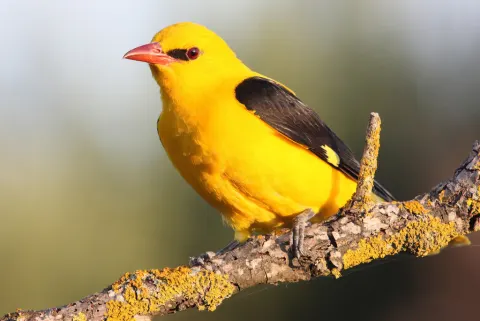
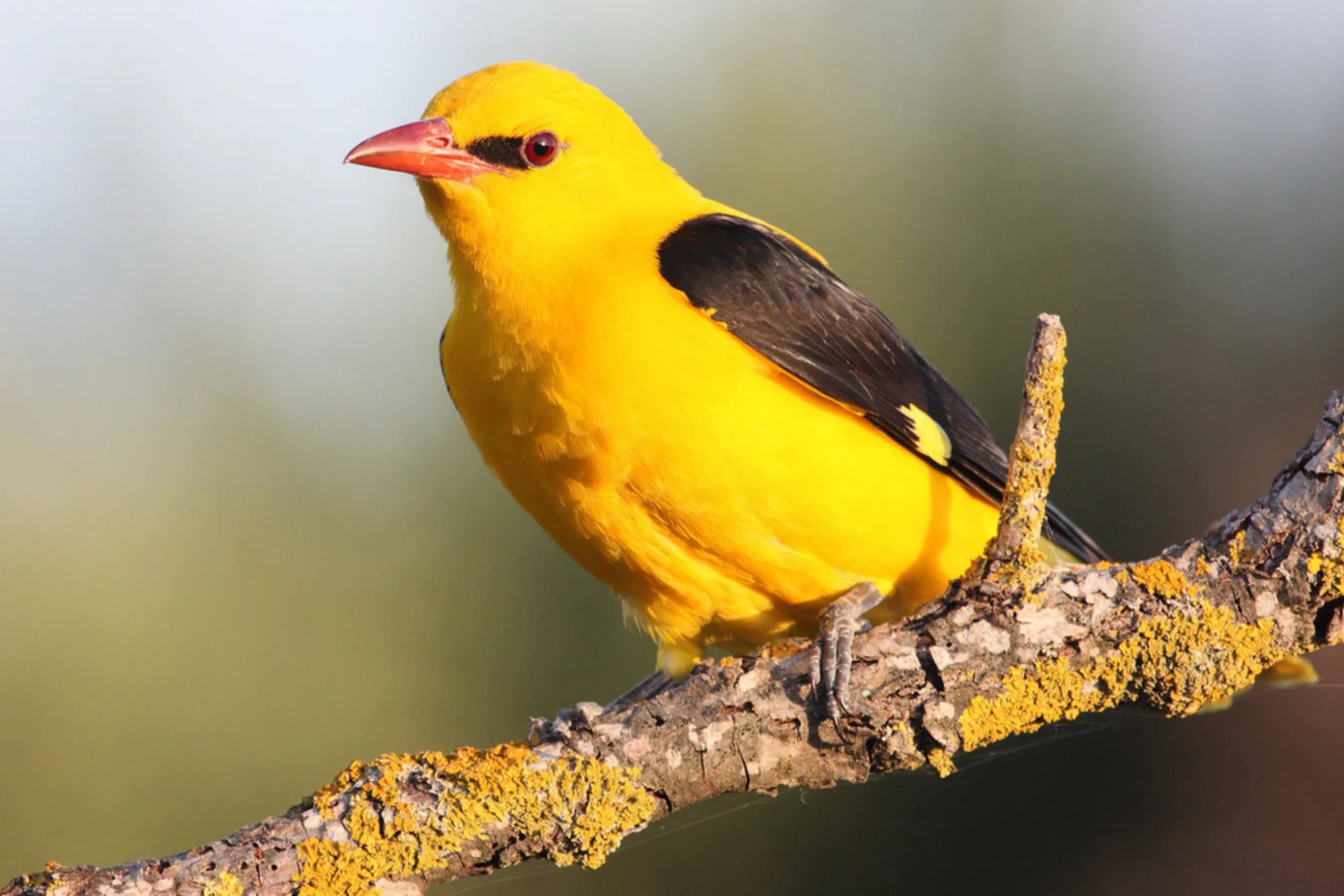
A flash of yellow in the canopy may be a male Eurasian Golden Oriole, though finding one takes patience. Males have black and yellow plumage, while females are a duller green. Both are shy, and even the brighter male can be hard to pick out among sun-dappled leaves. In flight, orioles look somewhat like thrushes, flying strongly and directly with shallow dips over longer distances. Listen for a harsh call, or a fluting song whose phrases often vary subtly.
The birds breed across a range reaching China from Scandinavia and western Europe, and spend winter in central and southern Africa. They usually migrate at night, although they may also travel by day in spring. On their autumn journey, they pass through the eastern Mediterranean and feed on fruit. In western Europe, look for them in open broadleaf woods, plantations, orchards, riverside woods and large gardens. Farther east, they also use more continuous forests, including mixed and coniferous woodland. Winter habitats range from dry to humid woodland, tall and riverside forests, and savanna.
Orioles eat insects and fruit, picking insects from crevices with their bills. Males usually reach the breeding grounds several days before females. High towards the edge of a tree crown, the female builds a deep cup nest suspended from a fork of thin branches. She lines it with fine grass, feathers and wool, and usually lays 3 to 5 eggs. Both parents feed the young and vigorously defend the nest, so the clutch is rarely lost to predators.
Written from the English Wikipedia article Eurasian golden oriole (CC BY-SA 4.0).
- Records
- 126,277
- Countries
- 26
No atlas park has a record of the Eurasian Golden Oriole in or around it yet.
These are open occurrence records, so they show where people looked for and recorded the Eurasian Golden Oriole as much as where it lives. Cells are up to 25 km across, and every location is generalised to its cell.
Generalised encounter areas, not exact locations. Each shape is a grid cell coloured by how likely the species is there.
- Very likelySpain25 km zone · high confidence · 43279 records · updated 80 days ago
- Very likelyFrance25 km zone · high confidence · 39355 records · updated 80 days ago
- Very likelyBelgium25 km zone · high confidence · 10902 records · updated 80 days ago
- Very likelyPortugal25 km zone · high confidence · 8209 records · updated 80 days ago
- Very likelyGermany25 km zone · high confidence · 3297 records · updated 80 days ago
- Very likelyHungary25 km zone · high confidence · 2830 records · updated 80 days ago
- Very likelyPoland25 km zone · high confidence · 2822 records · updated 80 days ago
- Very likelyCzechia25 km zone · high confidence · 2522 records · updated 80 days ago
- Very likelySerbia25 km zone · high confidence · 1668 records · updated 80 days ago
- Very likelyAustria25 km zone · high confidence · 1344 records · updated 80 days ago
Conservation status not assessed here yet, so every location is generalised to its grid cell.