Black-naped Oriole
Oriolus chinensis
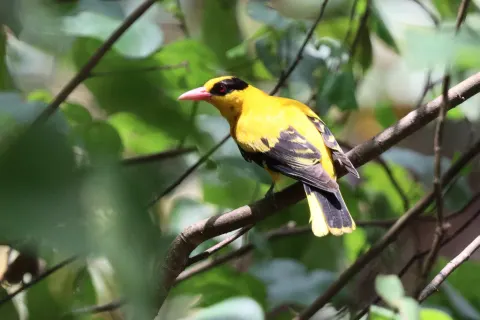
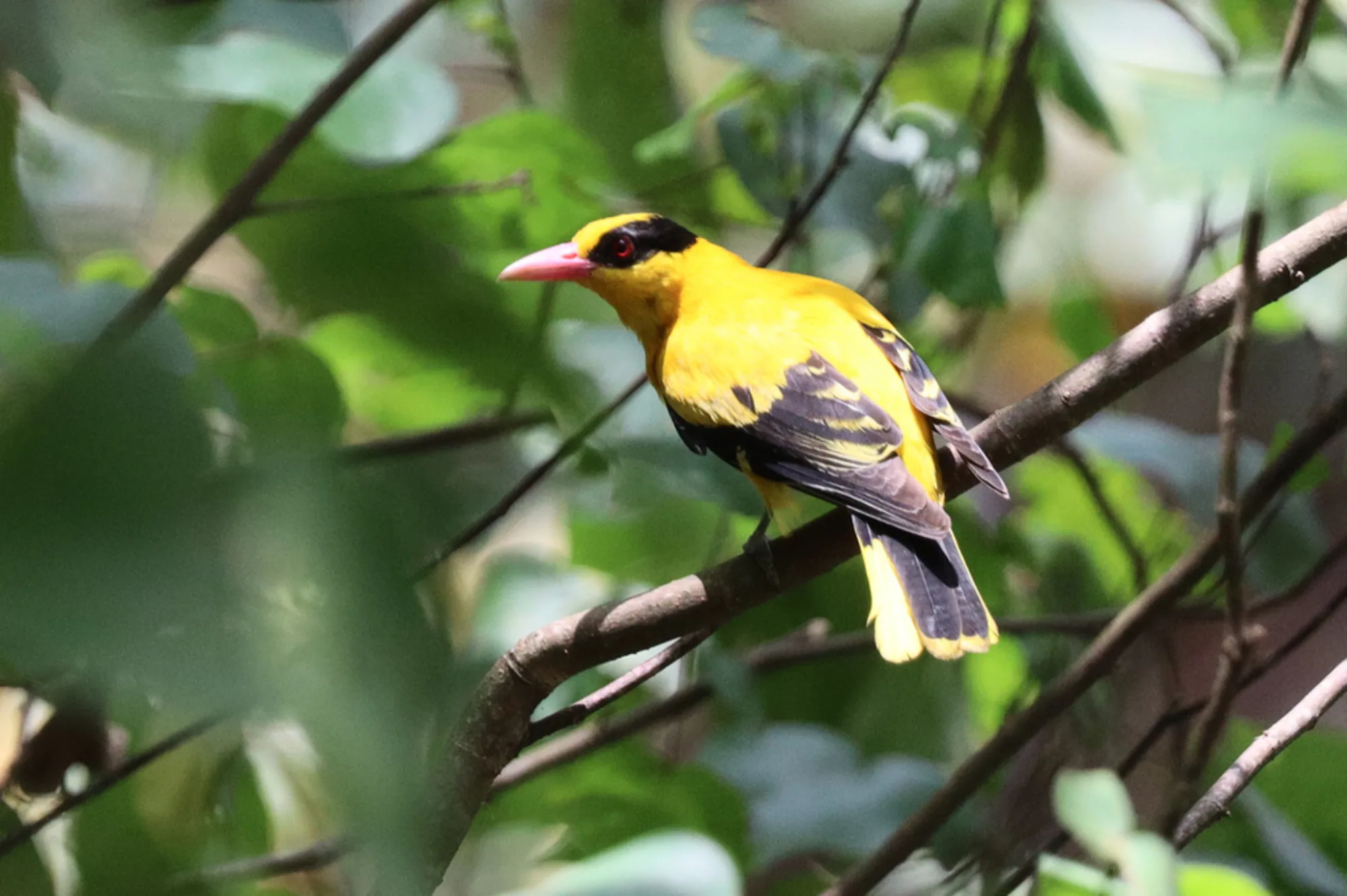
Golden plumage, a broad black mask and a pinkish bill make the Black-naped Oriole (Oriolus chinensis) a striking bird to look for across many parts of Asia. Its dark eye-stripe widens and meets at the back of the neck, while females tend to have a greener or olive-coloured back. Young birds have streaks underneath, and the species flies with a dipping motion. Listen for a nasal call; one population also has a fluty song. Appearance varies across its range: birds in the Andamans have entirely black wings, while those in the Nicobars have a particularly broad black band across the nape.
Look for this medium-sized oriole in forests, gardens and plantations, where it feeds among the canopy on berries and insects. In India it also takes nectar from large flowers, and it sometimes raids the nests of smaller birds. Some populations move with the seasons: birds breeding in eastern Asia spend winter in tropical Southeast Asia, while those in the Andaman and Nicobar Islands remain there year-round. In Singapore, the species is common even in city gardens.
Breeding usually takes place from April to June, or January to March in the Nicobars. The nest is a deep cup set in a tree fork, often close to a black drongo's nest, and holds two to three pink eggs marked with reddish spots and darker blotches. The female incubates the eggs, which hatch after 14 to 16 days; the chicks leave the nest about two weeks later. Both parents feed and protect the young, with males doing more of the feeding and guarding. Crows, treepies and hawks prey on nests, and people capture the birds for sale across many parts of Southeast Asia.
Written from the English Wikipedia article Black-naped oriole (CC BY-SA 4.0).
- Records
- 134,328
- Countries
- 25
- Atlas places
- 9
These are open occurrence records, so they show where people looked for and recorded the Black-naped Oriole as much as where it lives. Cells are up to 25 km across, and every location is generalised to its cell.
Generalised encounter areas, not exact locations. Each shape is a grid cell coloured by how likely the species is there.
- Very likelySingapore25 km zone · high confidence · 42734 records · updated 86 days ago
- Very likelyThailand25 km zone · high confidence · 18894 records · updated 86 days ago
- Very likelyIndia25 km zone · high confidence · 17787 records · updated 86 days ago
- Very likelyMalaysia25 km zone · high confidence · 15321 records · updated 86 days ago
- Very likelyPhilippines25 km zone · high confidence · 12861 records · updated 86 days ago
- Very likelyTaiwan25 km zone · high confidence · 9695 records · updated 86 days ago
- Very likelyIndonesia25 km zone · high confidence · 4402 records · updated 86 days ago
- Very likelySouth Korea25 km zone · high confidence · 3671 records · updated 86 days ago
- Very likelyCambodia25 km zone · high confidence · 3427 records · updated 86 days ago
- Very likelyChina25 km zone · high confidence · 2417 records · updated 86 days ago
Conservation status not assessed here yet, so every location is generalised to its grid cell.