Klipspringer
Oreotragus oreotragus
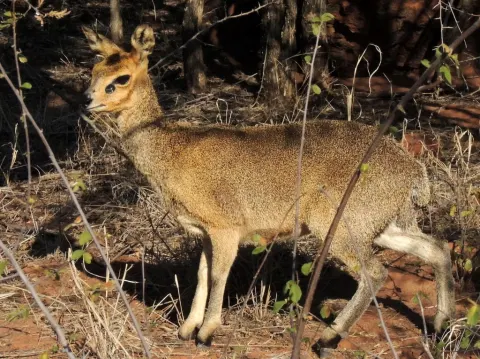
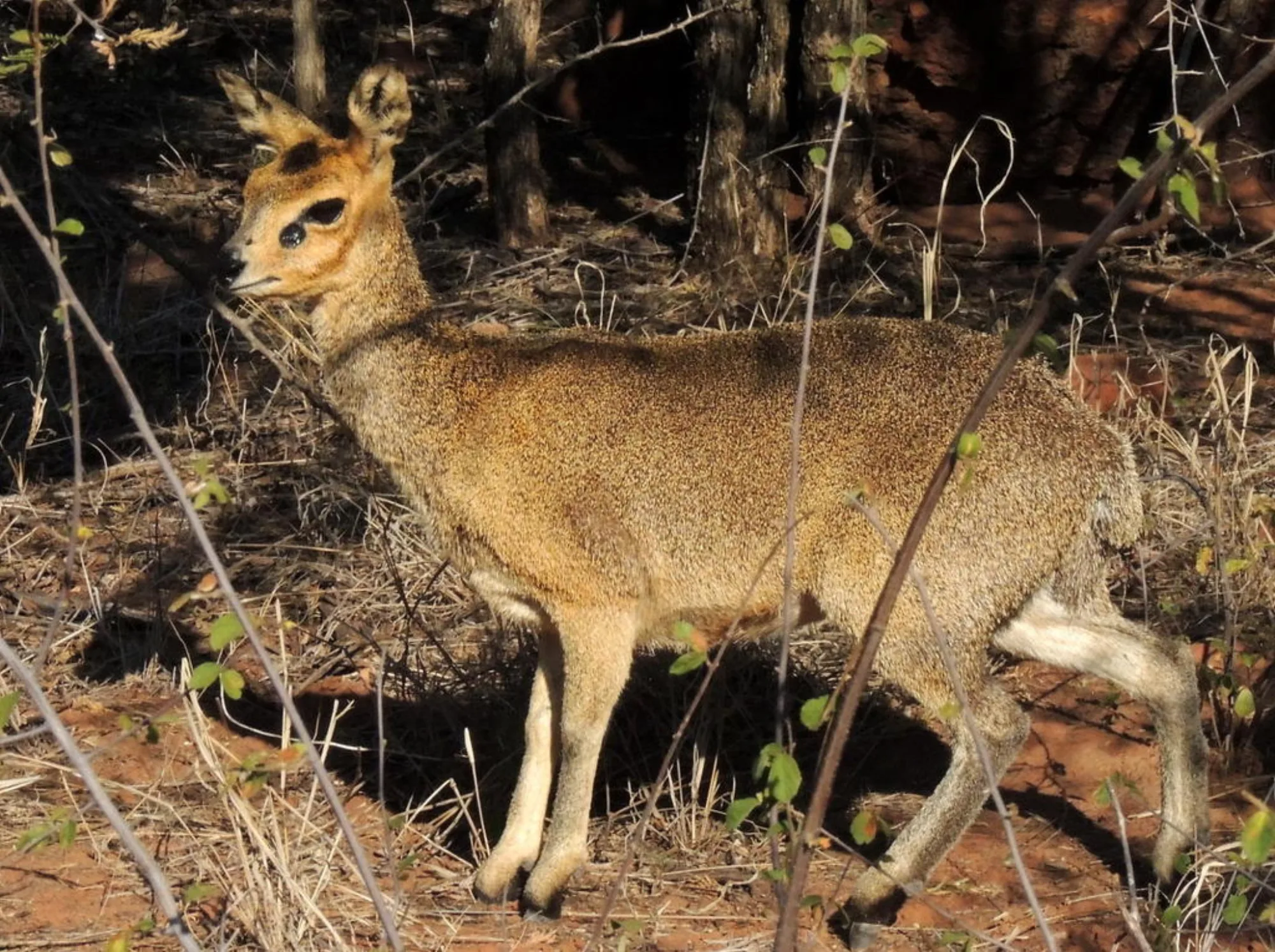
A small, sturdy antelope of eastern and southern Africa, the Klipspringer blends into rocky surroundings in a coat that ranges from yellowish grey to reddish brown. Its white chin and lips, short black-marked ears and brown forehead add to its distinctive appearance. Males carry short, spiky horns, while the thick, coarse coat helps protect the animal in steep falls. It walks on the tips of its hooves, gaining grip as it climbs and jumps across rocks.
Look for Klipspringers in rocky country with sparse vegetation, from northeastern Sudan and Ethiopia south to South Africa, and along the coasts of Angola and Namibia. They also occur in smaller populations in parts of Central African Republic, Democratic Republic of Congo and Nigeria. On Mount Kilimanjaro they can be found as high as 4,500 m, though they sometimes move to lowlands when food is scarce. Mainly active at night, they rest around midday and late at night, and may be more active when the moon is bright. In the morning they bask in the sun. A pair may stay together for life, usually close to one another, taking turns to watch for predators while the other feeds. Their shrill whistles can be heard in a duet. They browse mostly on young plants, fruit and flowers, relying mainly on succulent plants for water.
After a pregnancy of around six months, a female gives birth to a single calf, usually with births peaking between spring and early summer. The newborn is hidden in vegetation for up to three months, and leaves its mother at a year old. Klipspringers are hunted for meat, leather and hair, although their inaccessible habitat makes hunting difficult. Groups living lower down face a greater risk of being wiped out.
Written from the English Wikipedia article Klipspringer (CC BY-SA 4.0).
- Records
- 69
- Countries
- 8
- Atlas places
- 19
- Kruger National Park· South Africa
- Serengeti National Park· Tanzania
- Namib-Naukluft· Namibia
- Ngorongoro Conservation Area· Tanzania
- Lake Manyara National Park· Tanzania
- Tsavo East National Park· Kenya
- Ai-Ais/Richtersveld Transfrontier Park· Namibia
- Augrabies Falls National Park· South Africa
- Matobo National Park· Zimbabwe
- Tsavo West National Park· Kenya
- Dorob National Park· Namibia
- Karoo National Park· South Africa
- Maasai Mara National Reserve· Kenya
- Mapungubwe National Park· South Africa
- Pilanesberg National Park· South Africa
- Ruaha National Park· Tanzania
- Samburu National Reserve· Kenya
- Table Mountain National Park· South Africa
- Walvis Bay· Namibia
These are open occurrence records, so they show where people looked for and recorded the Klipspringer as much as where it lives. Cells are up to 25 km across, and every location is generalised to its cell.
Generalised encounter areas, not exact locations. Each shape is a grid cell coloured by how likely the species is there.
- Very likelySouth Africa25 km zone · medium confidence · 22 records · updated 80 days ago
- Very likelyNamibia25 km zone · medium confidence · 14 records · updated 80 days ago
- Very likelyKenya25 km zone · medium confidence · 12 records · updated 80 days ago
- Very likelyZimbabwe25 km zone · medium confidence · 10 records · updated 80 days ago
- Very likelyTanzania25 km zone · medium confidence · 9 records · updated 80 days ago
- LikelyMalawi25 km zone · medium confidence · 2 records · updated 80 days ago
- UncommonEthiopia25 km zone · low confidence · 0 records · updated 80 days ago
- RareDjibouti25 km zone · low confidence · 0 records · updated 80 days ago
Conservation status not assessed here yet, so every location is generalised to its grid cell.