Nile Tilapia
Oreochromis niloticus
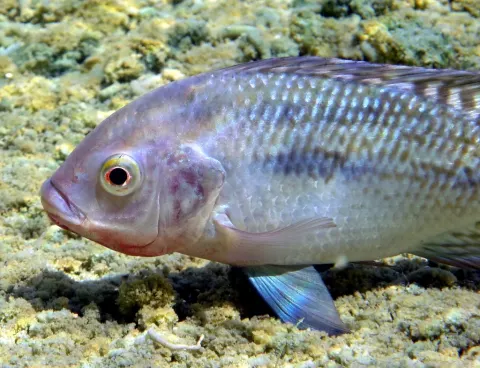
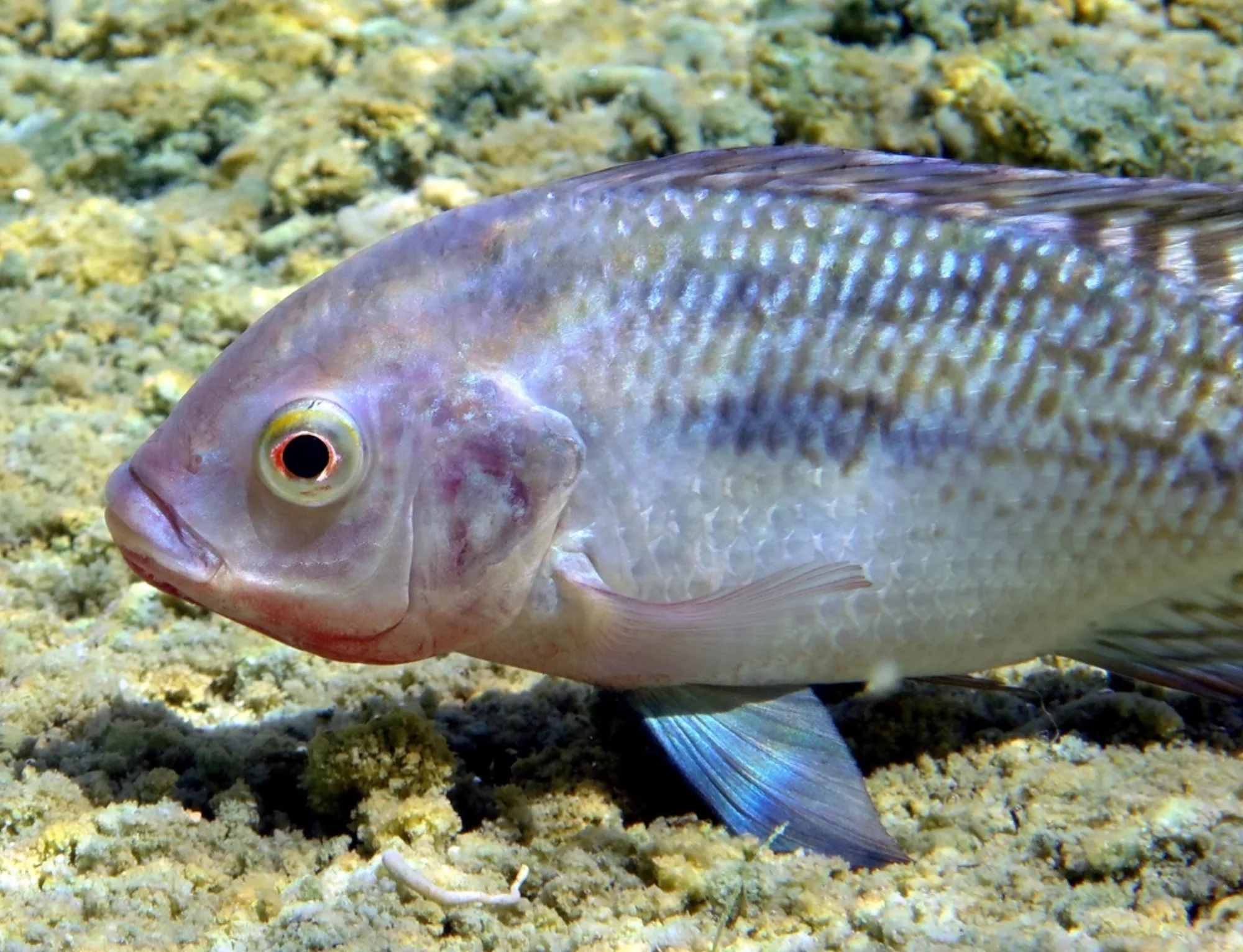
A vertically striped tail helps distinguish wild Nile Tilapia from the similar blue tilapia. Wild fish are generally brownish or greyish, sometimes with faint bands across the body. Breeding males turn reddish, particularly on their fins. They can reach 60 cm in length and exceed 5 kg, with males growing larger than females. Farmed and introduced fish may be hybrids or selectively bred variants, making their identification more difficult.
Native across much of Africa and in coastal river basins in Israel, the fish occurs in much of the Nile system and several other African lakes and rivers. It has also been introduced widely on other continents. It inhabits rivers, streams, canals, lakes and ponds, as well as brackish water, but cannot survive indefinitely in full salt water. Its range extends from sea level to 1,830 m, with isolated populations living in hot springs near the Suguta River and in the Awash Basin.
Nile Tilapia usually travel in schools and feed during the day, mainly on phytoplankton and algae. Some populations also eat aquatic plants, while other recorded foods include detritus and aquatic insect larvae. Competition for food can lead to feeding at night. Within a group, dominant males get priority access to food and mates, and males build circular nests that become sites of courtship and parental care. Females carry eggs or young in their mouths, and young fish may return there when danger approaches. Rapid reproduction can lead to overcrowding and stunted growth. The species is widespread and common, although some introduced populations can threaten native ecosystems and fish species; no specific threat to Nile Tilapia itself is described here.
Written from the English Wikipedia article Nile tilapia (CC BY-SA 4.0).
- Records
- 81,299
- Countries
- 31
- Atlas places
- 17
- Queen Elizabeth National Park· Uganda
- Mikumi National Park· Tanzania
- Mkomazi National Park· Tanzania
- iSimangaliso Wetland Park· South Africa
- Lake Mburo National Park· Uganda
- Addo Elephant National Park· South Africa
- Everglades National Park· United States
- Kruger National Park· South Africa
- Lake Manyara National Park· Tanzania
- Mapungubwe National Park· South Africa
- Murchison Falls National Park· Uganda
- Ngorongoro Conservation Area· Tanzania
- Nyerere National Park· Tanzania
- Rwenzori Mountains National Park· Uganda
- Tarangire National Park· Tanzania
- Tsavo West National Park· Kenya
- Udzungwa Mountains National Park· Tanzania
These are open occurrence records, so they show where people looked for and recorded the Nile Tilapia as much as where it lives. Cells are up to 25 km across, and every location is generalised to its cell.
Generalised encounter areas, not exact locations. Each shape is a grid cell coloured by how likely the species is there.
- Very likelyColombia25 km zone · high confidence · 74996 records · updated 80 days ago
- Very likelyTaiwan25 km zone · high confidence · 4734 records · updated 80 days ago
- Very likelyUganda25 km zone · high confidence · 555 records · updated 80 days ago
- Very likelyTanzania25 km zone · medium confidence · 262 records · updated 80 days ago
- Very likelyMexico25 km zone · medium confidence · 123 records · updated 80 days ago
- Very likelyChina25 km zone · medium confidence · 95 records · updated 80 days ago
- Very likelyPhilippines25 km zone · medium confidence · 92 records · updated 80 days ago
- Very likelyJapan25 km zone · medium confidence · 71 records · updated 80 days ago
- Very likelyRéunion25 km zone · medium confidence · 33 records · updated 80 days ago
- LikelySouth Africa25 km zone · medium confidence · 54 records · updated 80 days ago
Conservation status not assessed here yet, so every location is generalised to its grid cell.