Mountain Goat
Oreamnos americanus
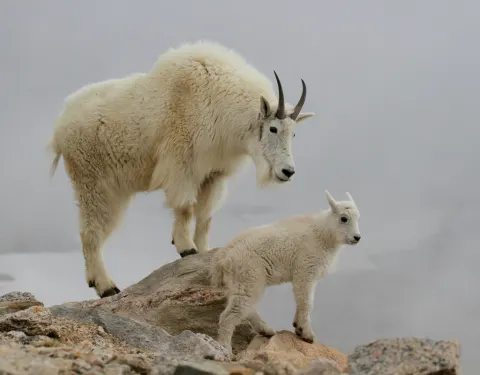
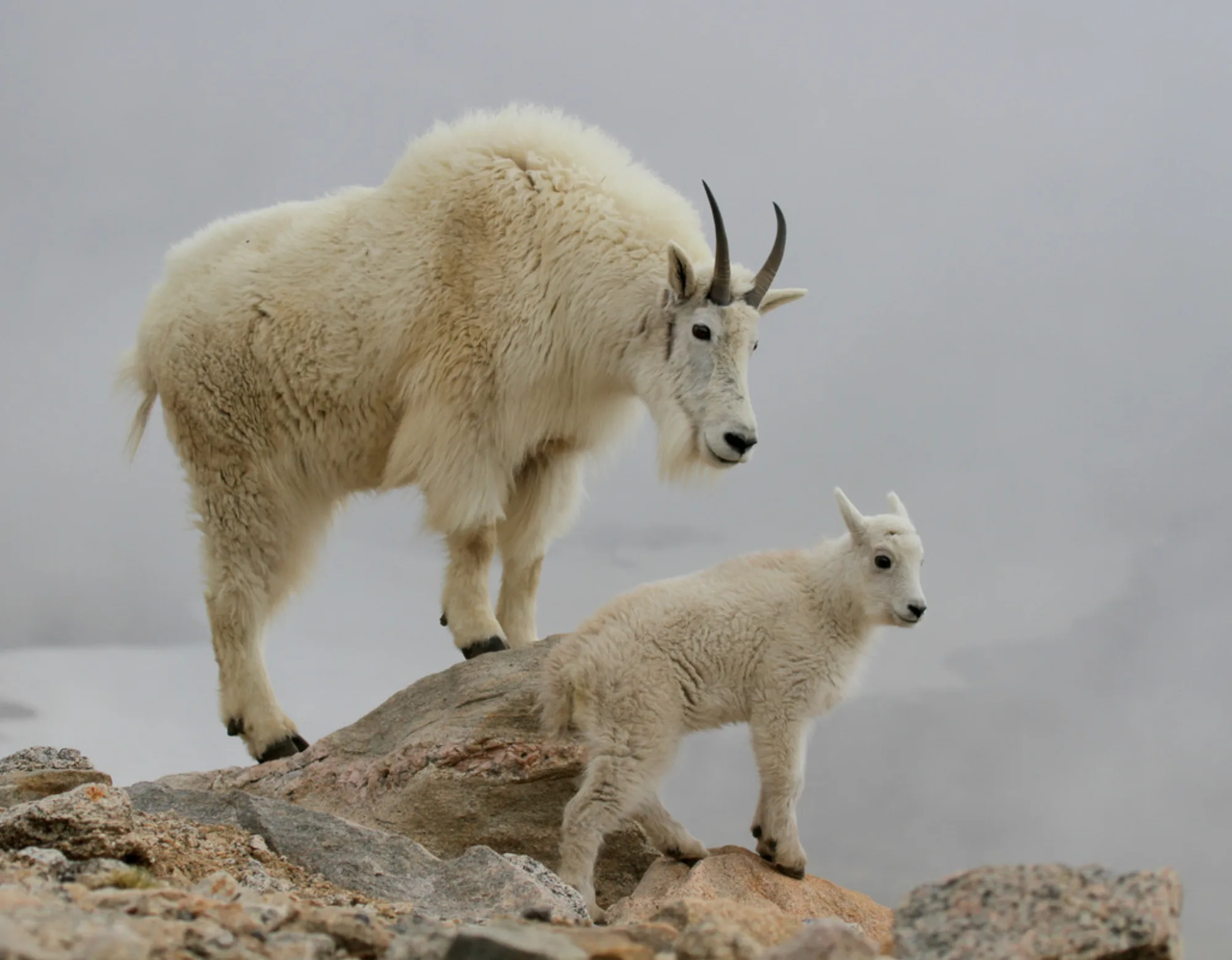
On the cliffs of western North America, the Mountain Goat moves across sheer rock and icy passages with the confidence of a skilled climber. A woolly, greyish-white coat protects both sexes from the elements, and each has a beard, a short tail and black horns. Males can be considerably heavier than females, and tend to have longer horns and beards.
Its range includes the Rocky Mountains, the Cascade Range and other western mountain regions, stretching from Washington, Idaho and Montana north into the southern Yukon and southeastern Alaska. Introduced populations live in several other areas, including Colorado and the Olympic Peninsula of Washington. Mountain goats are mainly alpine and subalpine animals, usually staying above the tree line, though they sometimes descend to sea level on the coast. They move with the seasons in response to food, breeding and weather, and may travel through forest to reach mineral licks. They spend much of their time grazing on plants including grasses, sedges, ferns and lichens, as well as leaves and twigs from low shrubs and conifers.
After the breeding season, females gather in loose nursery groups, while adult males often leave alone or in small groups. In late spring, a female typically gives birth to a single kid on an isolated ledge. The youngster attempts to run and climb within hours and follows its mother closely through its first year. Mothers protect their young on steep slopes and from predators, which include wolves, bears and eagles. Cougars can overcome even large adults, while avalanches are another cause of mountain goat deaths. On Washington's Olympic Peninsula, introduced goats were removed, mostly by capture and relocation, after some approached visitors aggressively while seeking salt.
Written from the English Wikipedia article Mountain goat (CC BY-SA 4.0).
- Records
- 2,239
- Countries
- 2
- Atlas places
- 12
- Banff National Park· Canada
- Jasper National Park· Canada
- Glacier National Park· United States
- Olympic National Park· United States
- Yellowstone National Park· United States
- Glacier Bay National Park· United States
- Kenai Fjords National Park· United States
- Kootenay National Park· Canada
- Waterton Lakes National Park· Canada
- Yoho National Park· Canada
- Grand Teton National Park· United States
- Kluane National Park and Reserve· Canada
These are open occurrence records, so they show where people looked for and recorded the Mountain Goat as much as where it lives. Cells are up to 25 km across, and every location is generalised to its cell.
Generalised encounter areas, not exact locations. Each shape is a grid cell coloured by how likely the species is there.
- Very likelyUnited States25 km zone · high confidence · 2144 records · updated 80 days ago
- Very likelyCanada25 km zone · medium confidence · 95 records · updated 80 days ago
Conservation status not assessed here yet, so every location is generalised to its grid cell.