Killer Whale
Orcinus orca
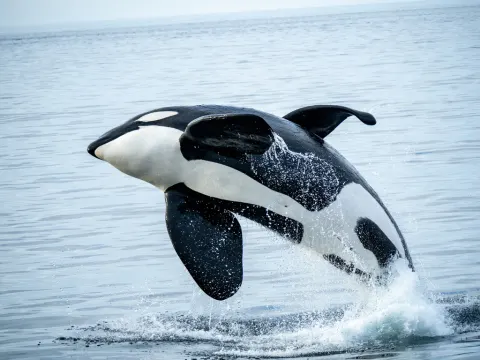
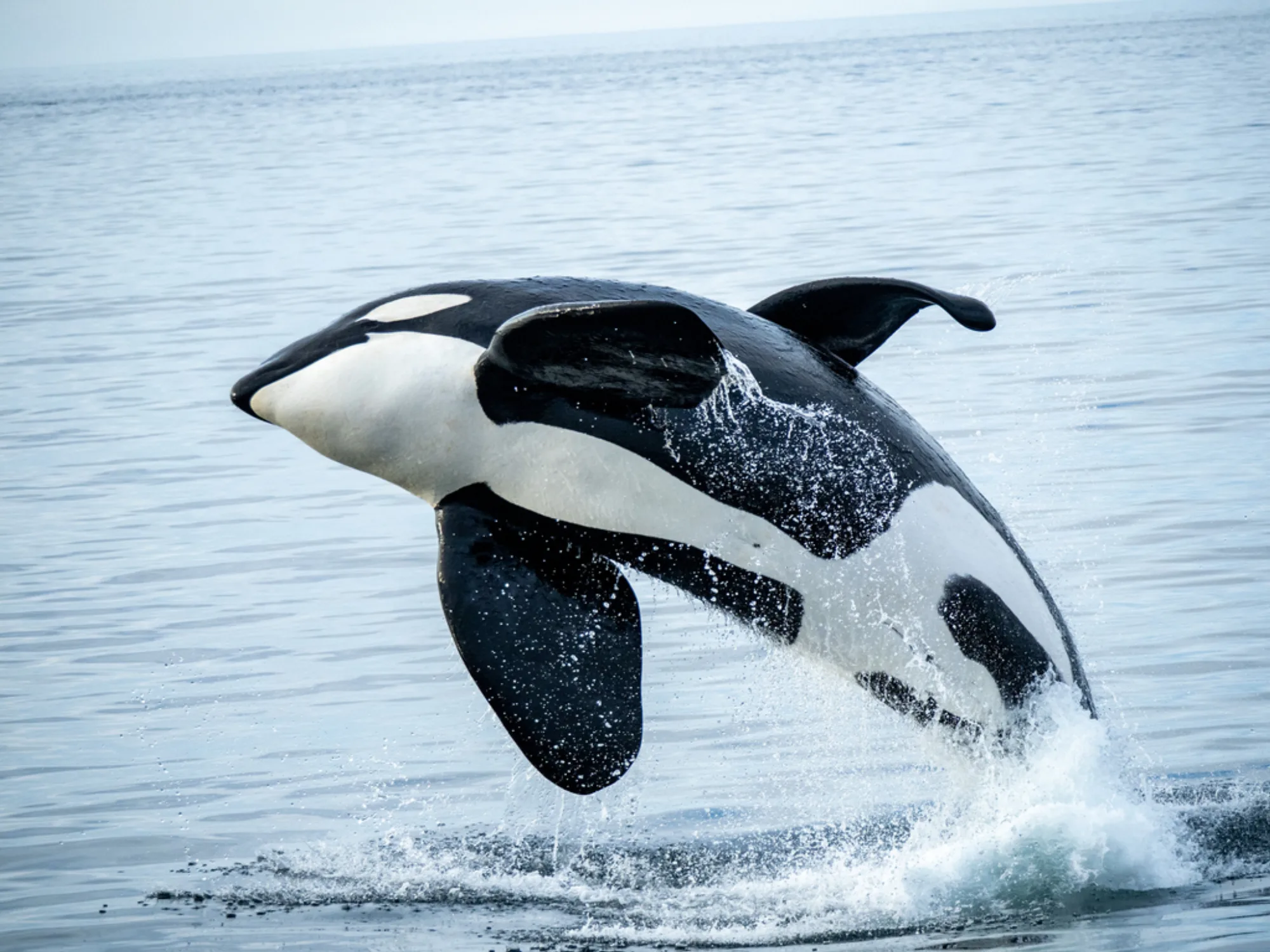
Black above and white below, the Killer Whale is the biggest of the oceanic dolphins. White patches above and behind the eyes and a grey or white saddle behind the dorsal fin help distinguish it. Males typically measure 6 to 8 m, while females generally reach 5 to 7 m.
Orcas range through every ocean and most seas, from polar regions to tropical waters, though they favour higher latitudes and coastal areas. Study sites include the coasts of Iceland and Norway, New Zealand, the Valdés Peninsula in Argentina and the west coast of North America. In Antarctica, they travel as far as the edge of the pack ice and may enter denser ice through open leads. At the surface, a traveller might see an orca breach, slap its tail or lift its head above the water to look around.
Orcas are social hunters, and different populations specialise in prey such as fish, sharks, rays and marine mammals. Off Norway, some herd herring into tight balls before striking them with their tails, while Antarctic orcas can work together to wash seals from ice floes. In the eastern North Pacific, resident orcas form stable family groups in which both males and females stay with their mothers throughout their lives. Mothers usually give birth to a single calf about once every five years, and observations in several regions show that other pod members help care for young. Threats include depleted prey, pollution, oil spills, underwater noise and conflicts with boats. Whale watching can also cause stress and change orca behaviour, especially when boats come too close or block their path.
Written from the English Wikipedia article Orca (CC BY-SA 4.0).
- Records
- 9,056
- Countries
- 17
- Atlas places
- 8
- Glacier Bay National Park· United States
- Olympic National Park· United States
- Kenai Fjords National Park· United States
- Channel Islands National Park· United States
- Katmai National Park· United States
- Pacific Rim National Park Reserve· Canada
- Península Valdés· Argentina
- Wilsons Promontory National Park· Australia
These are open occurrence records, so they show where people looked for and recorded the Killer Whale as much as where it lives. Cells are up to 25 km across, and every location is generalised to its cell.
Generalised encounter areas, not exact locations. Each shape is a grid cell coloured by how likely the species is there.
- Very likelyUnited States25 km zone · medium confidence · 6891 records · updated 80 days ago
- Very likelyCanada25 km zone · medium confidence · 831 records · updated 80 days ago
- Very likelyNorway25 km zone · medium confidence · 628 records · updated 80 days ago
- Very likelyMexico25 km zone · medium confidence · 315 records · updated 80 days ago
- Very likelyAustralia25 km zone · medium confidence · 182 records · updated 80 days ago
- Very likelyNew Zealand25 km zone · medium confidence · 53 records · updated 80 days ago
- Very likelyJapan25 km zone · medium confidence · 34 records · updated 80 days ago
- LikelyIceland25 km zone · medium confidence · 33 records · updated 80 days ago
- LikelyUnited Kingdom25 km zone · medium confidence · 21 records · updated 80 days ago
- LikelyMorocco25 km zone · medium confidence · 14 records · updated 80 days ago
Conservation status not assessed here yet, so every location is generalised to its grid cell.