Irrawaddy Dolphin
Orcaella brevirostris
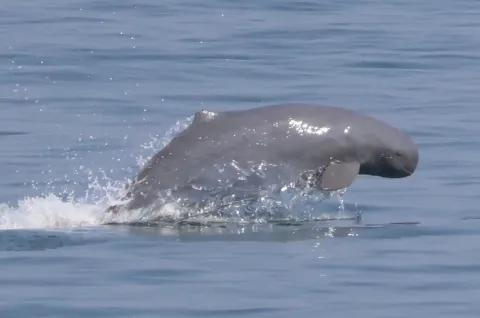
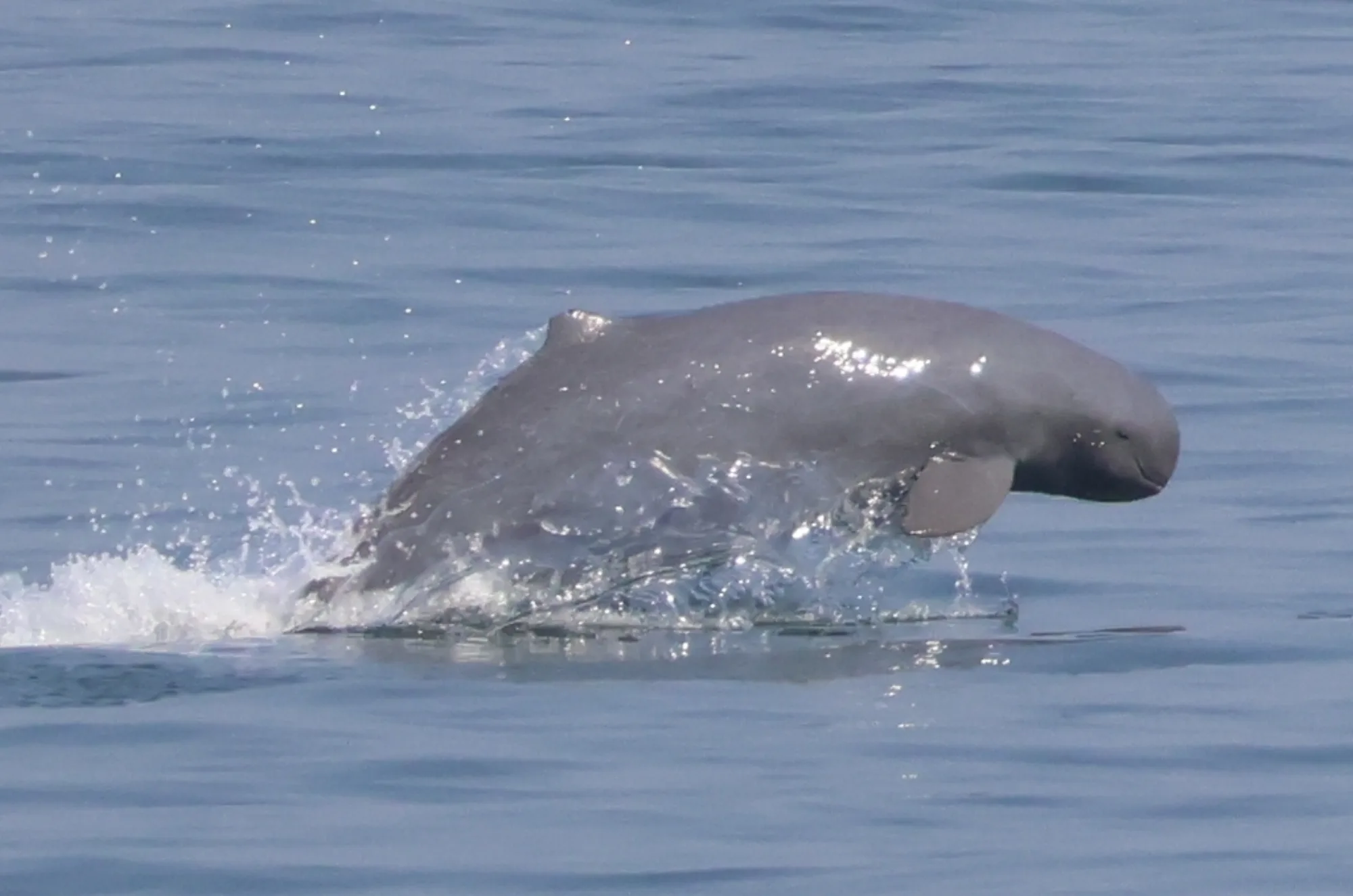
With a rounded head and no obvious beak, the Irrawaddy Dolphin has a distinctive profile. Its skin is grey to dark slate blue, lighter underneath, and its small, rounded dorsal fin sits behind the middle of its back. At full maturity, it reaches a length of 2.3 m and weighs 90 to 200 kg. This oceanic dolphin lives close to shore in brackish coastal waters, river mouths and estuaries, with separate populations in freshwater rivers. Its range reaches the Philippines and New Guinea, extending west to the Bay of Bengal; concentrated lagoon populations occur in India's Chilika Lake and Thailand's Songkhla Lake.
Usually found in small groups, these dolphins are generally shy of boats and dive when alarmed. They surface with a rolling movement, raising the tail above the surface only when making a deep dive. Sometimes they spyhop, roll onto one side while waving a flipper, or breach. Fish, fish eggs, crustaceans and cephalopods such as squid form part of their diet. Groups may circle prey just below the surface, and dolphins can squirt streams of water that help gather fish for hunting. In the upper Ayeyarwady River, some also work with fishers, driving fish towards cast nets in response to acoustic signals. Females give birth to one calf after a gestation of 14 months, with births occurring every two to three years.
Drowning in gillnets is the main threat across the dolphin's range, and accidental capture in other fishing nets also causes deaths. Habitat degradation, vessel noise and heavy tourist boat traffic add to the pressures, while electrofishing, gold mining and dam building are serious threats in Burma.
Written from the English Wikipedia article Irrawaddy dolphin (CC BY-SA 4.0).
- Records
- 327
- Countries
- 5
- Atlas places
- 1
These are open occurrence records, so they show where people looked for and recorded the Irrawaddy Dolphin as much as where it lives. Cells are up to 25 km across, and every location is generalised to its cell.
Generalised encounter areas, not exact locations. Each shape is a grid cell coloured by how likely the species is there.
- Very likelyBangladesh25 km zone · high confidence · 282 records · updated 80 days ago
- LikelyVietnam25 km zone · medium confidence · 26 records · updated 80 days ago
- LikelyMalaysia25 km zone · medium confidence · 11 records · updated 80 days ago
- PossibleCambodia25 km zone · medium confidence · 7 records · updated 80 days ago
- UncommonThailand25 km zone · medium confidence · 1 record · updated 80 days ago
Conservation status not assessed here yet, so every location is generalised to its grid cell.