Hamadryad
Ophiophagus hannah
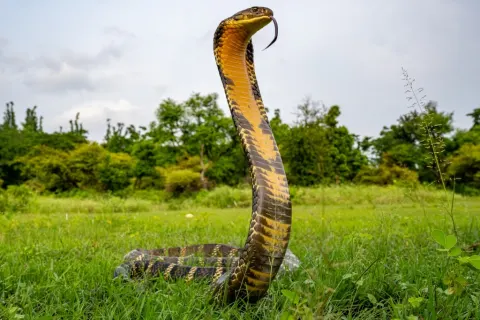
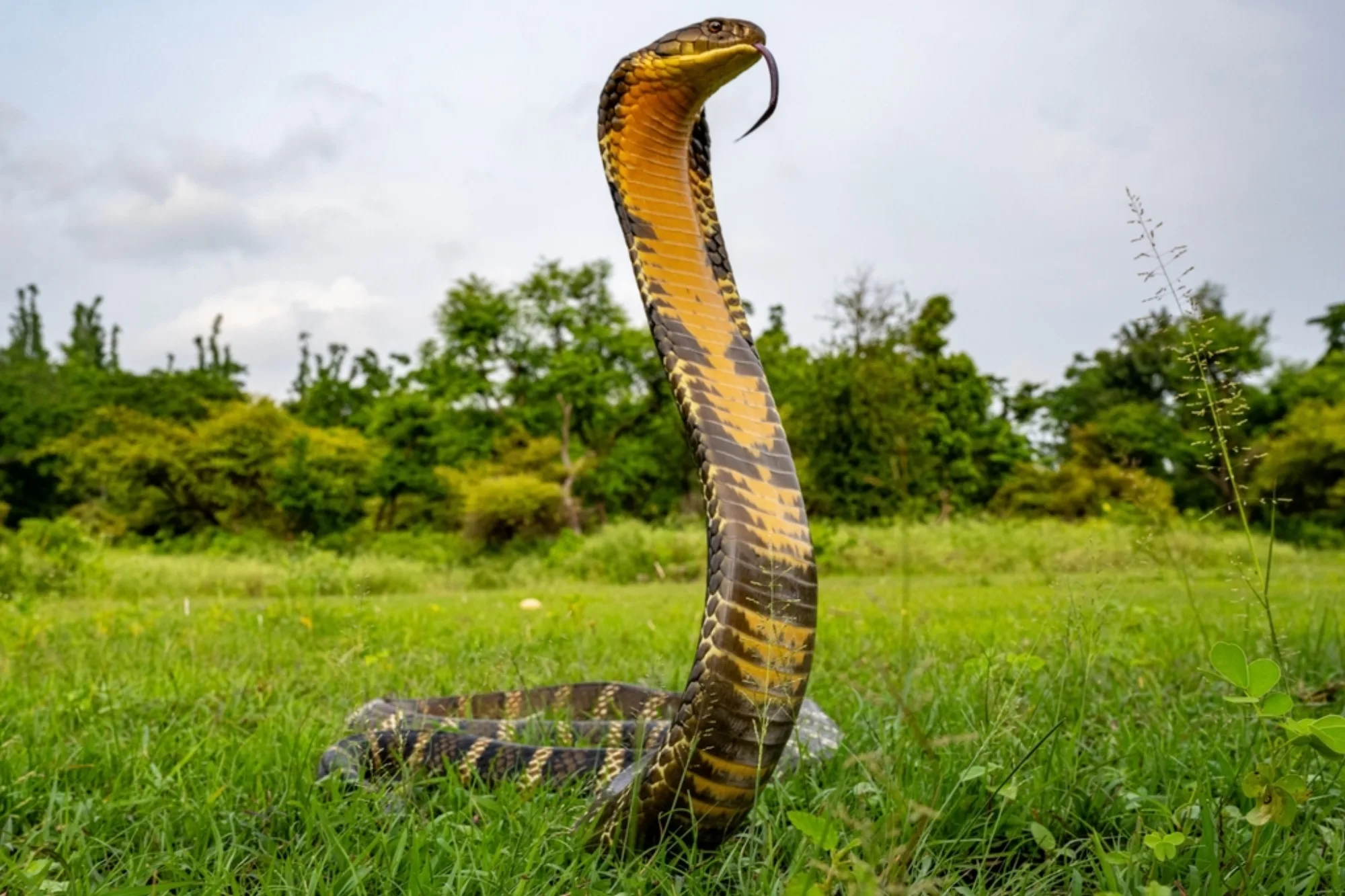
Known also as the king cobra, the Hamadryad (Ophiophagus hannah) is a venomous snake found across tropical Asia. Adults measure 3.18 to 4 m, and the longest recorded individual reached 5.85 m. Colour varies across its range, from black with white markings to plain brownish grey. Juveniles are black with white, yellow or buff chevrons pointing towards the head; their bright markings often fade as they mature. The snake has a rounded muzzle, large eyes with golden irises and an oval hood that it spreads when alarmed.
Its range extends from the Indian subcontinent through Southeast Asia to southern China, although it is widely distributed rather than commonly seen. It occurs from lowland regions to elevations of 2,000 m, including the Terai, and has been recorded on Baratang, an island within the Great Andaman chain. It usually hunts by day, taking chiefly other snakes, including its own kind, as well as lizards and occasionally rodents. After a large meal, it can go for many months without feeding again. It usually slips away from people when disturbed, but a cornered snake may rear up and strike in defence. When alarmed, it raises the front of its body and hisses, producing a low sound that many people compare to a growl.
Females build nests from dry leaves, often at the base of trees, and stay beside them while the eggs incubate. A clutch contains 7 to 43 eggs, and incubation lasts 66 to 105 days. In Southeast Asia, forest clearance and the spread of farmland destroy its habitat; wildlife smuggling and poaching for meat, leather and traditional medicine also threaten it.
Written from the English Wikipedia article King cobra (CC BY-SA 4.0).
- Records
- 19
- Countries
- 5
No atlas park has a record of the Hamadryad in or around it yet.
These are open occurrence records, so they show where people looked for and recorded the Hamadryad as much as where it lives. Cells are up to 25 km across, and every location is generalised to its cell.
Generalised encounter areas, not exact locations. Each shape is a grid cell coloured by how likely the species is there.
- Very likelyIndia25 km zone · medium confidence · 12 records · updated 80 days ago
- LikelyThailand25 km zone · medium confidence · 4 records · updated 80 days ago
- LikelyHong Kong SAR China25 km zone · medium confidence · 3 records · updated 80 days ago
- PossibleChina25 km zone · low confidence · 0 records · updated 80 days ago
- UncommonVietnam25 km zone · low confidence · 0 records · updated 80 days ago
Conservation status not assessed here yet, so every location is generalised to its grid cell.