Lingcod
Ophiodon elongatus
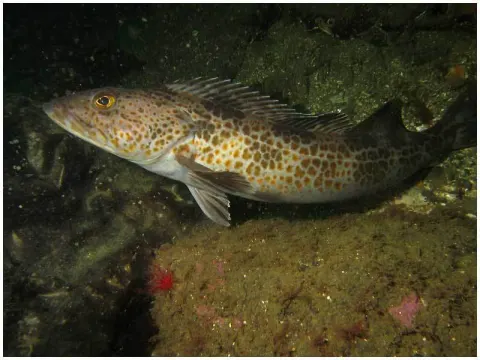
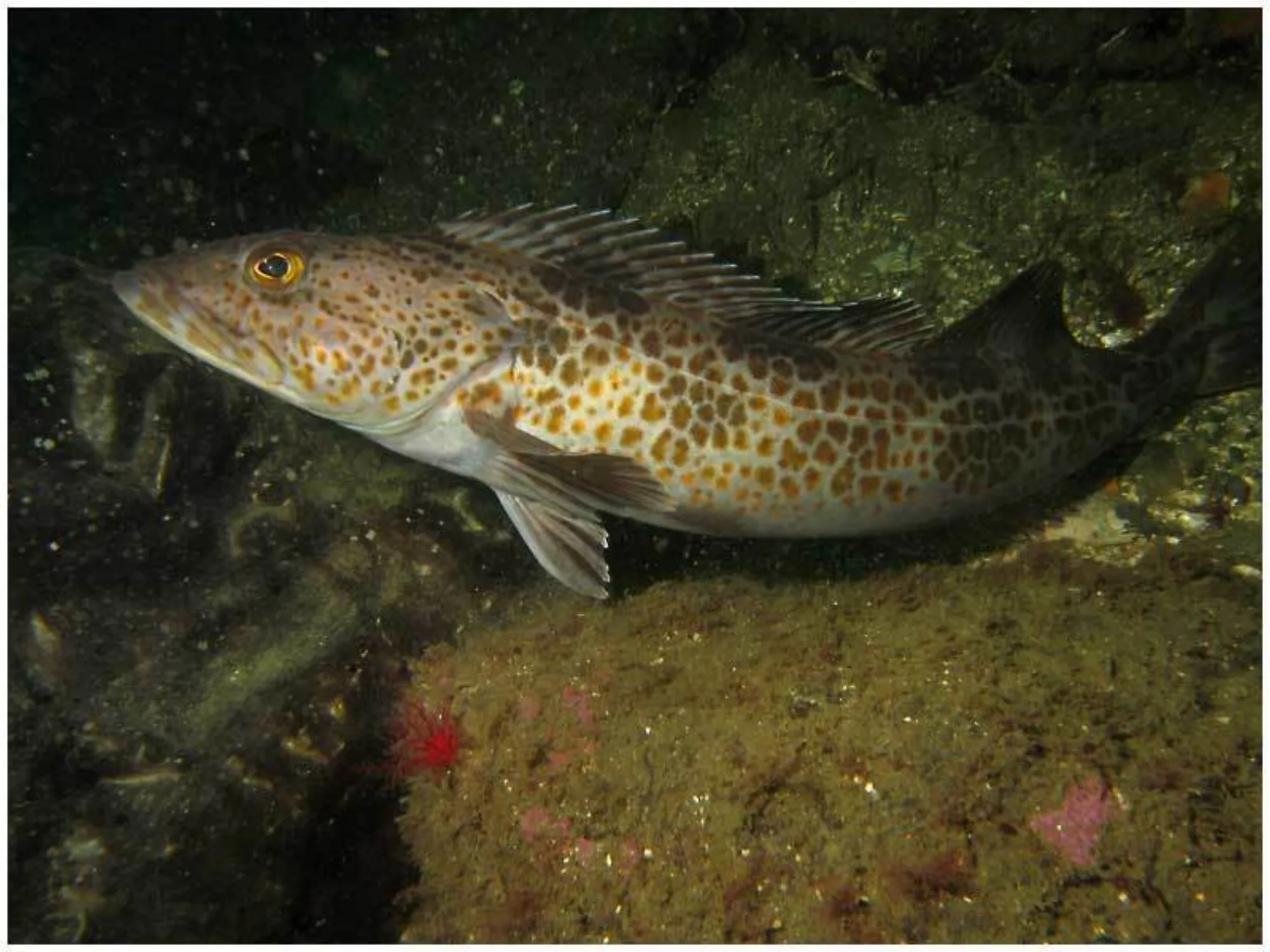
With a large head, wide mouth and sharp teeth, the Lingcod (Ophiodon elongatus) is a formidable-looking fish of the greenling family, despite a name that suggests otherwise. Its back can be dark grey, blue, brown or green, sometimes marked with copper-coloured spots or mottling, while its belly is usually lighter. It can reach 152 centimetres in length and a confirmed weight of 39 kilograms.
Native to North America's west coast, it ranges between Alaska's Shumagin Islands and Baja California, Mexico, and is most abundant near British Columbia and Washington. Most live close to the seabed in rocky areas at depths of 10 to 100 metres, though they have been found deeper. Young fish use shallow sandy bottoms and beds of eelgrass or kelp, moving towards rockier habitats as they grow. Lingcod generally stay within a small home range and can be territorial, returning to the same reef to spawn. Adults are aggressive predators that eat other bottom-dwelling fish, including lingcod and rockfishes, as well as squid, octopus and crab.
Spawning takes place each year between January and March, and females lay their eggs beneath rocks or in rocky crevices. Males guard the nests until the eggs hatch, sometimes lying motionless beside them or keeping watch nearby. Eggs and larvae are particularly vulnerable to predators, while nesting and the move towards shore expose adults to seals, sea lions and anglers. Fishing is a pressure, and lingcod can be slow to recover after overfishing. The kelp and eelgrass beds used by young fish are susceptible to natural and human impacts, while trawling can disturb seabed habitat.
Written from the English Wikipedia article Lingcod (CC BY-SA 4.0).
- Records
- 95,123
- Countries
- 2
- Atlas places
- 3
These are open occurrence records, so they show where people looked for and recorded the Lingcod as much as where it lives. Cells are up to 25 km across, and every location is generalised to its cell.
Generalised encounter areas, not exact locations. Each shape is a grid cell coloured by how likely the species is there.
- Very likelyUnited States25 km zone · high confidence · 75045 records · updated 80 days ago
- Very likelyCanada25 km zone · high confidence · 20078 records · updated 80 days ago
Conservation status not assessed here yet, so every location is generalised to its grid cell.