Sooty Tern
Onychoprion fuscatus
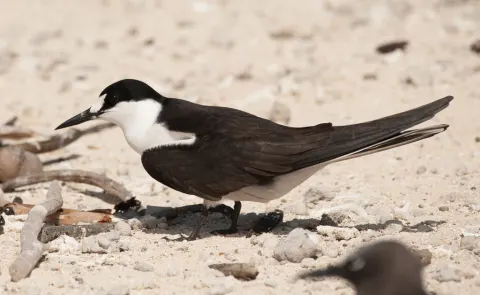
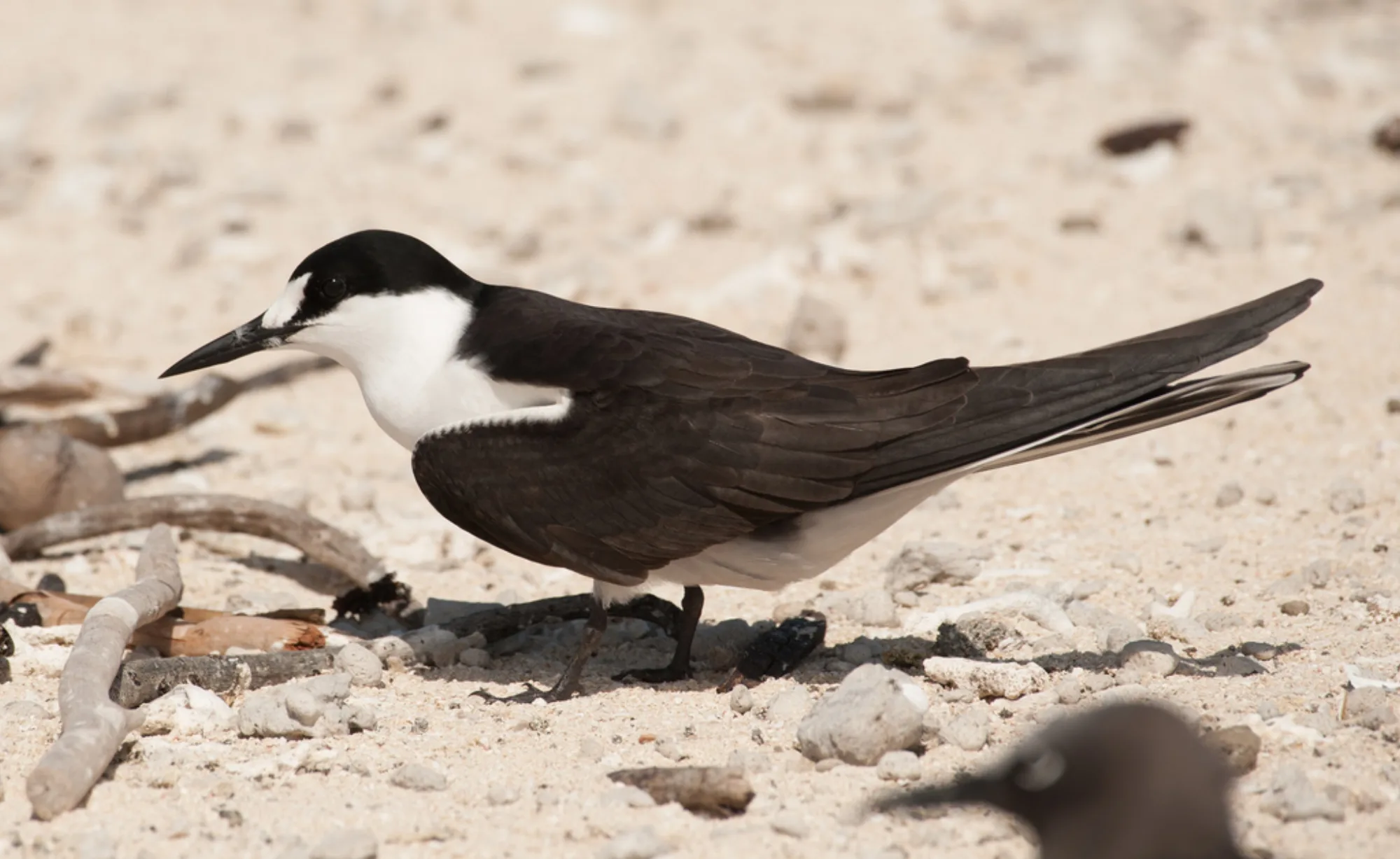
Over tropical oceans, the Sooty Tern can remain on the wing for years, returning to land to breed on islands across the equatorial zone. This medium-large seabird measures 36 to 45 cm in length, with a wingspan of 82 to 94 cm. Its long wings and forked tail are dark blackish-brown above, contrasting with its white forehead and pale underside. The tail has white outer edges, while the legs and bill are black. Young birds look different: they are grey-black above and below, with pale feather fringes that give the upperparts a scaly look and a whitish lower belly. A loud, piercing call sounds like “wide-a-wake”, and there is also a harsh alarm call.
The species breeds on islands across the tropical Atlantic, Indian and Pacific oceans, including islands in the Caribbean and those off Australia and New Guinea. It winters more widely across tropical oceans and is generally found inland only after severe storms. At sea, it picks fish from the surface, often gathering in large flocks. It can spend 3 to 10 years at sea, staying in flight because its feathers lack oil and it cannot float. Breeding birds gather in colonies on rocky or coral islands, where each nests in a scrape or hole in the ground and lays a single egg. For a traveller, the waters around Baja California offer a chance to see one more frequently, with several nesting locations offshore.
Hurricanes can devastate small breeding colonies, as has been suggested for nesting sites on cays off Colombia’s San Andrés Islands. Severe storms can also carry birds inland, where one was found exhausted on the slopes of Mount Cameroon after foul weather in the Gulf of Guinea.
Written from the English Wikipedia article Sooty tern (CC BY-SA 4.0).
- Records
- 36,640
- Countries
- 35
- Atlas places
- 3
These are open occurrence records, so they show where people looked for and recorded the Sooty Tern as much as where it lives. Cells are up to 25 km across, and every location is generalised to its cell.
Generalised encounter areas, not exact locations. Each shape is a grid cell coloured by how likely the species is there.
- Very likelyUnited States25 km zone · medium confidence · 19274 records · updated 80 days ago
- Very likelyAustralia25 km zone · high confidence · 8941 records · updated 80 days ago
- Very likelyU.S. Outlying Islands25 km zone · high confidence · 1668 records · updated 80 days ago
- Very likelyTaiwan25 km zone · medium confidence · 1365 records · updated 80 days ago
- Very likelyNorfolk Island25 km zone · high confidence · 1122 records · updated 80 days ago
- Very likelyGuadeloupe25 km zone · high confidence · 903 records · updated 80 days ago
- Very likelyMexico25 km zone · medium confidence · 438 records · updated 80 days ago
- Very likelySeychelles25 km zone · medium confidence · 414 records · updated 80 days ago
- Very likelyAruba25 km zone · medium confidence · 294 records · updated 80 days ago
- Very likelyGrenada25 km zone · medium confidence · 219 records · updated 80 days ago
Conservation status not assessed here yet, so every location is generalised to its grid cell.