Muskrat
Ondatra zibethicus
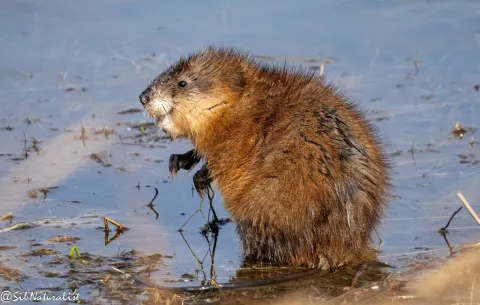
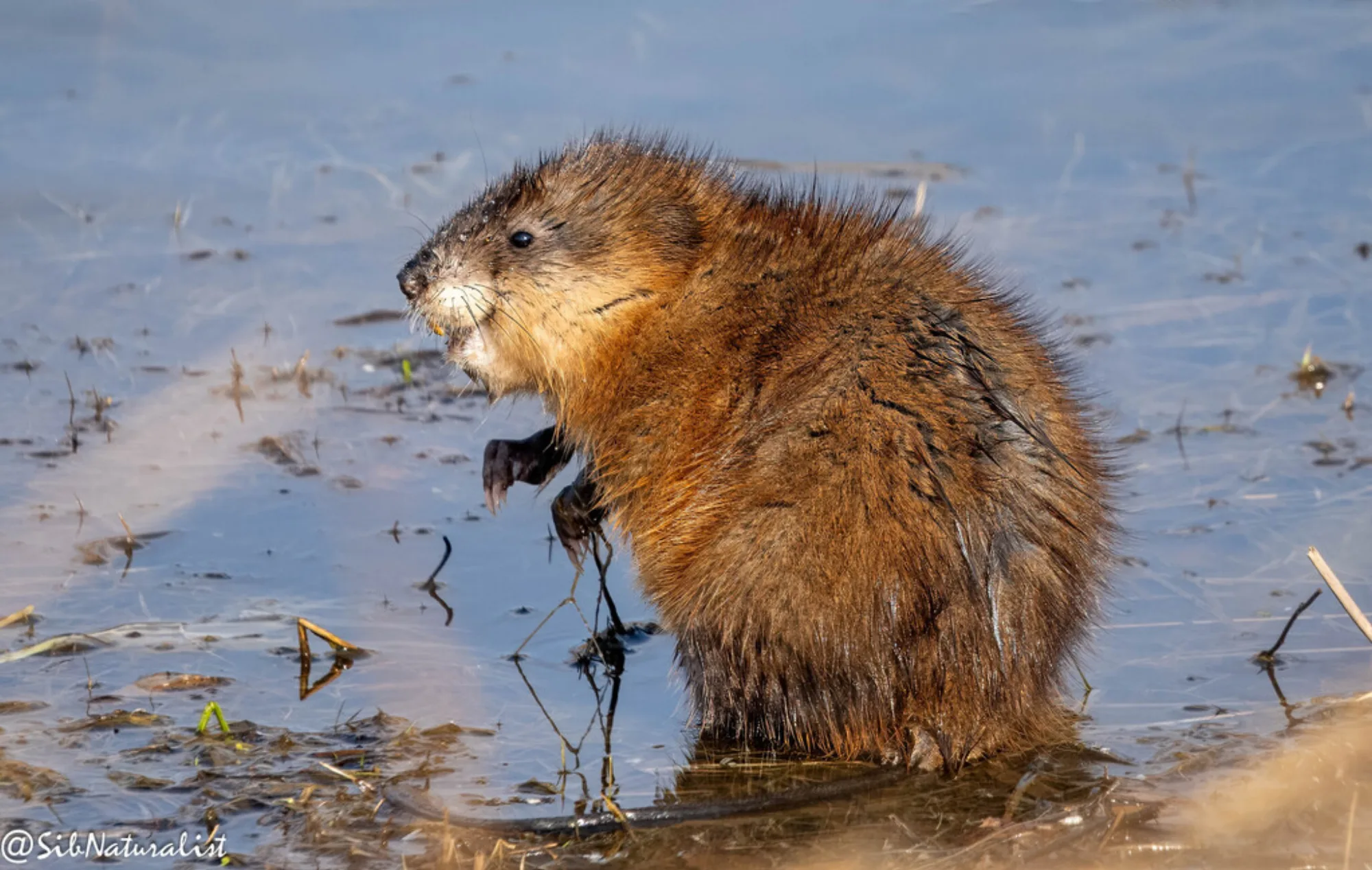
A swimmer with thick brown fur and a long, flattened tail, the Muskrat is a medium-sized rodent at home in wetlands. Its coat ranges from medium to dark brown or black, with a lighter belly, and becomes partly grey with age. Adults measure 40 to 70 cm from nose to tail, with the tail accounting for half that length. On land, the tail drags behind, leaving a recognisable trace.
Native to North America, Muskrats occur throughout most of Canada and the United States, extending into northern Mexico. They have also been introduced to parts of Eurasia and South America. Look for them around freshwater or saline wetlands, rivers, lakes and ponds, especially near dawn or dusk. They spend much of their time in water, swimming with partially webbed hind feet and steering with the tail. They can remain underwater for 12 to 17 minutes and follow their own trails beneath the ice when water freezes. Families typically consist of a male and female with their young. Along banks they make burrows with underwater entrances, while in marshes they build shelters from mud and vegetation. Their diet is mostly aquatic plants, including cattails, though they also take small animals such as frogs, crayfish and fish. Females can produce two or three litters a year, each with six to eight young.
Predators include mink, foxes, owls and alligators, and territorial fights between Muskrats can also be fatal. Human activity has eliminated much wetland habitat, although canals and irrigation channels have created new habitat. In Belgium, France and the Netherlands, Muskrats are trapped, poisoned and hunted to control their numbers.
Written from the English Wikipedia article Muskrat (CC BY-SA 4.0).
- Records
- 139,251
- Countries
- 13
No atlas park has a record of the Muskrat in or around it yet.
These are open occurrence records, so they show where people looked for and recorded the Muskrat as much as where it lives. Cells are up to 25 km across, and every location is generalised to its cell.
Generalised encounter areas, not exact locations. Each shape is a grid cell coloured by how likely the species is there.
- Very likelyBelgium25 km zone · high confidence · 92022 records · updated 80 days ago
- Very likelyNetherlands25 km zone · high confidence · 27478 records · updated 80 days ago
- Very likelyFrance25 km zone · high confidence · 10906 records · updated 80 days ago
- Very likelyGermany25 km zone · high confidence · 3732 records · updated 80 days ago
- Very likelySwitzerland25 km zone · high confidence · 2217 records · updated 80 days ago
- Very likelyUnited States25 km zone · medium confidence · 706 records · updated 80 days ago
- Very likelyAustria25 km zone · medium confidence · 566 records · updated 80 days ago
- Very likelyLuxembourg25 km zone · high confidence · 468 records · updated 80 days ago
- Very likelyNorway25 km zone · medium confidence · 389 records · updated 80 days ago
- Very likelyFinland25 km zone · medium confidence · 300 records · updated 80 days ago
Conservation status not assessed here yet, so every location is generalised to its grid cell.