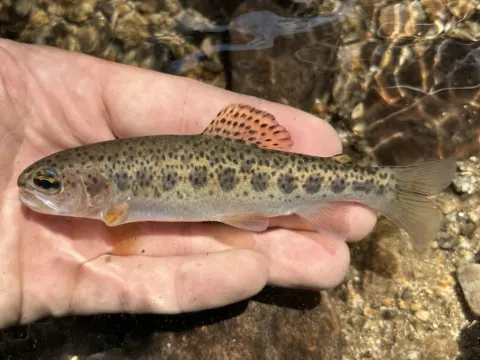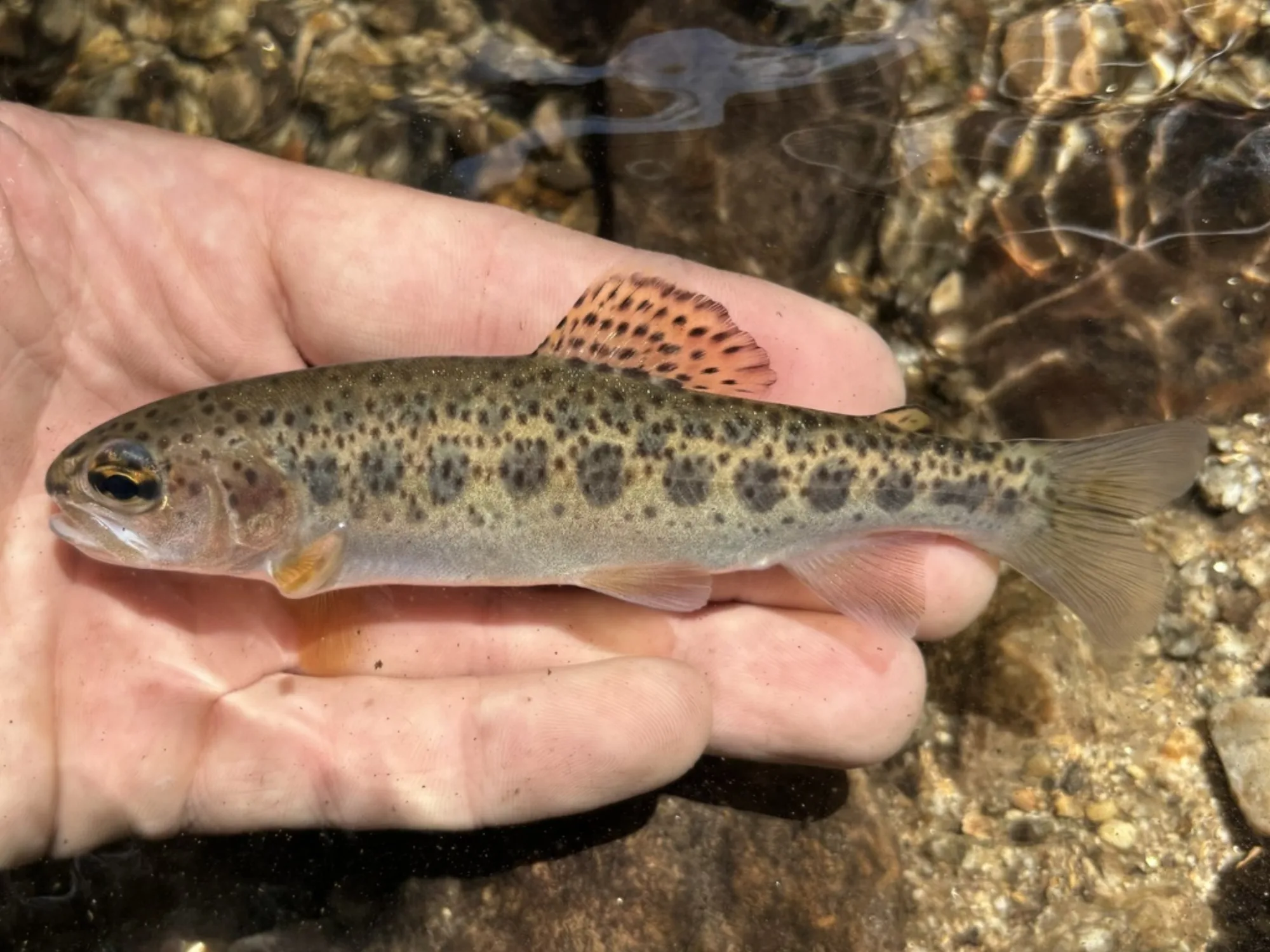
Rainbow Trout
Oncorhynchus mykiss
A broad reddish stripe running from gills to tail is a good mark to look for on an adult Rainbow Trout (Oncorhynchus mykiss), although its colouring varies with habitat and form. Freshwater adults have heavily spotted bodies and blue-green or olive colouring; lake-dwelling and sea-run fish tend to be silverier, with the red stripe barely visible. In rivers, adult freshwater residents average 0.5 to 2.5 kg, while lake-dwelling and sea-run fish may reach 9 kg.
The species is native to Pacific coastal waters and tributaries, from Russia's Kamchatka Peninsula through Alaska and along the west coast of North America to northern Mexico. It has also been introduced to at least 45 countries, with wild populations established in rivers elsewhere. Freshwater residents favour shallow, well-oxygenated rivers with gravel bottoms, while lake residents generally live in cool, moderately deep lakes with food-producing shallows and vegetation. Lake populations usually need access to gravel-bottomed streams to sustain themselves. The sea-run form, known as steelhead, returns to its original hatching grounds to spawn, generally after two to three years in the ocean.
Rainbow trout are opportunistic predators, taking aquatic insects, fish eggs, small fish and land insects that fall into the water. Some lake-dwelling fish feed on plankton, while adult steelhead at sea mainly eat fish, squid and amphipods. Spawning generally takes place from early to late spring, with hatching typically following four to seven weeks later. Populations have declined through habitat loss, over-harvest, pollution, disease, invasive species and breeding with other subspecies. Introduced rainbow trout can themselves harm native fish through predation, competition, disease transmission and hybridisation.
Written from the English Wikipedia article Rainbow trout (CC BY-SA 4.0).
- Records
- 106,933
- Countries
- 11
- Atlas places
- 3
These are open occurrence records, so they show where people looked for and recorded the Rainbow Trout as much as where it lives. Cells are up to 25 km across, and every location is generalised to its cell.
Generalised encounter areas, not exact locations. Each shape is a grid cell coloured by how likely the species is there.
- Very likelyUnited States25 km zone · high confidence · 68972 records · updated 80 days ago
- Very likelyCanada25 km zone · high confidence · 30300 records · updated 80 days ago
- Very likelySweden25 km zone · high confidence · 1993 records · updated 80 days ago
- Very likelyFrance25 km zone · high confidence · 1768 records · updated 80 days ago
- Very likelyRéunion25 km zone · high confidence · 1230 records · updated 80 days ago
- Very likelyAustralia25 km zone · high confidence · 1043 records · updated 80 days ago
- Very likelySwitzerland25 km zone · high confidence · 567 records · updated 80 days ago
- Very likelyColombia25 km zone · high confidence · 485 records · updated 80 days ago
- Very likelyNorway25 km zone · high confidence · 419 records · updated 80 days ago
- Very likelyAustria25 km zone · high confidence · 156 records · updated 80 days ago
Conservation status not assessed here yet, so every location is generalised to its grid cell.