Coho Salmon
Oncorhynchus kisutch
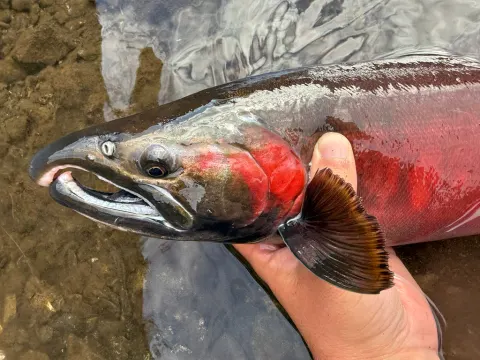
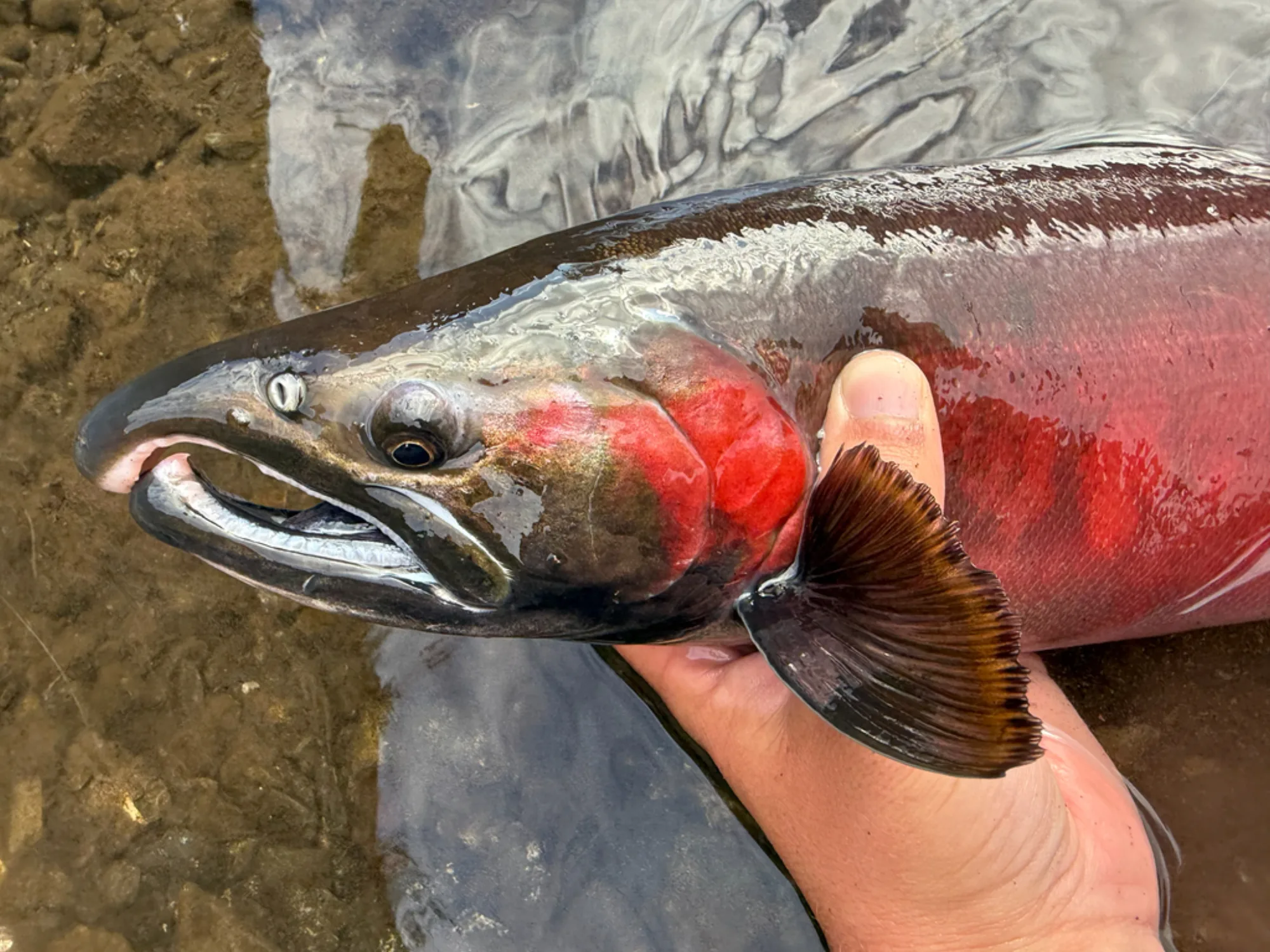
Silver-sided at sea, the Coho Salmon has a dark blue back marked with spots that also reach its upper tail. In fresh water, its sides turn bright red, while its head and back become bluish green and its belly darkens. Adults average 50.8 to 71 cm in length and 3.2 to 5.0 kg in weight, though size varies with age and location.
Its traditional range spans the North Pacific, from Hokkaidō and eastern Russia through the Bering Sea and along the American coast from Alaska to Monterey Bay, California. It has also been introduced to all the Great Lakes and many landlocked reservoirs in the United States. At sea, coho sometimes gather in schools in shallow water near beaches. Young fish remain in their freshwater birth streams for one to two years, often using off-channel sloughs during their first winter. Some later spend a summer in brackish estuarine ponds before returning to fresh water.
In fresh water, coho eat plankton, aquatic invertebrates and insects that fall into the water. At sea they eat plankton and fish, with fish becoming the main food once the salmon reach a certain size. After one to three years in salt water, adults return to spawn in rivers and streams, sometimes travelling into water just 5 centimetres deep. Females choose gravel beds for their nests, and the eggs hatch in late winter or early spring. Adults stop eating and die after spawning. In southern Oregon and northern California, declines have been linked to changing rainfall patterns, predation by sea lions and harbour seals, and commercial timber harvesting. Early life stages are also sensitive to contaminants in water and sediment.
Written from the English Wikipedia article Coho salmon (CC BY-SA 4.0).
- Records
- 110,620
- Countries
- 3
- Atlas places
- 2
These are open occurrence records, so they show where people looked for and recorded the Coho Salmon as much as where it lives. Cells are up to 25 km across, and every location is generalised to its cell.
Generalised encounter areas, not exact locations. Each shape is a grid cell coloured by how likely the species is there.
- Very likelyCanada25 km zone · high confidence · 106661 records · updated 80 days ago
- Very likelyUnited States25 km zone · high confidence · 3575 records · updated 80 days ago
- Very likelyUnnamed area25 km zone · high confidence · 175 records · updated 80 days ago
- LikelyRussia25 km zone · medium confidence · 209 records · updated 80 days ago
Conservation status not assessed here yet, so every location is generalised to its grid cell.