Pink Salmon
Oncorhynchus gorbuscha
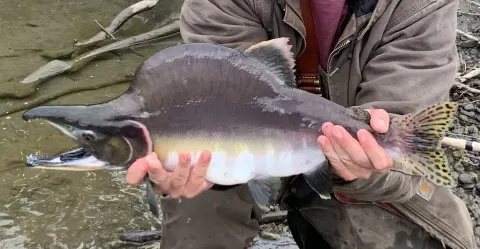
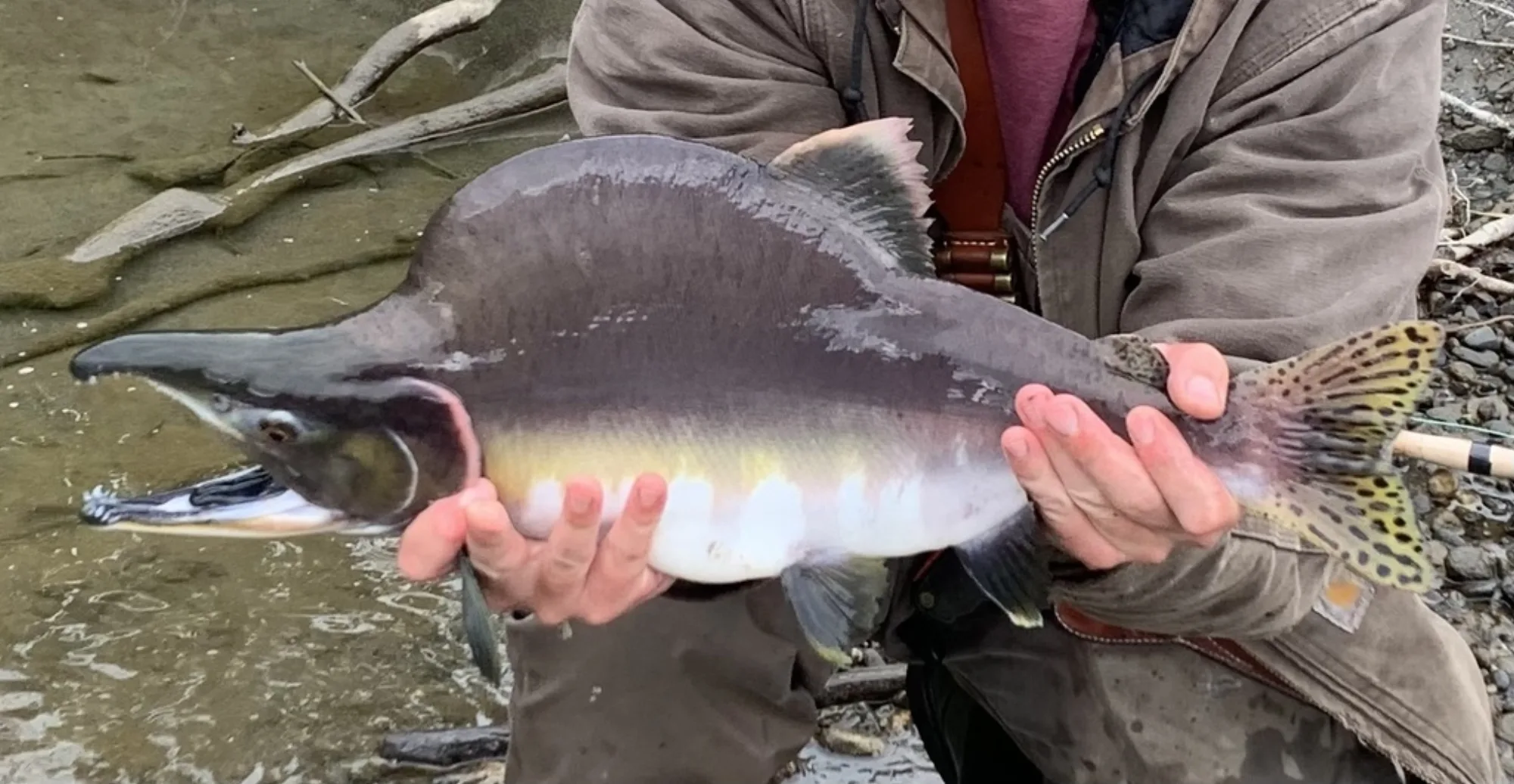
Bright silver in the ocean, Pink Salmon change colour when they return to spawning streams: their backs become pale grey and their bellies yellowish white, although some turn dull green all over. Large oval black spots mark the back, and the tail is V-shaped. Males develop a pronounced hump on their backs during the spawning migration. Pink Salmon average 2.2 kg in weight, and the largest recorded specimen measured 76 cm and weighed 6.8 kg.
Native populations inhabit coastal waters and rivers bordering the Pacific and Arctic, ranging from northern California to Canada's Mackenzie River, and from Siberia's Lena River to Korea and Honshu in Japan. They favour cold water, preferably between 5.6 and 14.6 °C. Introduced fish also live in the Great Lakes, where a self-sustaining population spends adulthood in open water and enters tributaries to spawn. Adults wander widely in open water, and while most return to their birth streams, some take up new ones. Spawning takes place from late June to mid-October in coastal streams, some longer rivers and, where freshwater is available, at stream mouths or in the intertidal zone.
Young fish eat invertebrates and zooplankton in freshwater, while those at sea feed on plankton, invertebrates and small fish. Adults stop feeding when they return to freshwater to spawn. Predators include fish, birds and mammals throughout the salmon's life cycle, with bears taking migrating adults. In crowded spawning grounds, later fish can build nests over earlier ones, causing substantial embryo mortality. Pink Salmon are also commercially harvested, and there is some evidence that fishing may affect their size.
Written from the English Wikipedia article Pink salmon (CC BY-SA 4.0).
- Records
- 16,198
- Countries
- 3
- Atlas places
- 2
These are open occurrence records, so they show where people looked for and recorded the Pink Salmon as much as where it lives. Cells are up to 25 km across, and every location is generalised to its cell.
Generalised encounter areas, not exact locations. Each shape is a grid cell coloured by how likely the species is there.
- Very likelyCanada25 km zone · high confidence · 12998 records · updated 80 days ago
- Very likelyUnited States25 km zone · high confidence · 2510 records · updated 80 days ago
- Very likelyRussia25 km zone · high confidence · 515 records · updated 80 days ago
- Very likelyUnnamed area25 km zone · high confidence · 175 records · updated 80 days ago
Conservation status not assessed here yet, so every location is generalised to its grid cell.