Ross Seal
Ommatophoca rossii
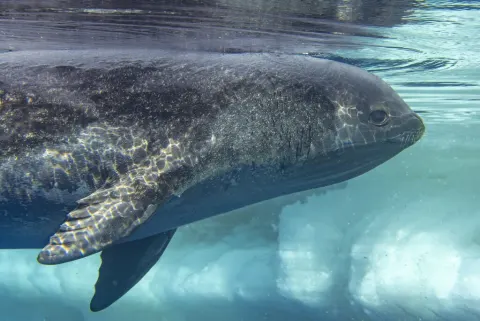
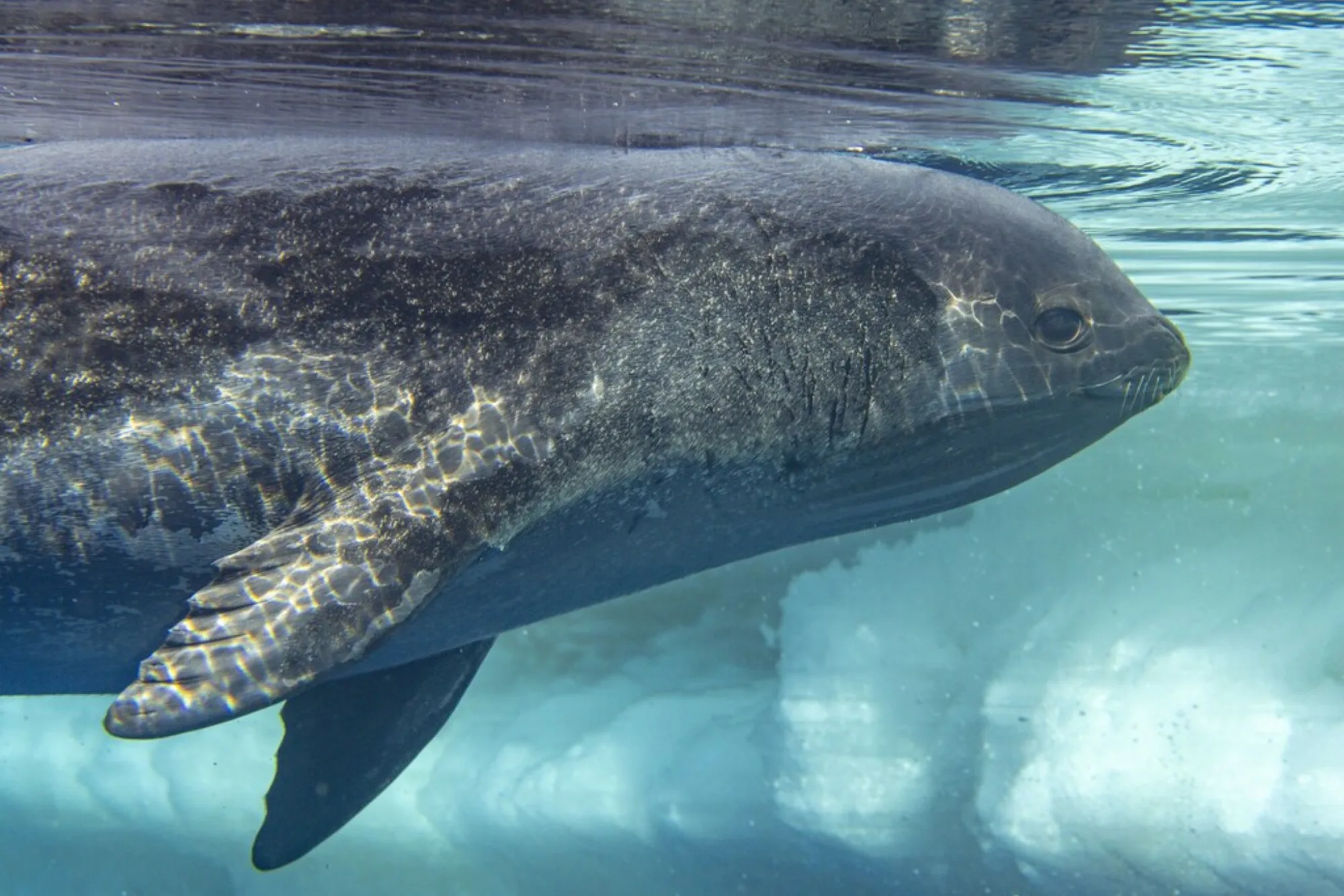
At close range, the Ross Seal can be recognised by its large eyes, short muzzle and dark brown coat, which is silvery white underneath. Its eyes can reach 7 cm across, and its coat gradually fades to light brown as the Antarctic winter begins. It is the smallest and least abundant of the Antarctic pinnipeds, and females are slightly larger than males. The seal makes complex twittering and siren-like sounds on the ice and underwater, where they travel long distances. Why it calls is unknown, although the sounds may help individuals find or avoid one another.
Ross Seals live around Antarctica, usually alone and at low densities in very thick pack ice. They almost never leave the Antarctic Ocean, although stray animals have rarely been found around subantarctic islands and off southern Australia. They spend much of their lives in the water and feed mainly on squid, fish and other invertebrates in the open ocean. Competition with whales or other seals reduces their specialised diet. Killer whales and leopard seals are presumed to prey on them, but no attacks have been documented.
Females give birth on the ice in November and care for their pups there, away from the greater risk of attack in the water. Pups are nursed for four weeks before weaning. During the breeding season, females may remain hauled out on pack ice for 5 to 7 days, occasionally entering the water briefly. Human contact has been limited, though Antarctic expeditions have collected Ross Seals in the past. Their range generally does not overlap with commercial fishing, and their extensive use of water is thought to make them more resilient to ice loss.
Written from the English Wikipedia article Ross seal (CC BY-SA 4.0).
- Records
- 793
- Countries
- 1
No atlas park has a record of the Ross Seal in or around it yet.
These are open occurrence records, so they show where people looked for and recorded the Ross Seal as much as where it lives. Cells are up to 25 km across, and every location is generalised to its cell.
Generalised encounter areas, not exact locations. Each shape is a grid cell coloured by how likely the species is there.
- Very likelyAntarctica25 km zone · medium confidence · 793 records · updated 80 days ago
Conservation status not assessed here yet, so every location is generalised to its grid cell.