Okapi
Okapia johnstoni
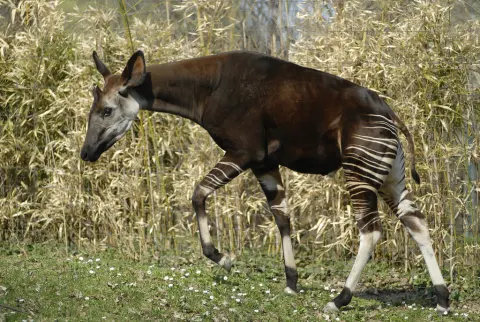
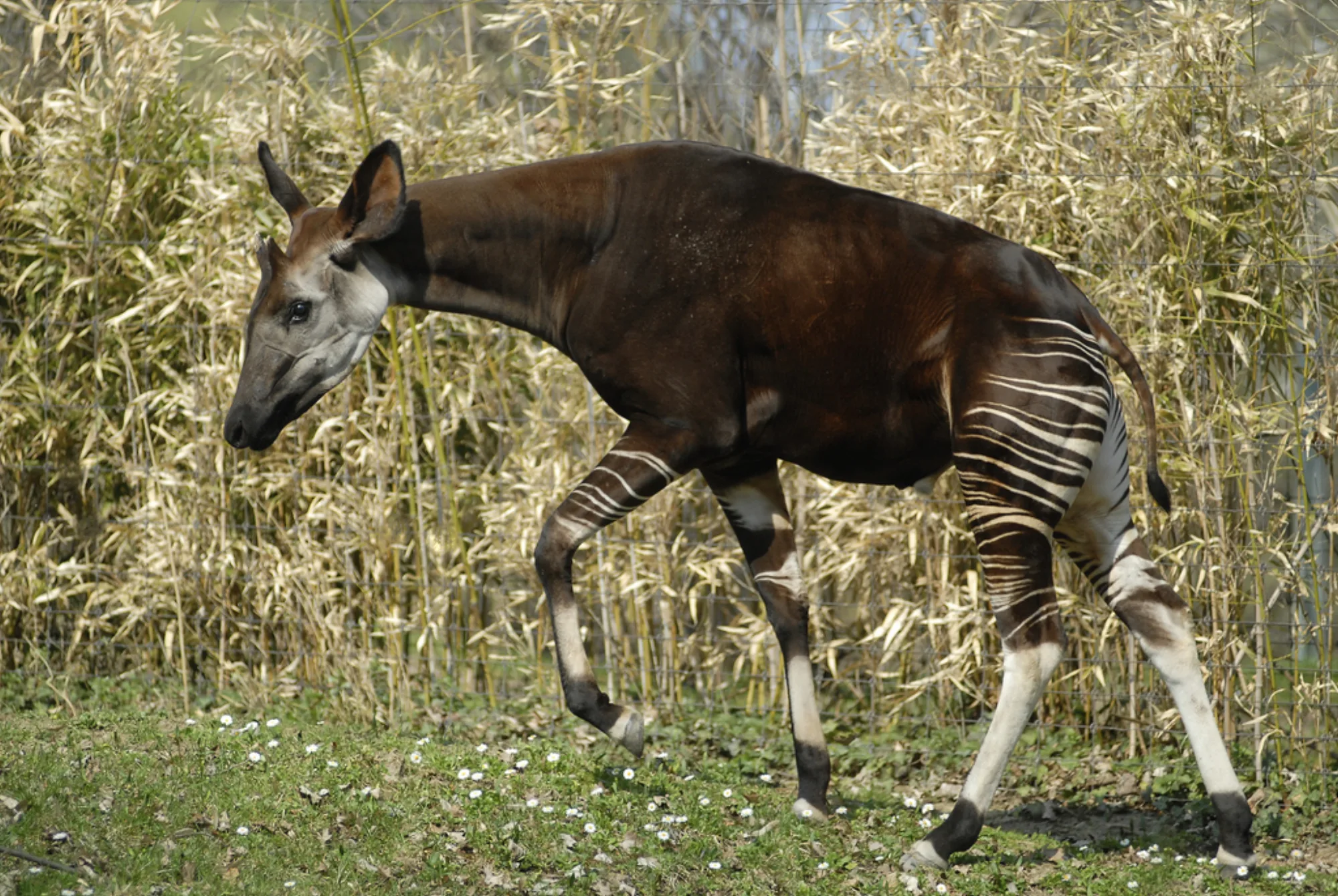
Often called the forest giraffe, this mammal is the only living relative of the giraffe. Standing about 1.5 m tall at the shoulder, the Okapi is easily identified by its chocolate or reddish brown coat and the striking white horizontal stripes on its legs. While its markings might suggest a zebra, its long neck and large, flexible ears reveal its true family ties. Males are distinguished by short, hair-covered horns less than 15 cm long, whereas females have hair whorls on their heads.
These solitary animals are found only in the northeast Democratic Republic of the Congo. They live in canopy forests at altitudes between 500 and 1,500 m, though they avoid areas disturbed by human settlements. Within the dense vegetation of the Ituri rainforest, they use an 18-inch-long black tongue to pluck tree leaves, buds, and fruits. Although primarily active during the day, they may move through the forest for a few hours after dark. They are generally tranquil and spend much of their time grooming or rubbing their necks against trees.
Breeding occurs year-round, resulting in a single calf after a pregnancy of 440 to 450 days. To avoid detection by predators like the leopard, young calves stay in hiding and do not defecate for their first month or two of life. Despite these natural defenses, populations are declining. Major threats include extensive hunting for skin and bushmeat, illegal mining, and the loss of forest habitat to logging. In recent years, the presence of illegal armed groups has further hindered efforts to protect the species.
Written from the English Wikipedia article Okapi (CC BY-SA 4.0).
- Atlas places
- 0
These are open occurrence records, so they show where people looked for and recorded the Okapi as much as where it lives. Cells are up to 25 km across, and every location is generalised to its cell.
No encounter zones yet
Where and when you can expect to see Okapi is calculated from observation density. No zones have been computed for this species yet.