White-tailed Deer
Odocoileus virginianus
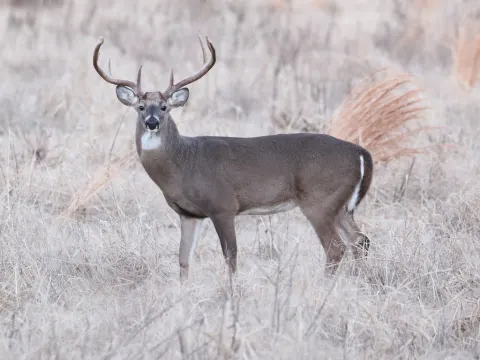
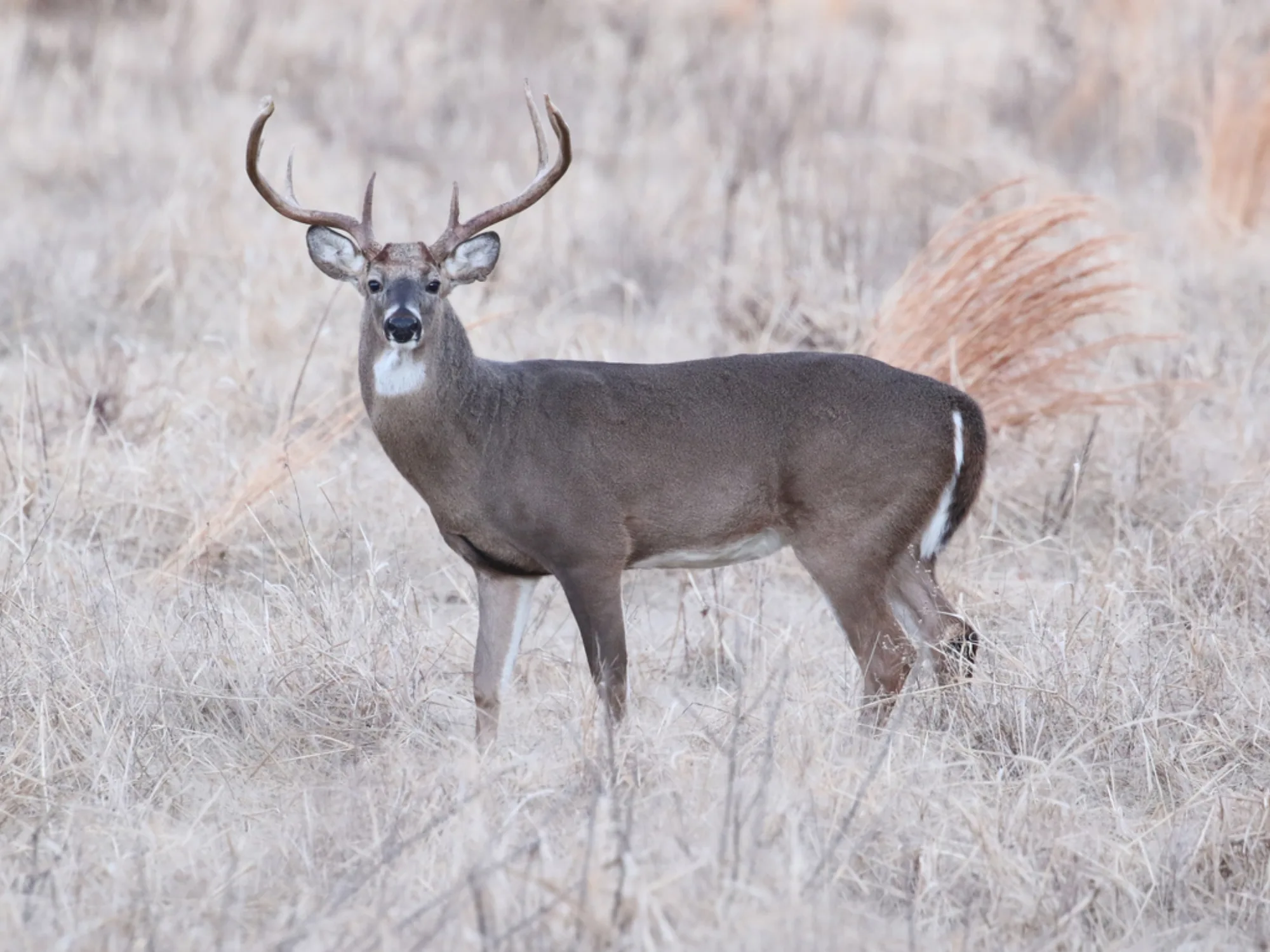
At dawn or dusk, a flash of white beneath a raised tail can reveal a White-tailed Deer on the move. This medium-sized deer has a reddish-brown coat in spring and summer, changing to grey-brown in autumn and winter. Males grow new antlers each year, while deer from the tropics and Florida Keys are markedly smaller than those in temperate regions. Native to North and South America, the species occupies dry grasslands, the Amazon and Orinoco basins, and high ground in the Andes. It also lives along forest edges, on open prairies and in savanna woodlands; Central American deer favour dry forests, savanna and nearby wetlands over dense moist forest.
White-tailed deer are most active at dawn and dusk, resting at intervals by day and night. When alarmed, they may blow heavily and flee, with the sound and their flashing tails alerting other deer. Their mainly plant-based diet changes with the seasons and includes shoots, leaves, grasses, acorns and fruit. In spring, a female has one to three fawns, which are spotted and spend their first four weeks hidden in vegetation. After about a month, the young can follow their mothers on feeding trips.
Wolves, cougars, jaguars and American alligators are among their predators, while bears and packs of coyotes mainly take fawns. Hunting has also taken a heavy toll: by the early 1900s, the species had been hunted almost to extinction. Overhunting and a lack of protection remain problems in parts of Central and South America, and natural habitat is being lost to human development.
Written from the English Wikipedia article White-tailed deer (CC BY-SA 4.0).
- Records
- 28,057
- Countries
- 6
- Atlas places
- 3
These are open occurrence records, so they show where people looked for and recorded the White-tailed Deer as much as where it lives. Cells are up to 25 km across, and every location is generalised to its cell.
Generalised encounter areas, not exact locations. Each shape is a grid cell coloured by how likely the species is there.
- Very likelyUnited States25 km zone · medium confidence · 20995 records · updated 80 days ago
- Very likelyCanada25 km zone · high confidence · 3061 records · updated 80 days ago
- Very likelyFinland25 km zone · medium confidence · 3014 records · updated 80 days ago
- Very likelyEcuador25 km zone · high confidence · 691 records · updated 80 days ago
- Very likelyMexico25 km zone · high confidence · 255 records · updated 80 days ago
- Very likelyColombia25 km zone · medium confidence · 41 records · updated 80 days ago
Conservation status not assessed here yet, so every location is generalised to its grid cell.