Mule Deer
Odocoileus hemionus
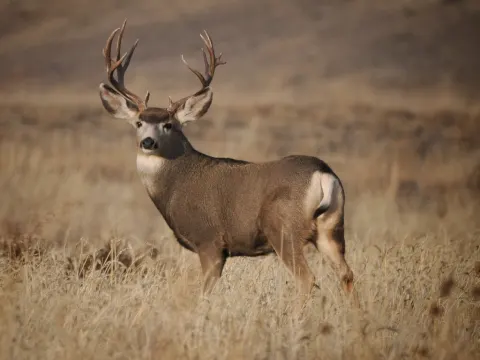
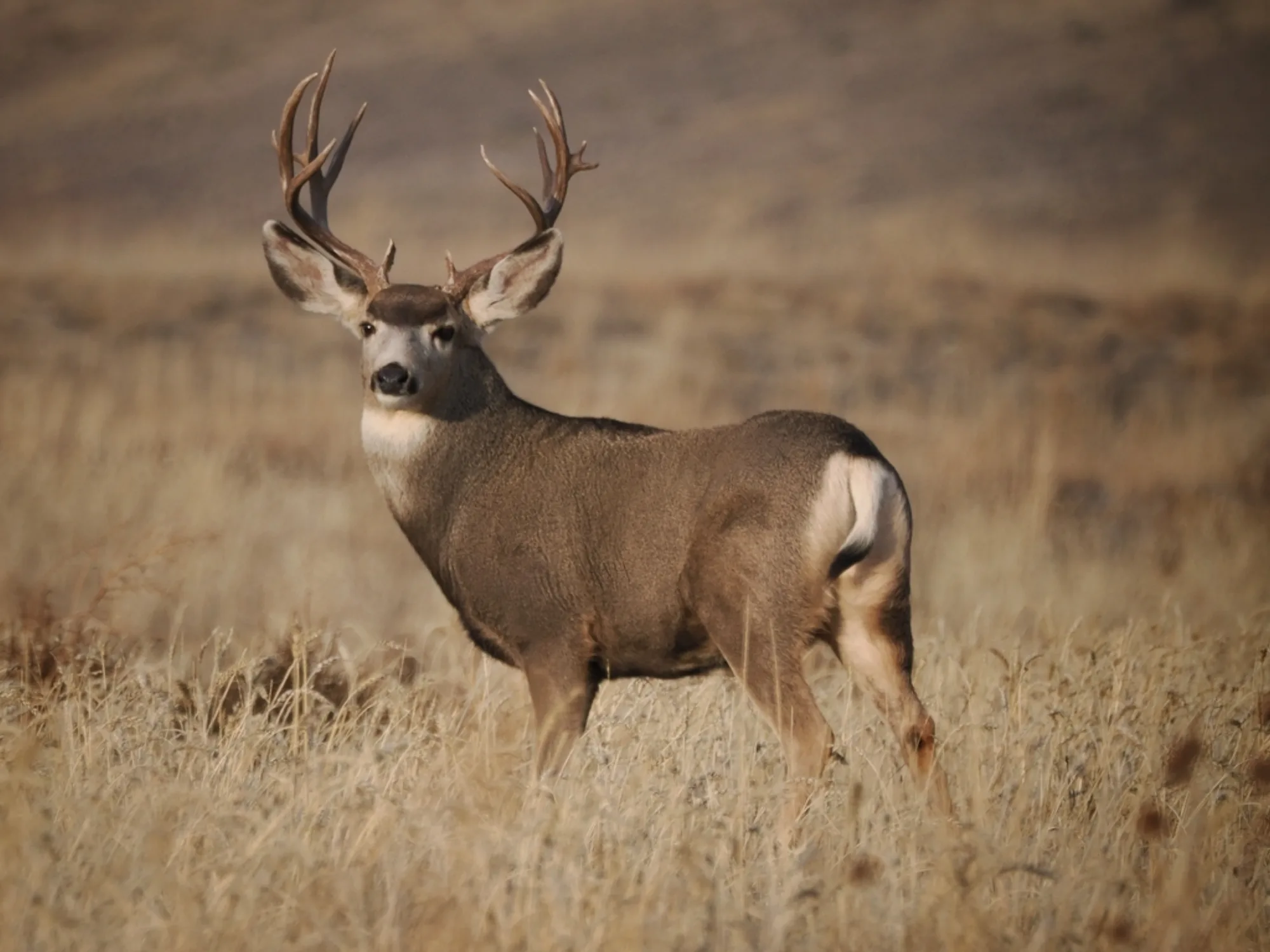
Named for its large, mule-like ears, the Mule Deer (Odocoileus hemionus) is native to western North America. Look for a black-tipped tail and, on bucks, antlers that fork as they grow. Adults stand 80 to 106 cm at the shoulder, and females are generally smaller than males. When moving, mule deer can run, but are often seen bounding with all four feet landing together. Their range extends across western and central North America, from the Great Plains and Rocky Mountains to the west coast, the southwestern United States and northern Mexico. Black-tailed deer, included within the species, live in coastal temperate rainforests of the Pacific Northwest and farther north into Alaska.
Mule deer may be solitary or gather in small groups, with group sizes changing through the seasons. Some migrate between low winter ranges and higher summer ranges, returning along familiar routes from year to year. They eat mainly browse, along with flowering plants, small amounts of grass and, where available, fruits, nuts and berries. In the Sierra Nevada, a lichen called Bryoria fremontii is an important winter food. Breeding usually begins in autumn, when males become more aggressive and compete for mates. Fawns are born in spring, usually as twins, and remain with their mothers through summer.
Coyotes, wolves and cougars are among their main predators, while other animals more often take fawns or weakened deer. Roads, fences, resource extraction and urban development can fragment habitat and disrupt migration; highways also kill and injure deer. Changing seasonal growth patterns can make established migration routes less reliable, while chronic wasting disease has had a major impact on wild populations.
Written from the English Wikipedia article Mule deer (CC BY-SA 4.0).
- Records
- 11,323
- Countries
- 3
- Atlas places
- 12
- Yosemite National Park· United States
- Grand Teton National Park· United States
- Sequoia National Park· United States
- Yellowstone National Park· United States
- Zion National Park· United States
- Grand Canyon National Park· United States
- Rocky Mountain National Park· United States
- Badlands National Park· United States
- Banff National Park· Canada
- Glacier National Park· United States
- Theodore Roosevelt National Park· United States
- Waterton Lakes National Park· Canada
These are open occurrence records, so they show where people looked for and recorded the Mule Deer as much as where it lives. Cells are up to 25 km across, and every location is generalised to its cell.
Generalised encounter areas, not exact locations. Each shape is a grid cell coloured by how likely the species is there.
- Very likelyUnited States25 km zone · medium confidence · 10311 records · updated 80 days ago
- Very likelyCanada25 km zone · medium confidence · 976 records · updated 80 days ago
- Very likelyMexico25 km zone · medium confidence · 36 records · updated 80 days ago
Conservation status not assessed here yet, so every location is generalised to its grid cell.