Walrus
Odobenus rosmarus
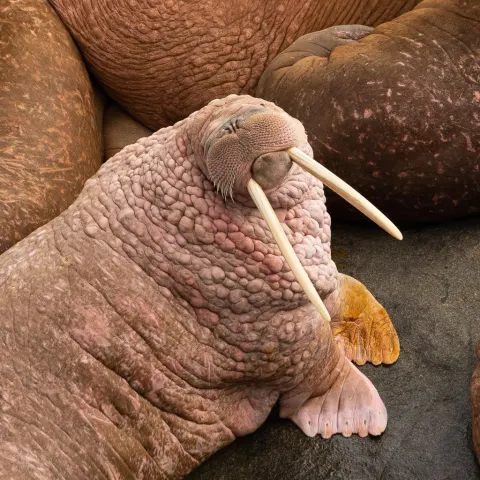
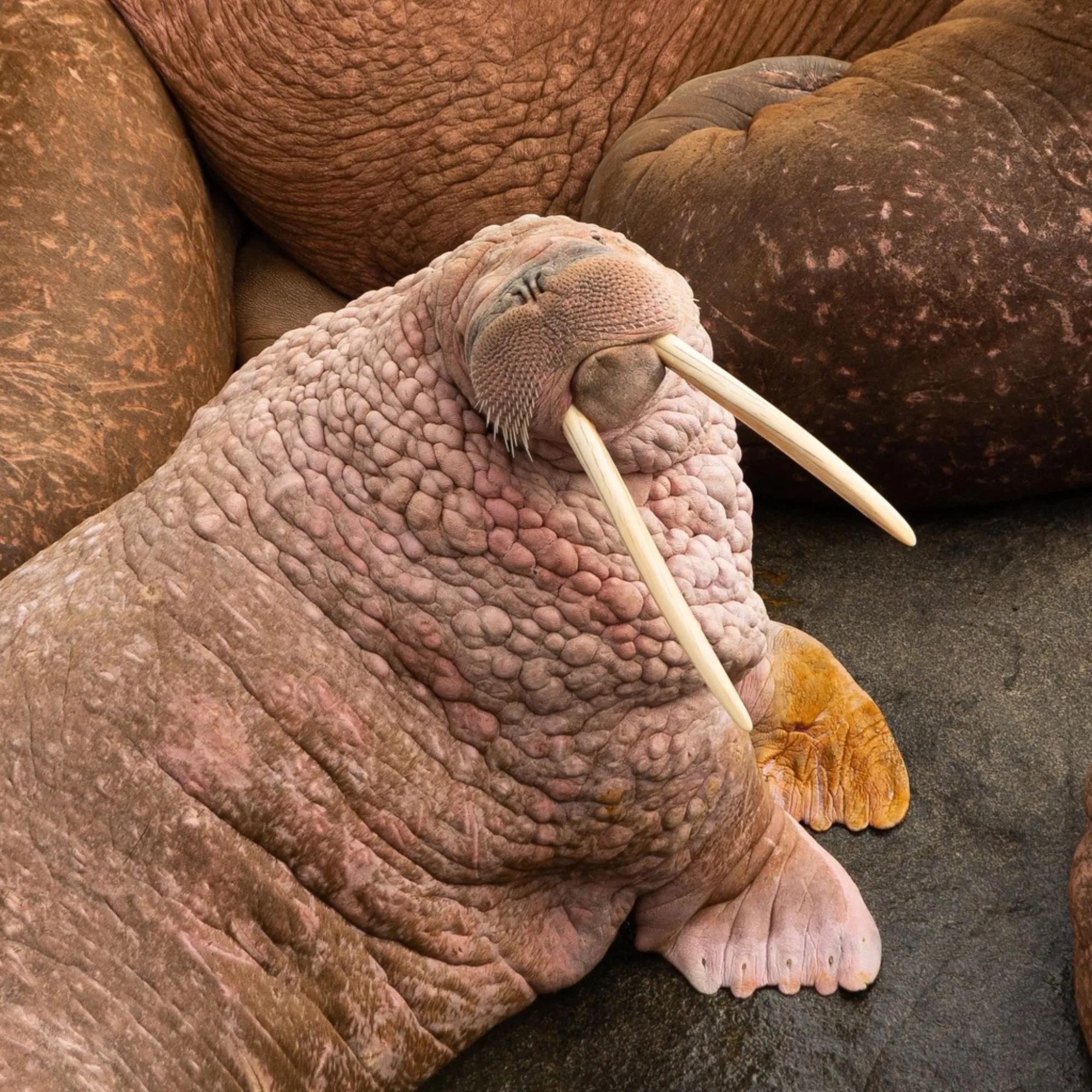
With its immense bulk, long tusks and bristling whiskers, the Walrus is a marine mammal built for life in northern waters. Both males and females have tusks, which can reach 1 m and help them climb from the water onto ice. Young animals are deep brown, becoming paler with age, while old males can appear almost pink. Its range is scattered around the North Pole, across the Arctic Ocean and northern subarctic seas. Atlantic walruses occur from the Canadian Arctic across Greenland and Svalbard to western Arctic Russia, while Pacific walruses move between the Bering and Chukchi seas. They spend much of their time in shallow water over continental shelves, often feeding from sea ice platforms.
Walruses are social animals, gathering in vast numbers on rocky beaches and outcrops in late summer and autumn. On the seabed they search with sensitive whiskers for food, favouring clams and other bivalve molluscs, although they eat a wide variety of marine life. During the spring migration, females give birth between April and June to calves that can already swim. Mothers nurse their young for over a year, and the young may stay with them for up to five years. When a group is threatened, adults may join in protecting the calves.
Past commercial hunting caused steep declines, and some Atlantic and Laptev populations remain fragmented and low compared with their levels before human interference. Thinning sea ice reduces resting space near feeding grounds and can separate nursing females from their calves, putting the young under nutritional stress. Reduced coastal ice has also been linked to deaths in stampedes among walruses crowded on Chukchi Sea shorelines.
Written from the English Wikipedia article Walrus (CC BY-SA 4.0).
- Records
- 764
- Countries
- 7
No atlas park has a record of the Walrus in or around it yet.
These are open occurrence records, so they show where people looked for and recorded the Walrus as much as where it lives. Cells are up to 25 km across, and every location is generalised to its cell.
Generalised encounter areas, not exact locations. Each shape is a grid cell coloured by how likely the species is there.
- Very likelySvalbard & Jan Mayen25 km zone · medium confidence · 453 records · updated 80 days ago
- Very likelyNorway25 km zone · medium confidence · 127 records · updated 80 days ago
- Very likelyNetherlands25 km zone · medium confidence · 114 records · updated 80 days ago
- Very likelyUnited States25 km zone · medium confidence · 62 records · updated 80 days ago
- LikelyDenmark25 km zone · medium confidence · 8 records · updated 80 days ago
- LikelyRussia25 km zone · low confidence · 0 records · updated 80 days ago
Conservation status not assessed here yet, so every location is generalised to its grid cell.